
Every year the same question goes around: will my phone get the new Android, and when? Every year the answer arrives in pieces, scattered across manufacturer forums, carrier notes and a hundred posts that were accurate for about a week. This page is the Android 17 update tracker we keep current instead, one URL that gets revised as rollouts move rather than replaced by a new article every time something ships.
The quick answer: Android 17 reached stable on 16 June 2026 and is rolling out now to Pixel 6 and newer. Samsung’s One UI 9 is preloaded on the new Galaxy Z Fold 8, Z Fold 8 Ultra and Z Flip 8 rather than reaching an existing phone as an update, though the Galaxy S26 series has had a public One UI 9 beta running since May 2026. The Xiaomi 17 and 17 Ultra also have a real, non-beta Android 17 build, through a smaller interim update called HyperOS 3.3. HyperOS 4 itself, the full release most Xiaomi, Redmi and POCO owners are waiting for, remains ahead. Motorola has a live beta on at least four devices, Realme has one too on the GT 8 Pro, and so do vivo’s X300 Pro and the iQOO 15. OnePlus and OPPO opened a closed ColorOS 17 beta on 6 August 2026 covering the OnePlus 15, OnePlus 15R and the OPPO Find X9 series. Honor unveiled MagicOS 11 that same day and opened its own closed beta shortly after, though it has not set a public stable release date. Nothing OS 5.0 remains further out, expected around November 2026. BLU, the budget US brand, has made no public commitment to Android 17 for any current device, and two Asus devices still under Asus’s own upgrade policy, the ROG Phone 9 and Zenfone 12 (sold at retail as the Zenfone 12 Ultra), are plausible candidates despite Asus having exited the phone business. The single biggest change this cycle is not a feature at all. OnePlus is retiring OxygenOS, and eligible devices get the option to move to ColorOS with Android 17, with a rollback path back to OxygenOS if you change your mind.
Status at a glance, by brand
Status wording on this page is deliberate and consistent. Rolling out means a stable public build is reaching real devices. Beta means a test build is live but the stable release is not. Confirmed means the manufacturer has said so on the record. Expected means it fits the company’s stated update policy but has not been confirmed. Not committed means the manufacturer has published no future-version promise either way, a gap in what they’ve said rather than a ruled-out upgrade. Not eligible means it has been ruled out.
This table summarizes each brand as a whole. Open a brand’s own tracker below the table for device-by-device status, model numbers and rollout dates for your specific phone.
| Brand | Android 17 skin | Status | Timing |
|---|---|---|---|
| Google Pixel | Stock Android 17 | Rolling out | Since 16 June 2026 |
| Samsung | One UI 9 | Rolling out (new foldables only) | Preloaded from 7 August 2026 |
| Motorola | Hello UI | Beta | Stable expected from August 2026, staggered by device into early 2027 |
| OnePlus | ColorOS (OxygenOS optional) | Confirmed, optional transition; closed beta live | Closed beta opened 6 August 2026; stable expected late 2026 |
| Honor | MagicOS 11 | Beta | Closed beta opened 6 August 2026; no public stable date yet |
| Xiaomi, Redmi, POCO | HyperOS 4 | Partially rolling out (Xiaomi 17, 17 Ultra only, via an interim update) | HyperOS 4 itself expected late Q4 2026 into 2027 |
| Nothing | Nothing OS 5.0 | Expected | From around November 2026 |
| Realme | ColorOS 17 (realme UI retired) | Beta (GT 8 Pro only) | Stable expected November 2026 |
| OPPO | ColorOS 17 | Beta (Find X9 Pro, Reno 15 Pro) | Closed beta opened 6 August 2026; stable expected late 2026 |
| vivo | OriginOS 6 | Beta | Beta live since 19 May 2026 (X300 Pro); no stable date announced |
| iQOO | OriginOS 6 | Beta | Beta live since 19 May 2026 (iQOO 15); no stable date announced |
| BLU | None (stock Android) | Not committed | No public commitment for any current device |
| Asus | None announced | Expected (ROG Phone 9, Zenfone 12 only) | Unconfirmed; both remain inside Asus’s own 2-upgrade policy window |
Google Pixel: the widest finished build in public hands
Android 17 became stable on 16 June 2026, released alongside the June Pixel Drop, and it covers every Tensor era Pixel: the Pixel 6 series through the Pixel 10 series, plus the Pixel Fold and Pixel Tablet. Android Authority covered the rollout at release.
Google staggers these releases in waves rather than pushing to everyone at once, so a Pixel 7 in the United States and a Pixel 7 in Australia can be several days apart on the same carrier-free build. If your Pixel is on the list and has not been offered the update, that is normal and not a fault.
Samsung: shipped, but not yet an update for anyone
This is the detail most coverage gets wrong. Samsung unveiled One UI 9 at Galaxy Unpacked on 22 July 2026, and it is preinstalled on the Galaxy Z Fold 8, Z Fold 8 Ultra and Z Flip 8, which reached shelves on 7 August. SamMobile reported the stable build arriving with those handsets.
Coming preloaded on a new phone is not the same as an update reaching an existing one. As of now, no Galaxy device that was already in someone’s pocket has received the stable One UI 9 build. The Galaxy S26 series is expected to be first in that queue, likely around September 2026, followed by the S25 and S24 families, with the S23 series, the A range and tablets landing toward the end of the year.
Stable is not the whole picture, though. Samsung opened a public One UI 9 beta for the Galaxy S26 series on 13 May 2026, in Germany, India, South Korea, Poland, the UK and the US, 9to5Google reported. A Galaxy S26 owner enrolled in that beta already has real Android 17 features to try, separate from the stable rollout described above, and it does not extend to any other Galaxy model.
Samsung has not published an official eligibility list, and it did not commit to a rollout schedule at Unpacked. Every Galaxy list circulating right now, including ours, is an informed reading of Samsung’s four and seven year update policies rather than a company statement. We flag those rows as Expected for that reason. Full device by device detail is on our Samsung Android 17 update tracker.
Motorola: four phones on beta, stable arriving in stages
Motorola opened its Android 17 beta and, as of 21 July 2026, builds were live on the Motorola Signature, the Moto G57 Power and the Edge 70, in selected markets including India, Brazil and parts of the EMEA region. Motorola has kept adding devices since. The Moto Edge 60 Pro joined the beta in India by late July, per Android Authority.
Motorola has not confirmed a full eligible list either. Its own tracker shows a staggered stable rollout starting sooner than that pattern might suggest. The Motorola Signature is expected around August to September 2026, the Edge 70 around October to November, and the Moto G57 Power not until early 2027, working down from flagships to the Edge line and then the Moto G series. Given Motorola’s US carrier presence, expect Verizon, AT&T and T-Mobile branded units to trail unlocked models.
The stable rollout is now underway too, and it has moved past the beta list above. Motorola began pushing the stable Android 17 build to the Motorola Edge 2025 in the US, and Lenovo’s own Spanish-language blog has published a list naming more than 50 eligible Motorola devices, Android Authority reported. The brand level breakdown is on our Motorola Android 17 update tracker.
OnePlus: the real story this cycle
The most consequential Android 17 news has nothing to do with features. OnePlus is retiring OxygenOS as its own platform, and eligible devices get the option to move to OPPO’s ColorOS with their Android 17 update, as 9to5Google reported. It is not forced. OnePlus says users can choose to stay on OxygenOS, older models outside the update scope keep receiving OxygenOS maintenance regardless, and anyone who does switch to ColorOS can roll back to OxygenOS afterward, though which specific version a rollback restores has not been detailed yet.
There is a second piece of context worth having if you own a OnePlus phone. On the same day, OnePlus confirmed it is ending new product launches in Europe and North America. Existing devices keep their software support, including this Android 17 transition, and warranty and repair continue. What stops is new hardware reaching those two regions. OnePlus’s business is consolidating around China, where it keeps operating normally, per Android Authority’s reporting, while its plans for India remain unresolved.
For anyone who chose OnePlus specifically because OxygenOS was lighter and closer to stock than ColorOS, the update prompt is still the moment to actually read what it says before tapping through it.
Everyone else: later than you probably expect
Xiaomi began an Android 17 developer preview on HyperOS 3.3 back on 30 April 2026, and that preview has since become a real rollout on two devices: the Xiaomi 17 and Xiaomi 17 Ultra have been receiving HyperOS 3.3 since 15 July 2026, Gizmochina reported, with the Xiaomi 15T Pro on a beta channel. That is still an interim update. HyperOS 4 is the release most Xiaomi, Redmi and POCO owners are actually waiting for, and it remains expected from late Q4 2026 into 2027. Full device detail is on our Xiaomi Android 17 update tracker.
vivo and iQOO round out the beta list, and both are easy to miss because neither has its own Android 17 tracker page yet. Both brands are running an official Android 17 beta through vivo’s developer program, live on the vivo X300 Pro and the iQOO 15 since 19 May 2026, vivo confirmed. Neither brand has announced a stable date. OPPO and OnePlus opened a closed ColorOS 17 beta of their own on 6 August 2026, covering the OnePlus 15, OnePlus 15R, the OPPO Find X9 Pro and Reno 15 Pro, plus Realme’s GT 8 Pro, GSMArena reported; slots were capped at 300 per model and the application window closed within two days. Honor unveiled MagicOS 11 at a Pioneer Event on the same day, 6 August 2026, and opened its own closed beta for 17 flagship phones and tablets shortly after, Gizmochina reported, though Honor has not published a public stable release date, so treat any specific month for its general availability as unconfirmed until Honor states one. Nothing OS 5.0 remains further behind, expected around November 2026, with no beta of any kind yet.
Two brands are edge cases, for opposite reasons. Asus has left the smartphone business entirely, so most Zenfone and ROG Phone owners should treat Android 17 as not coming. The exception is Asus’s own current models, the ROG Phone 9 and Zenfone 12 (marketed at retail as the Zenfone 12 Ultra, though Asus’s own support policy lists it simply as “Zenfone 12”). Both shipped on Android 15, both already received Android 16 as their first of two promised major upgrades under Asus’s published support policy, and Android 17 would be their second. Asus has not confirmed it, but exiting the phone business is a separate fact from an existing device’s update entitlement, and this page will not conflate the two. BLU, the Miami-based budget brand sold through Amazon and Walmart, is still an active company selling new phones, but has published no OS-upgrade policy anywhere on its site for any device, current or past. Full device detail is on our BLU Android 17 update tracker.
Why this rollout is slower than last year
Android 17 went stable in mid June, and by the end of July only two manufacturers outside Google had any stable build in public hands: Samsung, preinstalled on brand-new foldables, and Xiaomi, reaching two existing phones through the smaller HyperOS 3.3 update rather than full HyperOS 4. That is a slower start than recent cycles, and there are two reasons worth understanding.
The first is structural, and it is TheLeaker’s own reading of the pattern rather than something any manufacturer has spelled out. Manufacturer skins are no longer light layers on top of Android. One UI, HyperOS and ColorOS are substantial platforms with their own release cycles, their own feature sets and their own QA burden, and increasingly their own on-device AI stacks that have to be revalidated against a new Android base. The work between Google publishing source and a Galaxy phone receiving an update is measured in months for good reason.
The second is that two of the largest Android vendors are in the middle of software transitions this cycle rather than routine updates. OnePlus is offering its eligible devices a move from OxygenOS to ColorOS. Xiaomi is moving from HyperOS 3 to HyperOS 4.
For most people the practical takeaway is simple. Owners of the newest Samsung foldables, a Galaxy S26 on the One UI 9 beta, the Xiaomi 17 line, a phone on Motorola’s or Realme’s beta, a vivo X300 Pro or iQOO 15 on vivo’s beta, a OnePlus 15, OnePlus 15R or OPPO Find X9 Pro or Reno 15 Pro on the ColorOS 17 closed beta, or a flagship Honor phone on the MagicOS 11 closed beta all have something real to check for right now. Everyone else, across every brand in the table above, is more likely looking at late 2026 at the earliest, with early 2027 the realistic window for most mid-range and older devices. That staggered rollout is not a failure on your manufacturer’s part so much as the normal shape of an Android release.
Version updates and security patches are not the same thing
This trips up a lot of people, and it changes how worried you should be if your phone appears in a Not eligible row.
A version update brings the new Android release and its features. A security patch fixes vulnerabilities without changing the version. Manufacturers commit to these separately, and the security commitment almost always runs longer. A Galaxy S22 stopping at One UI 8 continues receiving security patches afterward. It is not an unsafe phone, it is a phone that has stopped gaining features.
So if your device is ruled out for Android 17, the question to ask is not whether to replace it immediately. It is when its security patch window closes, which is usually stated on the manufacturer’s own support pages and is frequently years further out.
How to check on your own phone
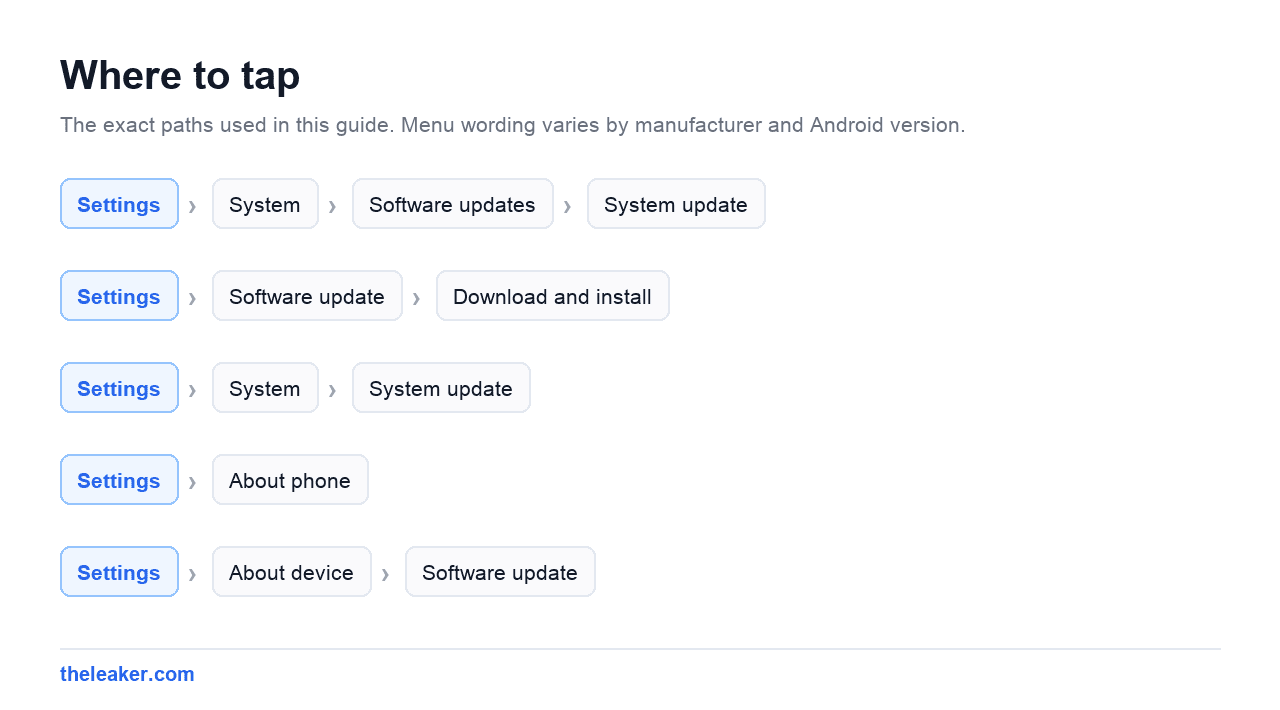
Manufacturer skins move the menus around, but the path is broadly the same everywhere.
- Pixel: Settings, then System, then Software updates, then System update.
- Samsung: Settings, then Software update, then Download and install.
- Motorola: Settings, then System, then System update.
- Xiaomi, Redmi, POCO: Settings, then About phone, then the version banner at the top.
- OnePlus and OPPO: Settings, then About device, then Software update.
Two practical notes. Staged rollouts mean tapping Check for updates repeatedly does not move you up the queue, and a phone bought through a carrier is on the carrier’s schedule, not the manufacturer’s, which routinely adds weeks.
Brand by brand trackers
- Samsung Android 17 update (One UI 9)
- Motorola Android 17 update (Hello UI)
- BLU Android 17 update
- OnePlus Android 17 update (ColorOS 17)
- Xiaomi, Redmi and POCO Android 17 update (HyperOS 4)
- Realme Android 17 update (ColorOS 17)
These brands don't have an Android 17 tracker yet, so here is their most current one:
Frequently asked questions
Why has Android 17 not reached my phone yet?
Most likely because your manufacturer has not released it, or has only reached a small first batch of devices. Outside Pixel, Samsung’s newest foldables, two Xiaomi phones on an interim update and the Motorola Edge 2025, stable Android 17 has not shipped to any other device yet, though several brands have real betas running. Even where a rollout has started, it is staged by region, model and carrier over weeks.
Does carrier branding delay the update?
Yes, consistently. Carrier variants go through additional certification, so a locked handset commonly trails the unlocked version by two to six weeks. This is the single most common reason two identical phones update on different days.
Can I force the update or sideload it early?
It depends which kind of sideload you mean. On Pixel, Google’s own signed full-OTA packages install over ADB without unlocking the bootloader or wiping the device, and this is the safe, official method if your build hasn’t been offered yet. Flashing a full factory image or a custom ROM is a different thing entirely. That typically requires an unlocked bootloader, wipes the device, and can affect contactless payments and future automatic updates. Waiting for your normal rollout costs nothing and avoids the second category altogether.
My phone is not listed here. What does that mean?
It means no credible source has placed it either way, not that it is ruled out. We only list a device once there is something real behind the status. If yours is missing, it is usually a sign the manufacturer has said nothing yet.
Changelog
- 12 August 2026: Correction. This page previously said Samsung excluded the 2022 devices from One UI 8.5 because that release formed part of the Android 17 transition. That was wrong and is retired. One UI 8.5 is built on Android 16 QPR2, so it is still Android 16 and could never have carried any device to Android 17. Samsung’s own Galaxy S26 specification table lists the OS as Android 16 with One UI 8.5 as the interface, and Android Authority traced the build to Android 16 QPR2. Samsung has published no reason for leaving the 2022 devices out, and this page no longer supplies one. SamMobile reads it as the extra porting work a QPR2 base needs on older hardware, which is SamMobile’s inference rather than a Samsung statement. The device rows are unchanged: the Galaxy S22 series and S21 FE still end on One UI 8.
- 11 August 2026 (eighth pass): Added vivo and iQOO to the brand table and body, both missing entirely despite real official Android 17 beta programs live on the vivo X300 Pro and iQOO 15 since 19 May 2026. Corrected the Honor row, which still read “Expected, from around October 2026”; Honor unveiled MagicOS 11 and opened a closed beta on 6 August 2026, so the row now reads Beta with no public stable date, matching the correction already made on Honor’s own tracker. Rewrote the “practical takeaway” paragraph, which named only Samsung’s newest foldables, the Xiaomi 17 line and Motorola’s or Realme’s beta as having something real to check for today; it omitted the Galaxy S26’s own One UI 9 beta (running since May), the vivo/iQOO betas, and the OnePlus/OPPO/Realme ColorOS 17 closed beta and Honor’s MagicOS 11 closed beta that both opened 6 August 2026. Added a citation for the Xiaomi HyperOS 3.3 stable-rollout claim and for Nothing’s November 2026 estimate, both previously stated without a source. Added a newer citation to the Motorola section: a stable Android 17 build has started reaching the Motorola Edge 2025 and Lenovo’s own blog has published a 50-plus device eligibility list, alongside the earlier Android Authority beta citation rather than replacing it, since that citation still supports the beta claim it was attached to. Cut an uncited causal claim in the “why this rollout is slower” section asserting OnePlus’s and Xiaomi’s software transitions had “pushed timelines later,” which neither cited source supported.
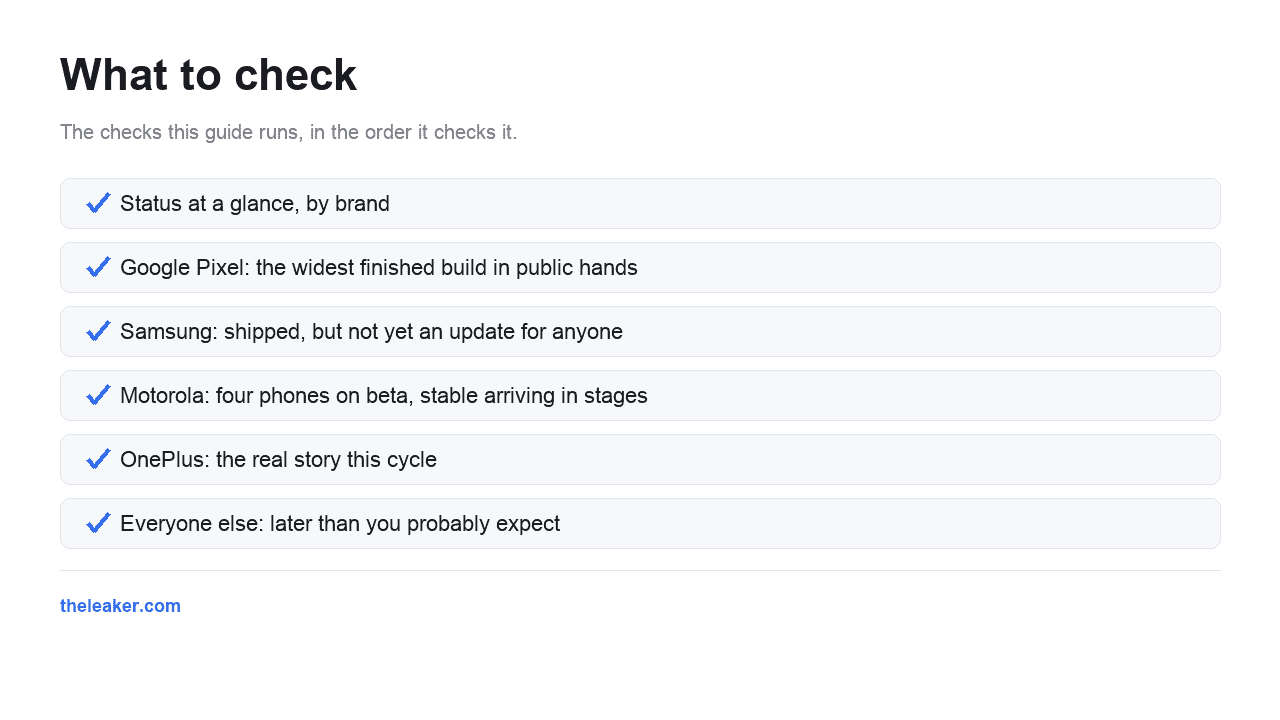
- 11 August 2026 (seventh pass): Regenerated the “What to check” infographic a second time. Its fourth row still read “Motorola: three phones on beta, stable still some way off,” unchanged since the page was created even though the body text and its own H2 heading were corrected to “four phones” in an earlier pass; the row now reads “Motorola: four phones on beta, stable arriving in stages” to match. Added a line to the “why this rollout is slower” section marking the structural explanation (skins as substantial platforms with their own QA burden) as TheLeaker’s own reading of the pattern rather than a manufacturer statement, since it previously carried no source and no hedge.
- 11 August 2026 (sixth pass): Removed a stray unfixed sentence that survived two prior OnePlus corrections: “OnePlus is migrating its entire device base from OxygenOS to ColorOS” still implied a mandatory move in the “why this rollout is slower” section, even after the rest of the page was corrected to say it’s optional. Corrected Motorola’s beta count from three devices to at least four; the Moto Edge 60 Pro joined the beta in India by late July and neither this page nor its own Motorola tracker had picked that up. Corrected Motorola’s collapsed “late 2026 to early 2027” timing, which understated how soon the flagship Motorola Signature is expected (around August to September 2026, per its own tracker) by folding it into the same window as the last device to get it. Softened an overgeneralized claim that any non-Pixel owner should expect to wait until early 2027, which this page’s own table already contradicted for Samsung’s newest foldables, the Xiaomi 17 line, and anyone on Motorola’s or Realme’s beta.
- 11 August 2026 (fifth pass): Regenerated the “What to check” infographic, which still read “Google Pixel: the only finished build in public hands” in its second row, an image generated on page creation that never picked up the text fix retracting that exact claim two rounds ago. Added Realme’s live GT 8 Pro beta to the quick answer, which named Motorola’s beta but not Realme’s despite both being in the page’s own table. Added a real citation for the claim that OnePlus keeps operating normally in China after its Europe/North America exit, previously stated without direct source support.
- 11 August 2026 (fourth pass): Split the “Brand by brand trackers” list into two groups: brands with a real Android 17 tracker, and brands where the most current thing we have is still their Android 16 tracker. Previously all 14 were mixed into one list with no distinction, so a reader could click through to an Android 16 page from an Android 17 tracker with no warning. Corrected “Zenfone 12 Ultra” to “Zenfone 12” where it names the device Asus’s own cited support policy covers; Asus’s page lists it as “Zenfone 12” without “Ultra,” even though it is sold at retail as the Zenfone 12 Ultra. Added the OnePlus section’s missing context: OnePlus confirmed the same day as the ColorOS news that it is ending new product launches in Europe and North America, while existing devices (including this Android 17 transition) keep their support. Fixed the byline date, which was showing yesterday’s date because it had been bumped from the server’s own local clock (US Eastern) instead of WordPress’s configured timezone (India), a roughly 10-hour gap that crossed midnight.
- 11 August 2026 (third pass): Finished propagating the previous pass’s fixes, which had landed only where they were written. The “why this rollout is slower” section and the FAQ’s first answer both still said nobody outside Pixel and Samsung was shipping stable Android 17, contradicting this page’s own table showing Xiaomi partially rolling out since 15 July; both now reflect it. The page title, byline heading and social-share titles disagreed: the SEO title tag had been tightened, but the H1 and the Facebook/X preview titles still read “Every Phone Confirmed and Expected.” All three now match.
- 10 August 2026 (second pass): Fixed a broken brand-index shortcode: every link in “Brand by brand trackers” was rendering as literal unexecuted code rather than a working URL, a theme bug that predated today and also affected the site’s guides hub, now fixed in both places. Corrected the Asus row, which read “Not eligible” for exiting the phone business; Asus’s own published policy actually gives its current ROG Phone 9 and Zenfone 12 Ultra a second major-version upgrade, and both remain inside that window. Corrected the OnePlus row and section, which described the OxygenOS-to-ColorOS move as mandatory; OnePlus’s own reporting says it is optional, with a rollback path. Fixed the FAQ’s sideloading answer, which conflated safe, official OTA sideloading with custom-ROM flashing; only the second carries the bootloader and payments risk. Removed an overclaim that Pixel was the only phone running a finished public Android 17 build, since the Xiaomi 17 and 17 Ultra also have one. Rewrote the SEO title, which promised “Every Phone Confirmed and Expected” on a page where several rows are Not committed or Not eligible.
- 10 August 2026: Added BLU as a tracked brand, linked in the table and the brand-by-brand index below. Linked the Xiaomi, OnePlus and Realme rows, which had live trackers but no hyperlink. Updated the Xiaomi row and the “Everyone else” section: the Xiaomi 17 and 17 Ultra have been rolling out an interim Android 17 update (HyperOS 3.3) since 15 July 2026, ahead of HyperOS 4 itself.
- 1 August 2026: Corrected the Galaxy S22 and S21 FE rows. Those devices end on One UI 8 (Android 16), not One UI 8.5. The reason given here for the One UI 8.5 exclusion was wrong and has been retired; see the 12 August 2026 entry above.
- 31 July 2026: Page created. Pixel 6 and newer rolling out since 16 June. Samsung One UI 9 shipping preloaded on Z Fold 8, Z Fold 8 Ultra and Z Flip 8. Motorola beta live on Signature, Moto G57 Power and Edge 70. OnePlus confirmed moving to ColorOS.
Related: OPPO Android 16 Update (ColorOS 16): Full Device List and Rollout · Tecno Android 16 Update (HiOS 16): Eligible Devices and Update Policy

I am the chief editor of TheLeaker. I also maintain the backend stuff of the site. I’m a tech enthusiast and loves to do Python coding in my free time. I have worked at many giant publications like XDA Developers and NXTtech before starting TheLeaker.
You can get in touch with me at Garv[at]theleaker.com.