
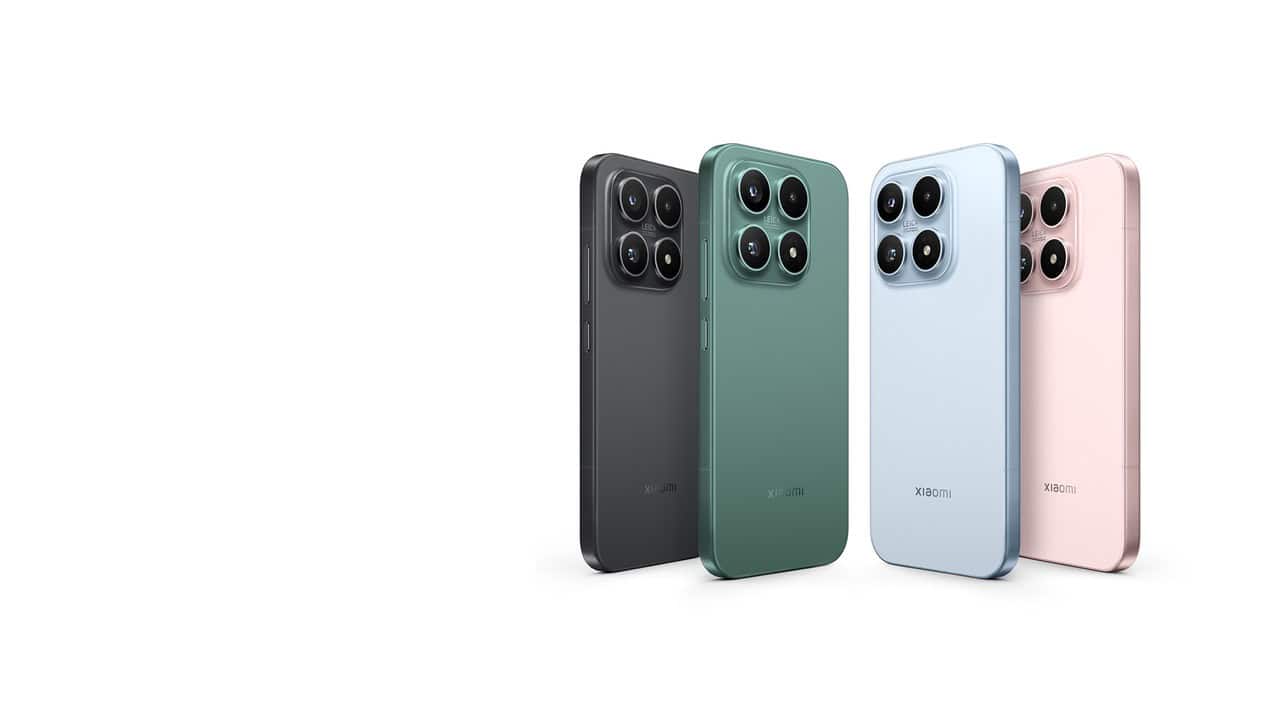
If you are waiting on Android 17 for a Xiaomi, Redmi or POCO phone, nothing has arrived yet for most devices, and the full release has not even been unveiled. Three phones are the exception, and they are in the first table below. This page tracks all three brands together and gets revised as rollouts move. Xiaomi sells more phones than almost anyone and explains its update plans less clearly than almost anyone, which is why this needs a page at all.
The quick answer: Xiaomi’s full Android 17 release is HyperOS 4. Xiaomi officially confirmed a July or August 2026 unveiling and has not held it yet; a more specific leaked window of 5 to 7 August passed with nothing official. Android 17 itself has already started shipping ahead of that, through a smaller interim update: on 15 July 2026, Xiaomi began rolling out HyperOS 3.3 to the Xiaomi 17 and Xiaomi 17 Ultra, with the Xiaomi 15T Pro following on a beta channel. Which device debuts HyperOS 4 itself is unresolved, covered in more detail below. Older eligible devices are expected to pick up HyperOS 4 from around September into October 2026, once it ships. Other current flagships follow, then Redmi and POCO mid-range devices from late 2026 into 2027. Expected eligibility reaches back to roughly the Xiaomi 13T, the Redmi Note 14 series, the Redmi K90 series and POCO’s F6 and X6 lines. Xiaomi has published no official eligibility list for HyperOS 4, so every device row below marked Expected remains exactly that.
What is actually live right now
| Device | Model number | Status | Update | Region |
|---|---|---|---|---|
| Xiaomi 17 | 25113PN0EG (Global), codename "pudding" | Rolling out | HyperOS 3.3 (Android 17) | Global, Europe |
| Xiaomi 17 Ultra | 2512BPNDAG (Global), codename "nezha" | Rolling out | HyperOS 3.3 (Android 17) | Global, Europe |
| Xiaomi 15T Pro | 2506BPN68G (Global), codename "klimt" | Beta (Mi Pilot) | HyperOS 3.3 (Android 17) | Global |
HyperOS 3.3 is an interim update, not HyperOS 4 itself, first reported rolling out on 15 July 2026 by Gizmochina. It focuses on stability and the June 2026 security patch, not new features, and lays groundwork for HyperOS 4. Every device not in this table is still waiting on HyperOS 4, which Xiaomi has not yet unveiled. No China-track build has been reported for this specific interim update; the tables further down still assume the usual China-first pattern applies once HyperOS 4 itself ships.
The three names, and why they matter
Xiaomi, Redmi and POCO are one company with one software team. HyperOS 4 is the same release across all three, which is why they belong on one tracker rather than three.
What differs is priority. Xiaomi-branded flagships go first, Redmi and POCO follow, sometimes by six months or more. A POCO phone is frequently a rebadged Redmi sold in different markets, and the two can still update on different schedules because they clear regional certification separately.
China comes first, and that is the pattern that catches people out. HyperOS builds land in China ahead of global, and the global build is a separate release with different app defaults and, occasionally, different features. A Chinese rollout beginning is not the same as your phone being close to an update.
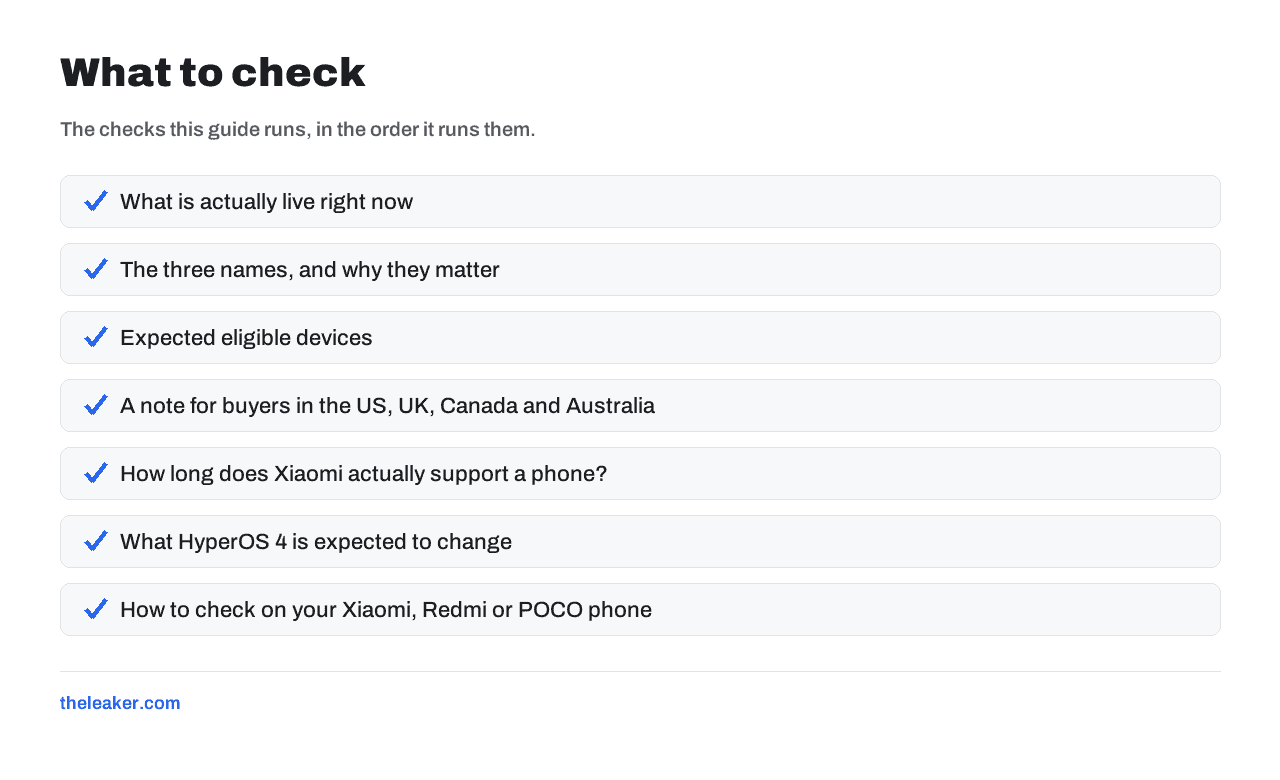
Expected eligible devices
Expected means the device fits Xiaomi’s support pattern but the company has not confirmed it. Not eligible means it has been ruled out. Nothing here is Confirmed, because Xiaomi has published no supported-device list.
There is no Xiaomi 16 series, so do not go looking for one below. Xiaomi president Lu Weibing announced in September 2025 that the company was skipping straight from the 15 series to the 17 series to align its naming with the iPhone 17. An earlier version of this table listed a Xiaomi 16 series row; that was an error, corrected below.
Which device actually debuts HyperOS 4 is unresolved. Earlier reporting expected it alongside the numbered Xiaomi 18 series, but Gizchina reports that Xiaomi’s next foldable has already cleared network certification under model number 2608BPX34C, while the Xiaomi 18 series has not yet appeared in any certification database. Certification usually runs a few weeks ahead of launch, so the foldable debuting HyperOS 4 first is the better-supported read today. It is not settled.
The Model number column lists each model’s primary Global SKU where one exists, then India, then China, plus the device’s internal codename. The codename matters because Xiaomi’s own flashing and firmware-download community (sites like xiaomifirmwareupdater.com and its mirrors) indexes builds by codename. Several current devices, including the Xiaomi 17 Pro and Pro Max, are China-exclusive and were never given a Global or India SKU at all.
Xiaomi flagships and mid-range
| Device | Model number | Status | Expected timing |
|---|---|---|---|
| Xiaomi 17, 17 Ultra | 17: 25113PN0EG, codename "pudding"; 17 Ultra: 2512BPNDAG, codename "nezha" | Partially rolling out | Android 17 live now via HyperOS 3.3 (see table above); full HyperOS 4 still pending |
| Xiaomi 17 Pro, 17 Pro Max | 17 Pro: 25098PN5AC (China only, no Global/India SKU), codename "pandora"; 17 Pro Max: 2509FPN0BC (China only), codename "popsicle" | Expected | HyperOS 4, timing unconfirmed |
| Xiaomi 17 Max | 2605EPN8EC (China only), launched 21 May 2026 | Expected | Named in the leaked first HyperOS 4 beta batch (see FAQ); HyperOS 4 timing otherwise unconfirmed |
| Xiaomi 15, 15 Pro, 15 Ultra | 15: 24129PN74G, codename "dada"; 15 Pro: 2410DPN6CC (China only), codename "haotian"; 15 Ultra: 25010PN30G, codename "xuanyuan" | Expected | Late 2026 |
| Xiaomi 14, 14 Pro, 14 Ultra | 14: 23127PN0CG, codename "houji"; 14 Pro: 23116PN5BG, codename "shennong"; 14 Ultra: 24030PN60G, codename "aurora" | Expected | Late 2026 into early 2027 |
| Xiaomi 15T Pro | 2506BPN68G (Global; not sold in India), codename "klimt" | Beta | HyperOS 3.3 (Android 17) via Mi Pilot, ahead of the rest of the 15T/14T line |
| Xiaomi 15T, 14T series (excl. 15T Pro) | 15T: 25069PTEBG, codename "goya"; 14T: 2406APNFAG, codename "degas"; 14T Pro: 2407FPN8EG, codename "rothko" (T-series not sold in India) | Expected | Early 2027 |
| Xiaomi 13T, 13T Pro | 13T: 2306EPN60G, codename "aristotle"; 13T Pro: 23078PND5G, codename "corot" (not sold in India) | Expected | 2027, likely final version update |
| Xiaomi 13 series and earlier | N/A | Not eligible | Support window exhausted |
Redmi
| Device | Model number | Status | Expected timing |
|---|---|---|---|
| Redmi K90 series | K90: 2510DRK44C (China only), codename "annibale"; K90 Pro Max: codename "myron" (model number not published) | Expected | September to December 2026 |
| Redmi Note 17 series | Note 17: 26081RA18G (Global, unreleased), 2607DRA18I (India, launched Aug 2026), codename "mist"; Note 17 Pro: 2607DRA18C (China, released 14 July 2026), 2607DRA18G (Global, not yet released), codename "iolite" | Expected | Late 2026 |
| Redmi Note 15 series | Note 15 5G: 25096RA9BG (China), codename "kunzite" (4G variant: "spinel"); Note 15 Pro: codename "lapis" (model number not published) | Expected | Early 2027 |
| Redmi Note 14 series | Note 14 Pro: codename "malachite" (model number not published) | Expected | 2027, likely final version update |
| Redmi Pad (recent models) | Redmi Pad 2: 25040RP0AG (Global), codename "taiko" | Expected | 2027 |
| Redmi Note 13 series and earlier | N/A | Not eligible | Support window exhausted |
POCO
| Device | Model number | Status | Expected timing |
|---|---|---|---|
| POCO F8 series | F8 Pro: 2510DPC44G (Global), 2510DRK44C (China, shared with Redmi K90), codename "annibale"; F8 Ultra: 25102PCBEG (Global), codename "myron"; both launched globally 26 November 2025; base F8 not released | Expected | Late 2026 |
| POCO F7 series | F7: codename "onyx" (model number unresolved, conflicting sources); F7 Pro: 24117RK2CG (Global), codename "zorn"; F7 Ultra: 24122RKC7G (Global), codename "miro" | Expected | Early 2027 |
| POCO F6, F6 Pro | F6: 24069PC21G (Global), 24069PC21I (India), codename "peridot"; F6 Pro: 23113RKC6C (China), codename "vermeer" | Expected | 2027, likely final version update |
| POCO X8 series | X8 Pro Max: 2602BPC18G (Global), 2602BPC18I (India), codename "dash"; base X8 and X8 Pro not yet assigned a public model number | Expected | Late 2026 into 2027 |
| POCO X7 series | X7 Pro: 2412DPC0AG (Global), 2412DPC0AI (India), codename "rodin"; X7: codename "malachite" (model number unresolved, conflicting sources) | Expected | 2027 |
| POCO X6, X6 Pro | X6: 23122PCD1G (Global), 23122PCD1I (India), codename "garnet"; X6 Pro: 2311DRK48G (Global), 2311DRK48I (India), codename "duchamp" | Expected | 2027, likely final version update |
| POCO Pad (recent models) | POCO Pad C1: 25128PC17G (Global), 25128PC17I (India); codename not yet found | Expected | 2027 |
| POCO F5, X5 and earlier | N/A | Not eligible | Support window exhausted |
A note for buyers in the US, UK, Canada and Australia
Xiaomi does not sell phones officially in the United States, so American readers encountering a Xiaomi, Redmi or POCO device are almost always looking at an import. That has two consequences for updates.
First, an imported Chinese-market device runs the China build, which is a different software track from global. It does not simply switch to the global build when an update arrives, and converting between them requires flashing rather than an over-the-air update. Second, band support and VoLTE certification on US carriers are the practical problem with imported Xiaomi hardware, and no software update fixes that.
In the UK, Australia and much of Europe, Xiaomi sells officially through normal retail and the global build applies, so the tables above read straightforwardly.
How long does Xiaomi actually support a phone?
Xiaomi’s own official support policy commits to a floor and nothing more specific: security updates for “at least 2 years after the first shipment,” with “3 years or longer for some models,” subject to unstated conditions. Xiaomi does not publish a tier-by-tier commitment table the way Samsung or Google do. The numbers below come from Xiaomi’s own device-specific announcements as reported by Android Authority’s tracked update-policy roundup and, for the 13T/13T Pro specifically, GSMArena’s report on that announcement. Two Redmi rows come straight from Xiaomi instead. Its spec sheets for the Redmi Note 13 Pro 5G and the Redmi Note 13 Pro+ 5G both read “3 Major Android Updates | 4 Years Security Patch Updates”. Xiaomi’s spec sheet for the 4G Note 13 Pro carries no equivalent line, which is why that row is sourced differently. These are specific commitments for specific devices, not a blanket policy, and most Redmi and POCO devices carry no published commitment beyond Xiaomi’s two-year floor above.
| Device | Announced OS updates | Announced security patches |
|---|---|---|
| Xiaomi 15 series | 4 | 6 years |
| Xiaomi 14 series | 4 | 5 years |
| Xiaomi 13T, 13T Pro | 4 | 5 years |
| Older Xiaomi flagships | 3 | 4 years |
| Redmi Note 13 Pro 5G, Note 13 Pro+ 5G | 3 | 4 years |
| Redmi Note 13 Pro 4G | 3 (GSMArena’s figure; Xiaomi publishes none) | No published figure |
| POCO F7 Ultra | 4 | 6 years |
| POCO X6 series | 3 | 4 years |
| Most other Redmi and POCO devices | 1 to 2 | No device-specific commitment; falls back to Xiaomi’s 2-year policy floor |
The pattern: Xiaomi’s newest numbered flagships and a handful of specifically-announced models, the 13T/13T Pro and POCO F7 Ultra among them, get terms in the same range as Samsung and Google. Most Redmi and POCO devices were never given a specific commitment at all. Where the eligibility tables above mark an older series “Not eligible,” that is this site’s inference from Xiaomi’s device-by-device pattern, not a Xiaomi-confirmed exclusion, since Xiaomi has not published an EOL list either. Being ruled out for HyperOS 4 is not the same as being unsafe to use today, but the assumption should run the other way for any device without a specific announced commitment: don’t assume years of coverage it was never promised.
What HyperOS 4 is expected to change
Xiaomi has not published full release notes, so this section is short, and it will grow as details are confirmed.
What is known is that HyperOS 4 continues Xiaomi’s move away from the old MIUI architecture, which began with HyperOS 1 and has been incremental since. The direction of travel has been lighter system apps, a more consistent design language across phone, tablet and Xiaomi’s wider device ecosystem, and a growing set of on-device AI features. Whether the AI features reach global builds at the same time as China builds has been a recurring gap in previous releases.
What is not yet known is anything device-specific, including which features are gated to newer chipsets and whether older eligible devices receive a reduced version of the release. Xiaomi has done exactly that in past cycles, shipping a flagship feature set in China first and a trimmed one globally.
How to check on your Xiaomi, Redmi or POCO phone
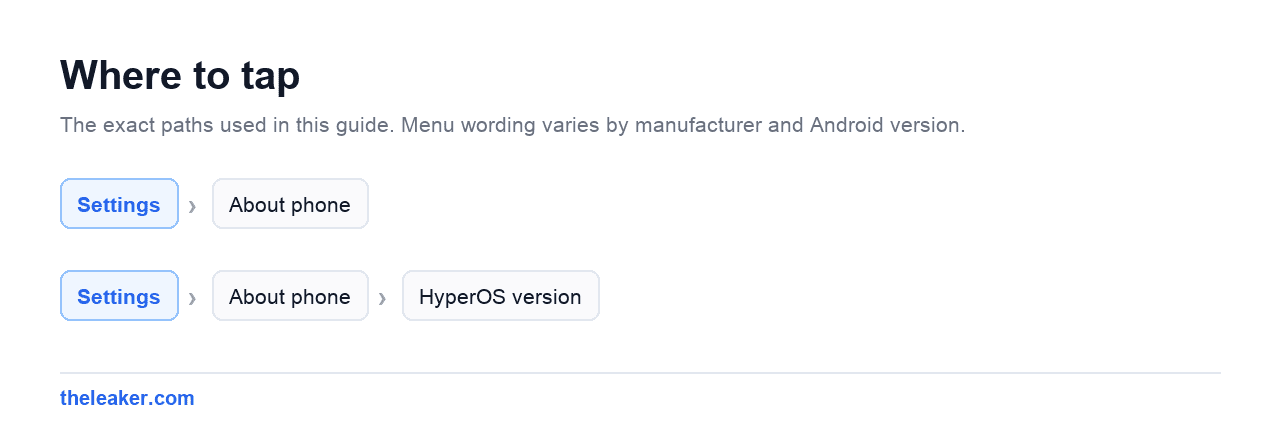
Open Settings, then About phone, and tap the version banner at the top, which opens the update screen. Alternatively Settings, then About phone, then HyperOS version.
The version string tells you which track you are on. Every build carries a region code near the end of the string: MIXM is the global standard build, EUXM is Europe, INXM is India, and CNXM is China. If you are unsure which you have, that code is the fastest way to find out, and it determines which rollout timeline actually applies to you. Your device’s model number, which pins down exactly which hardware variant you own, is on the same About phone screen, usually labeled “Model” or “Model number.”
Frequently asked questions
Why has HyperOS 4 not reached my phone yet?
Because Xiaomi has not held its own confirmed unveiling for it yet, and the specific device it debuts on is still unsettled. Leakster Digital Chat Station has named a first beta batch for China of the Xiaomi 17, 17 Pro, 17 Pro Max, 17 Ultra and 17 Max alongside the Redmi K90, K90 Pro Max and K90 Pro Max Champion Edition, per Gizmochina’s report on the leak. Treat that list as unconfirmed leak material from a named tipster, not an announced batch, until Xiaomi actually holds the unveiling it has committed to for July or August 2026.
Is HyperOS 3.3 the same as HyperOS 4?
No. HyperOS 3.3 is the smaller interim update covered in the table above, moving the Xiaomi 17, Xiaomi 17 Ultra and (in beta) the Xiaomi 15T Pro onto Android 17 early. Nothing in current reporting indicates Xiaomi plans to extend HyperOS 3.3 to more devices before HyperOS 4 ships; it reads as scoped specifically to that launch batch. If your device is not in the live table above, your realistic wait is for HyperOS 4 itself.
Will my imported Chinese Xiaomi get the global update?
No. China and global are separate software tracks. A China-build device continues receiving China builds. Moving to global requires flashing, which carries real risk of bricking the device and may void your warranty.
My phone is not listed here. What does that mean?
Xiaomi’s range is enormous and regionally fragmented, so a missing device usually means no credible source has placed it rather than that it is ruled out. Check Settings, then About phone, and compare your model against the closest series above.
How we source and maintain this tracker
Xiaomi is the brand where update reporting most often goes wrong, and the reason is almost always the China and global split. A build shipping in China gets written up as “rolling out” and then owners of global devices wait months.
This page keeps those separate. A device is marked Rolling out or Beta only for the track it has actually shipped on, and the timing column says which region. A developer preview is never counted as a rollout, because it is a test channel for app developers rather than a public release. An interim update like HyperOS 3.3 is counted as live only for the specific devices confirmed to have received it, and is kept visibly separate from HyperOS 4 itself so the two are never conflated. Nothing is Confirmed, because Xiaomi has published no supported-device list for HyperOS 4, so every other row is Expected and derived from Xiaomi’s tier-by-tier support pattern.
Where a source refers to a Redmi and a POCO model that are the same hardware under two names, we treat them as separate rows, because they clear regional certification separately and can update months apart. Changes are dated in the changelog below.
Changelog
- 12 August 2026 (sixth correction pass): Corrected the support-commitment table, which understated the Redmi Note 13 Pro 5G. It listed only the Note 13 Pro+ at three announced OS updates and left every other Note 13 Pro variant inside the “most other Redmi and POCO devices, 1 to 2” row. Xiaomi’s own spec sheets for the Note 13 Pro 5G and the Note 13 Pro+ 5G both state three major Android updates and four years of security patches, so both now have their own row, sourced directly to Xiaomi instead of to a secondary roundup. The 4G Note 13 Pro is listed separately, because Xiaomi’s spec sheet for it publishes no upgrade count at all and the three-upgrade figure for that variant comes from GSMArena.
- 11 August 2026 (fifth correction pass): Replaced the featured image, which had been silently overwritten by an unrelated Redmi Note 12 Android 15 graphic at the same file URL and no longer matched this page. Corrected several model numbers that had gone stale or were never right: the Xiaomi 17 Max now has a verified model number (2605EPN8EC) instead of “not yet verified”. The POCO F8 Pro and F8 Ultra rows described both devices as “leaked pre-launch”; both launched globally on 26 November 2025, and their model numbers are corrected to the ones GSMArena and Xiaomi’s own firmware trackers list (F8 Pro: 2510DPC44G Global, shared 2510DRK44C China number with the Redmi K90; F8 Ultra: 25102PCBEG Global). The Redmi Note 17 Pro row had the China and Global model numbers and their release status backwards; corrected to China 2607DRA18C (released 14 July 2026) and Global 2607DRA18G (not yet released). The Redmi Note 17 India model number was wrong and is corrected to 2607DRA18I. Table cells using an em dash as a “not applicable” placeholder were changed to “N/A” for consistency with this site’s no-dash style.
- 10 August 2026 (fourth correction pass): Fixed the FAQ’s citation for the leaked HyperOS 4 first-beta-batch device list. It was attributed to Gizmochina’s 5 August article, whose fetchable text does not actually contain the device list; the list itself, correctly, is from Gizmochina’s 20 June article, which names leakster Digital Chat Station as the source. The device names published were already accurate; only the link and attribution were wrong.
- 10 August 2026 (third correction pass): Added a source link for the quick answer’s claim about which device debuts HyperOS 4 (previously stated without a citation): Gizchina reports Xiaomi’s next foldable has already cleared network certification under model number 2608BPX34C, while the Xiaomi 18 series has not appeared in any certification database yet. Added a missing table row for the Xiaomi 17 Max, a real, distinct, already-launched device (China, 21 May 2026) that was named in the FAQ’s leaked beta-batch list but had no row in the eligibility table.
- 10 August 2026 (model number and codename pass): Added a Model number column to every table on this page, plus the Xiaomi/Redmi/POCO device codename alongside each number, because one marketing name can cover several real hardware variants (China, Global, India) on different update schedules, and a reader checking their own phone needs to know which row is actually theirs. Numbers and codenames were verified per device against GSMArena, Wikipedia device infoboxes, Xiaomi/POCO firmware-tracking sites and certification filings; where a number could not be verified, or exists only as an unconfirmed leak, the cell says so rather than guessing.
- 10 August 2026 (second correction pass): Replaced the unsourced security-and-version support table with device-specific announced commitments, each linked to its source, and Xiaomi’s own official policy floor. Rewrote both FAQ answers that only restated the body; added the leaked first HyperOS 4 beta batch (labeled as unconfirmed) and a note on whether HyperOS 3.3 is expected to spread to more devices. Reframed the quick answer’s “next flagship generation” claim: which device debuts HyperOS 4, the numbered Xiaomi 18 series or Xiaomi’s next foldable, is contested in current reporting, not settled. Replaced the “What to check” graphic, which had gone stale after the “What is actually live right now” section was added above it. Tightened the SEO title, which had claimed a “Full Device List” this page has never had, since Xiaomi publishes no official eligibility list.
- 10 August 2026 (correction pass): Removed a “Xiaomi 16 series” row that should never have appeared; Xiaomi officially skipped that generation in September 2025 and went straight from the 15 series to the 17 series. Fixed the region-code guidance in “How to check”, which had the China/global distinction backwards; China builds do carry a region code (CNXM), they were never coded as regionless. Corrected the live-rollout region for the Xiaomi 17 and 17 Ultra from an unsourced “China, global, Europe” to the sourced “Global, Europe.” Restored the officially confirmed July/August HyperOS 4 unveiling window, which an earlier edit today had replaced with only the failed 5-7 August leak.
- 10 August 2026: HyperOS 3.3 (Android 17) confirmed rolling out to the Xiaomi 17 and Xiaomi 17 Ultra since 15 July 2026, with the Xiaomi 15T Pro on the Mi Pilot beta channel. This is an interim update, not HyperOS 4. Tables and FAQ updated to separate the live HyperOS 3.3 devices from everything still marked Expected under HyperOS 4.
- 31 July 2026: Page created. Android 17 developer preview on HyperOS 3.3 since 30 April 2026. HyperOS 4 confirmed for a July or August 2026 unveiling in China. No stable public build on any Xiaomi, Redmi or POCO device. No official eligibility list published, so all device rows are Expected.
Tracking another brand? See our Android 17 update tracker for every manufacturer, the Samsung tracker or the Motorola tracker.
Related: Redmi Note 14 Android 17 Update: Why the 5G Model Misses Out · Redmi Note 13 Pro Android 17 Update: Why It Is Not Coming

Hola everyone! I’m Sajid and I’m a typical freelance Graphic Designer with a keen interest in technology and science stuff. I actually like to write about the recent happenings around the world of technology as a part of The Leaker.