
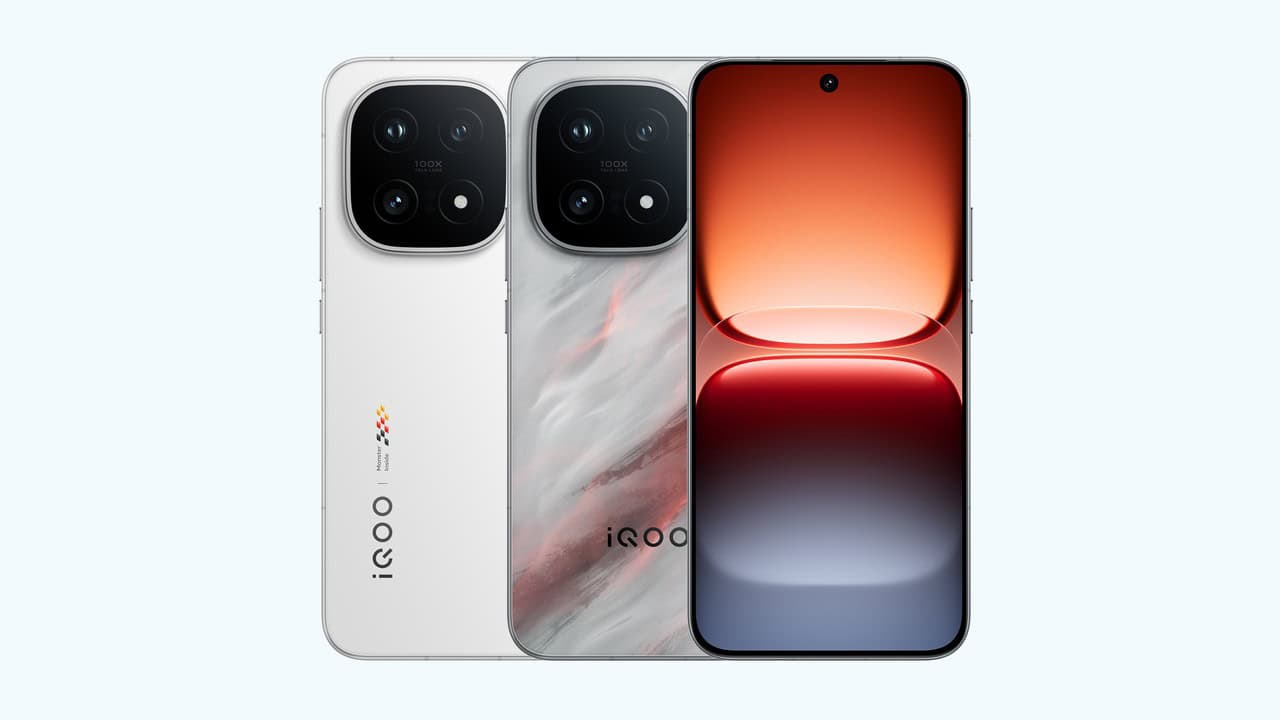
iQOO owners get the worst of both worlds on update information. The brand is big enough that people expect answers, and small enough in coverage that nobody writes them, so most iQOO update questions end up answered by a vivo article that mentions iQOO in one line. This iQOO Android 16 update tracker treats the brand properly, device by device, and is revised as rollouts move.
The quick answer: iQOO’s Android 16 release is OriginOS 6, not Funtouch OS 16. Funtouch OS has been retired and every eligible iQOO phone moves to OriginOS by over-the-air update. The iQOO 15 series ships with OriginOS 6 out of the box. For existing phones the rollout began in early November 2025 with the iQOO 13, then older flagships such as the iQOO 12, then Neo and Z models, running from Q4 2025 through the first half of 2026 globally including India, with most tiers now rolling. Eligibility is simple. Any iQOO with at least one OS upgrade remaining qualifies. Android 17 is not a public release yet, but vivo has opened an early developer beta for it and the iQOO 15 is enrolled in both the April developer preview and the separate 30 July to 4 August recruitment. Neither is a public release, and no public date is set.
Why your iQOO update has a different name
Short version: vivo owns iQOO, vivo retired Funtouch OS across both brands, and OriginOS took its place. Funtouch OS 15 was the last release under the old name, so anything numbered 16 is OriginOS 6.
The reason this bites iQOO owners harder than vivo owners is distribution. iQOO sells overwhelmingly online and overwhelmingly in India, where Funtouch was the only name anyone knew, so the forums and buying guides people rely on still use it. Our vivo tracker covers the migration itself in detail; this page stays on iQOO hardware.
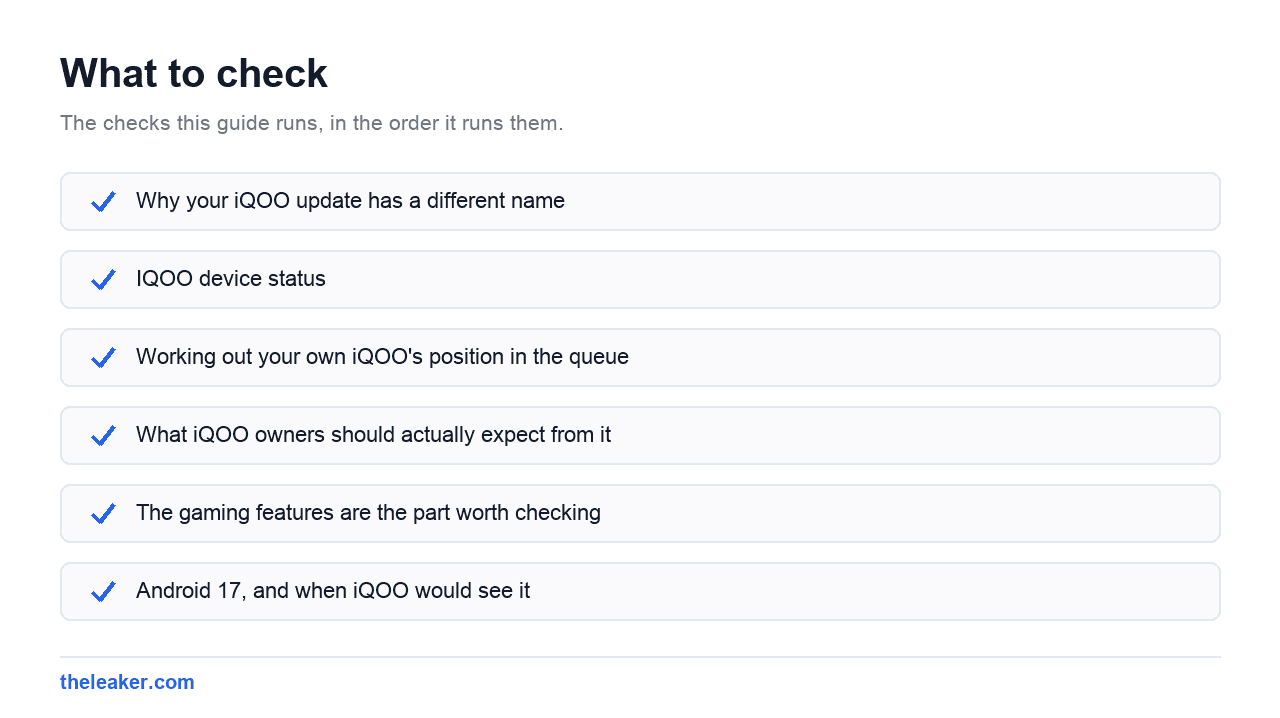
iQOO device status
Status wording is consistent across our trackers. Ships with it means the device came with OriginOS 6 preinstalled. Rolling out means a stable build is reaching existing devices. Expected means it fits vivo’s eligibility rule but has not shipped. Not eligible means no OS upgrade remains.
Flagship and numbered series
| Device | Status | Notes |
|---|---|---|
| iQOO 15 series | Ships with it | OriginOS 6 preinstalled, no update needed |
| iQOO 13 | Rolling out | First existing device, from early Nov 2025 |
| iQOO 12, 12 Pro | Rolling out | Second wave of flagships |
| iQOO 11 series | Rolling out | Stable build reaching devices in the first half of 2026, likely final version update |
Neo series
| Device | Status | Notes |
|---|---|---|
| iQOO Neo 10, Neo 10R | Rolling out | Stable build reached this tier from December 2025 |
| iQOO Neo 9, Neo 9 Pro | Rolling out | Stable build reached this tier from December 2025, likely final version update |
| iQOO Neo 7 series and earlier | Not eligible | No OS upgrade remaining |
Z series
| Device | Status | Notes |
|---|---|---|
| iQOO Z10, Z10x | Rolling out | Stable build reaching this tier from early 2026, last in the queue |
| iQOO Z9, Z9s, Z9x, Z9 Lite, Z9s Pro | Rolling out | Stable build reaching this tier from January to March 2026, likely final version update |
| iQOO Z7 series and earlier | Not eligible | No OS upgrade remaining |
Working out your own iQOO’s position in the queue
iQOO’s rollout order is strictly by tier, and it is unusually predictable because it always runs numbered flagships, then Neo, then Z. Your position is a function of which of those three you own, not how recently you bought it.
So a Neo 10 bought last month updates before a Z9 bought the same day. And an iQOO 11, despite being the oldest flagship still in the programme, is likely to see OriginOS 6 before any current Z series device does.
The second factor is whether you have an upgrade left at all. Count the Android versions your iQOO has already received against its tier row in the policy table below. If you have used them all, the queue position is irrelevant.
What iQOO owners should actually expect from it
iQOO sells on performance, and that shapes which parts of this update matter.
The visible change is large, because this is a skin replacement rather than a version bump. The launcher, settings layout, notification shade and control center all differ from Funtouch OS, and iQOO’s own gaming tools sit inside that new structure.
The performance question is the one iQOO owners ask most, and the honest answer is that a major release on an older device usually feels slower for the first week while background indexing completes, then settles. On iQOO hardware, which is generally over-specified for its price, that settling period is typically short.
What is worth watching is the game mode and performance toolkit. iQOO layers its own features on top of vivo’s software, and The gaming toolkit is the exception to all of this, and it gets its own section next.
The gaming features are the part worth checking
The section above covers what changes across the whole phone. This one is narrower, and it is the part most iQOO owners check first.
Everything that makes an iQOO an iQOO rather than a vivo sits in a layer above the base software: the Game Space hub, per-title frame rate and touch sampling controls, the Monster Mode performance profile, and on models that have it, the independent display chip that drives frame interpolation in supported games.
Those are the components most exposed by a skin replacement, and vivo has not detailed how each one migrates on a per-device basis. So the sensible thing after updating is to open Game Space and confirm your per-game profiles survived, rather than assuming they carried across.
The frame interpolation chip is the one to check most carefully if you have a Neo or numbered flagship that includes it, since its controls sit deepest inside the gaming layer and are the least documented part of this transition.
Android 17, and when iQOO would see it
There is movement here now, though it is not a public rollout. vivo opened an Android 17 developer beta in April 2026, and the iQOO 15 is one of only two phones enrolled, alongside the Vivo X300 Pro. Gizmochina’s report on vivo’s developer preview describes the build as based on Android 17 Beta 2, restricted to mainland China at launch, and unstable enough that vivo does not recommend running it as a daily driver. Reported problems on the iQOO 15 include window-opening failures, a temporarily disabled face unlock, and occasional Home button glitches; fingerprint unlock and screenshots are broken on both enrolled phones.
A developer beta is not a public release, and vivo has not announced an OriginOS 7 stable date or a wider iQOO device list for Android 17. If the past OriginOS 6 rollout is any guide, a public release would likely follow the same tier order, with numbered flagships going first and the Z series unlikely to receive it at all. This section will be rewritten with a full device list once vivo names one.
One update to the section above. Alongside the April developer beta, vivo ran a separate OriginOS 7 beta recruitment from 30 July to 4 August 2026, and the iQOO 15 and iQOO Pad 6 Pro were both on that list. That is still a closed beta rather than a public release.
Which phones are unlikely to get OriginOS 7
As of 18 August 2026 I could not find a complete official OriginOS 7 eligibility or exclusion list from vivo, and vivo’s Weibo channel could not be checked from here. The question that can be answered instead is which phones have already used up the updates vivo promised them. Gizmochina worked through vivo’s published update policy and produced a list of models that received Android 16 and have now exhausted their commitment, which makes them unlikely to get OriginOS 7.
Read it for what it is. It is a derivation from vivo’s policy rather than a vivo announcement, Gizmochina itself calls it mostly accurate rather than definitive, and it only covers phones that received Android 16. A phone that never got Android 16 is not on this list and is not covered by it, so absence here is not good news. If your iQOO did get Android 16 and is not listed, the same derivation implies it still has at least one major version left, with the same mostly-accurate caveat attached.
| Line | Models unlikely to get OriginOS 7 |
|---|---|
| Numbered flagships | iQOO 11, iQOO 11 Pro |
| Z series | iQOO Z9, Z9x, Z9 Lite, Z9s, Z9s Pro |
This is the closest thing to a firm answer an iQOO owner has, and it is consistent with the tier order this page describes, because the Z series runs out first. The 26 vivo-branded models in the same position are listed in the vivo tracker.
Checked 18 August 2026. The 30 July to 4 August recruitment has closed. vivo’s own recruitment thread then published the list of selected testers, with group entry on 8 August and the closed beta pushed to those testers on 11 August. No global public rollout has been announced.
iQOO’s update policy, and how it compares
iQOO publishes its commitments per model rather than per tier, and they vary sharply in a way the marketing does not make obvious. The two flagships iQOO states outright are below; the ranges beneath them are compiled from per-launch commitments and should be treated as indicative, not as a promise for any specific handset.
| Range | Android version upgrades | Security patches |
|---|---|---|
| iQOO 15 (stated) | 5 | 7 years |
| iQOO 13 (stated) | 4 | 5 years |
| Other numbered flagships (compiled) | 3 to 4 | 4 to 5 years |
| iQOO Neo series (compiled) | 2 to 3 | 3 to 4 years |
| iQOO Z series (compiled) | 2 | 3 years |
The Z series number is the one to weigh before buying. Two version updates on a phone bought for performance per rupee is short next to a Samsung Galaxy A series device on six, and the Z range is precisely where iQOO competes hardest on price.
The flagship line is more competitive. Three to four versions with four to five years of patches is a reasonable commitment for the segment, though still behind what Samsung and Google now offer at the top end.
How to check on your iQOO
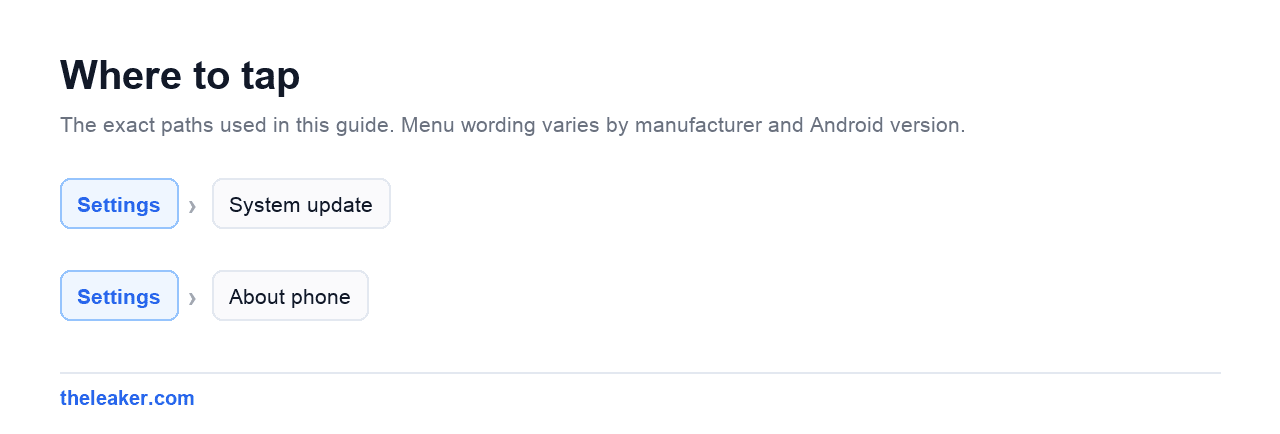
Open Settings, then System update, and tap Check for updates. To confirm what you are on, Settings, then About phone, and read the OriginOS or Funtouch OS version alongside the Android version.
Still on Funtouch OS 15 is normal and simply means your device has not reached its batch. The migration arrives as a standard system update and vivo has not required a factory reset for it, though backing up before a release this size is sensible.
How we source and maintain this tracker
iQOO is the brand where we lean hardest on the eligibility rule rather than on device lists, because iQOO’s own India community rollout announcement publishes the rule and the tier order but not a complete per-device schedule with fixed dates.
Devices named in vivo’s announced waves are marked Rolling out. Everything else is marked Expected and ordered by tier, following the stated sequence of flagships, then upper mid-range, then budget. Where a device has clearly exhausted its upgrades it is marked Not eligible rather than left ambiguous.
We do not carry full Android 17 device rows yet, because vivo has enrolled only two phones in an early developer beta and has not announced a public rollout programme or a wider device list for iQOO. That beta is covered above and this section will expand once vivo names more devices. Changes are dated in the changelog below.
Frequently asked questions
When is Funtouch OS 16 coming to my iQOO?
It is not. Funtouch OS has been retired. The Android 16 release for iQOO is OriginOS 6, delivered over the air.
Does my iQOO lose support by moving to OriginOS?
No. The number of Android versions and security patches your device was promised does not change. Only the software you receive them through does.
My iQOO 15 did not get an update. Why?
Because it already has OriginOS 6 preinstalled. There is nothing to update to.
Will my iQOO Z series phone get it?
If it has an OS upgrade remaining, yes, but last. Budget devices sit at the back of vivo’s rollout order, and on the Z series this is frequently the final major version the device will receive.
Changelog
- 18 August 2026: Added a section on which iQOO phones are unlikely to get OriginOS 7, from Gizmochina’s derivation of vivo’s update policy, and noted the separate 30 July to 4 August beta recruitment that enrolled the iQOO 15 and iQOO Pad 6 Pro. Updated the OriginOS 7 status, which had stopped at the recruitment close and missed the 11 August push to selected testers.
- 1 August 2026: Page created. Funtouch OS confirmed retired, OriginOS 6 (Android 16) confirmed as the replacement for iQOO. iQOO 15 series ships with it preinstalled. Rollout to existing devices confirmed from early November 2025 starting with the iQOO 13. Eligibility rule confirmed as any device with at least one OS upgrade remaining. No Android 17 programme announced.
- 11 August 2026: Device status table updated after checking iQOO’s own India community rollout announcement and independent reports. The iQOO 11 series, Neo 10, Neo 10R, Neo 9, Neo 9 Pro, Z10, Z10x, Z9, Z9s and Z9x had already moved from Expected to Rolling out; the table listed several of these as still Expected. Removed an unsourced claim about iQOO’s gaming tools historically lagging a release behind the base skin in past transitions.
- 11 August 2026: Corrected a factual error. This page previously said Android 17 had not been announced for iQOO at all. vivo opened an Android 17 developer beta in April 2026 that names the iQOO 15 as one of two enrolled devices, alongside the Vivo X300 Pro. Updated the quick answer, the Android 17 section and the sourcing note to reflect this, and made clear it is a developer beta, not a public rollout.
Tracking another brand? See our vivo Android 16 tracker, which covers the same migration on vivo-branded phones, or the Android 17 update tracker.

Yash Jain writes about Android and Apple for The Leaker, focusing on how to guides, download resources, and top and best roundups. His articles walk readers through setup steps and app choices, compare options across categories, and follow news updates across both mobile platforms as they develop.