
VR was supposed to eat the world by now. It didn’t. What actually happened is messier and more interesting: the category shrank, most of the companies that promised you a headset went away, and the handful of devices left are genuinely good at a few specific things.
So this is not a list of twenty headsets. There aren’t twenty VR headsets worth buying in 2026. There are about five, they sit in very different price tiers, and plenty of people reading this should buy none of them.
The quick answer: If you want VR and you don’t want to think about it, buy a Meta Quest 3 (around $499 to $599 depending on storage and sales) or the cheaper Quest 3S (around $299 to $349). They’re standalone, they have by far the biggest library, and they also work as PC headsets over a cable or Wi-Fi. If you own a PS5 and mostly want games, PlayStation VR2 is fine but the software pipeline has slowed badly. If you’re a sim racer or flight sim person with a strong gaming PC, the high-end PC headsets from Pimax and Bigscreen are where the visual quality is, and you’ll pay $1,000+ for it. Apple Vision Pro is a roughly $3,500 spatial computer, not a games machine. And AR glasses you’d actually wear outside still don’t really exist: what’s sold today is mostly a wearable display, not augmented reality.
The category consolidated, and that’s the real story
Between roughly 2016 and 2020 there were dozens of headsets: Oculus Rift, HTC Vive and its many variants, Windows Mixed Reality from Samsung, Lenovo, HP, Acer and Dell, plus phone-holder shells like Gear VR and Google Daydream. Almost all of that is dead. Microsoft removed Windows Mixed Reality support from Windows. Google shut Daydream down years ago. HTC still exists in VR but has drifted toward enterprise pricing.
What’s left is basically Meta at the mainstream end, Sony tied to the PlayStation, Apple at the top, and a small cluster of enthusiast PC brands. That’s a normal outcome for a hardware category that didn’t go mass-market. It also means buying advice is simpler than it used to be.
The other big shift: standalone won. Nobody wants to mount base stations on their walls. Modern headsets track themselves using onboard cameras, which is why setup went from an afternoon to about four minutes.
Standalone vs PC-tethered: pick your side first
Standalone means the headset is the computer. Meta’s Quest line is the example everyone means. You charge it, put it on, and you’re in. Graphics are roughly mobile-console level, because the chip inside is a phone chip with a bigger cooling budget. Battery life is real-world 1.5 to 2.5 hours, which is honestly about as long as most people want to be in a headset anyway.
PC-tethered means a gaming PC does the rendering and the headset is a display with tracking. You get much better visual fidelity (sharper text, better lighting, higher resolution) and you get SteamVR’s back catalog. You also need a good graphics card, and the good headsets in this space start around $1,000 and go up fast.
The useful thing about the Quest headsets is they do both. Plug into a PC with a USB-C cable, or stream wirelessly over a 5GHz or 6GHz network, and the same headset becomes a PC headset. For most people that flexibility is worth more than a small fidelity bump.
The headsets actually worth naming in 2026
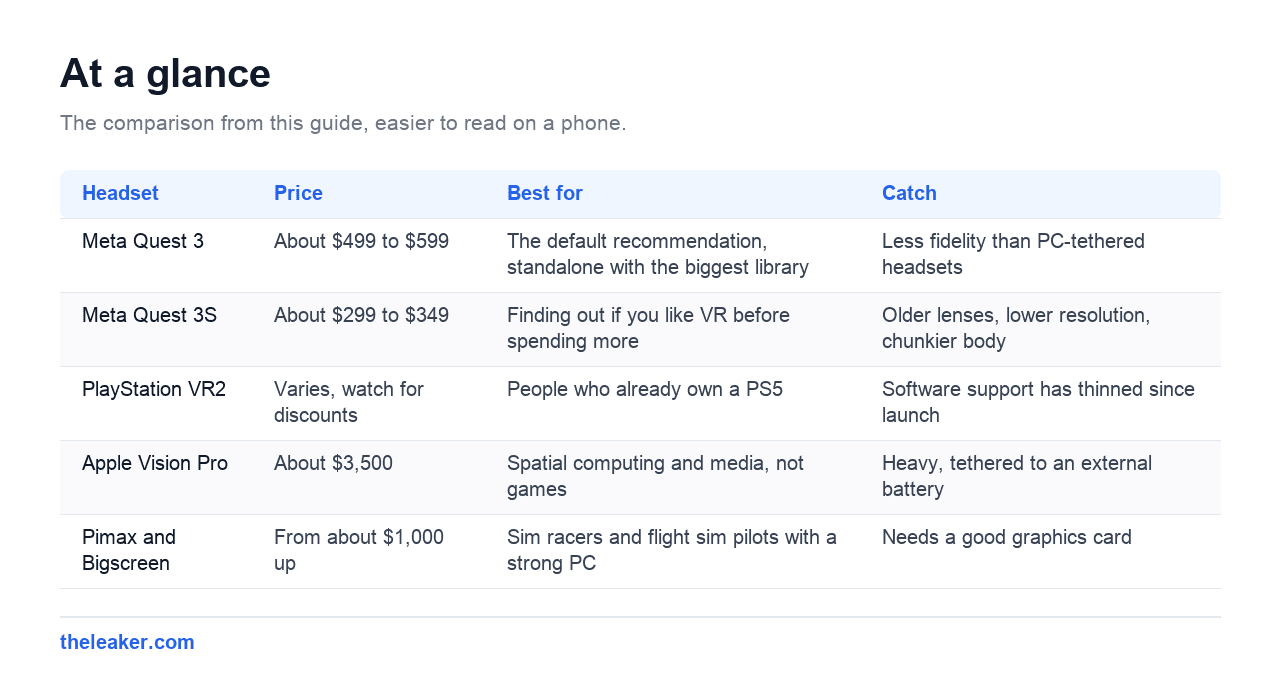
| Headset | Price | Best for | Catch |
|---|---|---|---|
| Meta Quest 3 | About $499 to $599 | The default recommendation, standalone with the biggest library | Less fidelity than PC-tethered headsets |
| Meta Quest 3S | About $299 to $349 | Finding out if you like VR before spending more | Older lenses, lower resolution, chunkier body |
| PlayStation VR2 | Varies, watch for discounts | People who already own a PS5 | Software support has thinned since launch |
| Apple Vision Pro | About $3,500 | Spatial computing and media, not games | Heavy, tethered to an external battery |
| Pimax and Bigscreen | From about $1,000 up | Sim racers and flight sim pilots with a strong PC | Needs a good graphics card |
Meta Quest 3: the default recommendation
Pancake lenses, decent color passthrough so you can see your room, self-contained, and the library nothing else comes close to. If someone asks “which VR headset should I get” with no other context, this is the answer, and it has been for a while. Expect roughly $499 to $599 depending on storage tier and whether there’s a sale on. UK pricing lands near £469 to £549, Australia around AU$799 to AU$999.
Meta Quest 3S: the cheap way in
Same processor as the Quest 3, older lens design, lower resolution, chunkier body. Around $299 to $349. If you’re buying VR to find out whether you like VR, buy this one. If you decide you love it, the resale market for Quest hardware is healthy.
PlayStation VR2: only if you already own a PS5
The hardware is good. OLED panels, eye tracking, excellent haptics in the controllers. The problem is software support has thinned out considerably since launch. Sony has released a PC adapter, which helps, but it’s a hard headset to recommend at full price to someone who isn’t already deep in the PlayStation ecosystem. Watch for discounts.
Apple Vision Pro: extraordinary, and not for you
At roughly $3,500 it’s the best display you can put on your face and the most polished passthrough anyone has shipped. It is also heavy, tethered to an external battery, and its game library is thin because Apple isn’t really pitching it as a games device. As a giant private movie screen and a multi-monitor Mac display it’s impressive. As a purchase, it makes sense for developers and for people with money to spend on the frontier. Apple’s cheaper follow-up has been rumored for years; it isn’t here yet.
High-end PC headsets: Pimax and Bigscreen
If you’re a sim racer or a flight sim pilot, this is your neighborhood. Pimax’s Crystal line chases raw resolution and field of view. Bigscreen’s Beyond headsets go the other direction: tiny, custom-molded to your face, absurdly light, using SteamVR base stations. Both assume you have a serious PC and a serious hobby. Both cost more than the console you might otherwise have bought.
Valve’s Steam Frame: announced, not yet a purchase
Valve revealed a standalone SteamOS headset called Steam Frame in late 2025 and has said it ships in 2026, but as of this writing there is still no confirmed retail price or firm ship date. If you’re patient and PC-focused, it’s the one thing on the horizon worth waiting to see. Don’t plan a purchase around a device with no announced price.
What VR is good at now
Fitness. This is the sleeper use case and it’s not a gimmick. Rhythm and boxing games get your heart rate up in a way a stationary bike doesn’t, mostly because you forget you’re exercising. People who quit every gym they’ve joined stick with this. Get a sweat-resistant facial interface; the stock foam is miserable.
Sim racing and flight. The single most convincing VR use case. Depth perception in a cockpit is transformative: judging braking points and apexes in a headset is a different sport from doing it on a monitor. This is also the use case that justifies expensive PC headsets.
Big-screen video. A movie on a virtual 100-inch screen in a hotel room or on a plane is nice. Not life-changing, but nice.
Social spaces. Smaller than the hype suggested, but real. Some people have their entire social life in there and are perfectly happy.
What it still isn’t good at
Productivity. Every headset maker promises virtual monitors will replace your desk setup. In practice: text is still softer than a real display, you can’t see your keyboard without passthrough, the thing is heavy after an hour, and nobody wants to take a video call with their face covered. Apple’s Vision Pro comes closest and it still isn’t how most people work. Treat any “replace your monitors” claim as marketing.
Casual daily use. Headsets get worn a lot in month one and much less by month six. That’s not a defect, it’s just the shape of the medium. Budget accordingly: buy the cheaper one first.
Actual augmented reality. Real AR (digital objects convincingly anchored in the world, in glasses you’d wear on the street) still isn’t a shipping consumer product. What you can buy today are display glasses (Xreal, Viture and similar) that float a virtual screen in front of you, and camera-and-audio glasses like Meta’s Ray-Ban line that have no real display in the standard models. Both are decent products. Neither is the AR from the concept videos.
Who should skip VR entirely
If you get motion sick easily, try before you buy: comfort has improved enormously but some people never adapt. If you wear strong prescription glasses, budget for lens inserts. If you have less than about six feet of clear floor space, a lot of the best content isn’t practical. If you’re buying it for a kid under 13, note that the major platforms set 10 to 13 as their minimum age and parental controls vary in quality.
And if you’re buying it because you feel like you should own one: don’t. Buy it because you want to box, or race, or hang out in there.
Before you buy: a few practical notes
Storage matters less than people think for standalone headsets, but games are getting bigger: the same squeeze that has phone owners hunting for space. If you’re used to clearing storage without deleting anything on Android, the same instinct applies here: uninstall and re-download rather than paying up a tier you’ll barely use.
Buy a head strap with a counterweight. The stock strap on almost every headset is the worst part of the product, and a $40 replacement changes how long you’ll wear it. Buy a spare set of facial interfaces if more than one person will use it.
Check refund windows. Most platforms will refund a VR game if you’ve played under a certain amount of time, which matters more than usual because comfort varies so much per person.
FAQ
Do I need a gaming PC for VR in 2026?
No. Standalone headsets like the Quest 3 and 3S run everything on-device. A PC only becomes necessary if you want the high-fidelity SteamVR library or sim titles with maxed-out visuals. If you already own a strong PC, having both options is a nice bonus, but plenty of people never plug in once.
Is VR dead?
No, but it’s a niche, and it stopped pretending otherwise. Hardware sales are well below the projections from the late 2010s and several major players exited. What’s left is a smaller, more stable market with a few good devices and steady software output. That’s a normal outcome, not a collapse.
Can I use a VR headset with glasses?
Usually yes, but it’s uncomfortable and risks scratching the lenses. Most headsets ship with a spacer that makes room for frames. The better fix is prescription lens inserts: third-party makers supply them for every mainstream headset, typically $50 to $100.
Are AR glasses worth buying instead?
Depends what you want. Display glasses give you a floating virtual monitor for video and laptop use and they’re light enough to wear on a plane. Camera glasses take photos and pipe audio to your ears. Neither does world-anchored augmented reality in a way that would impress you, and no consumer product currently does. If someone sells you “AR glasses,” check whether there’s actually a display inside.
If you’re setting up new hardware around the house and want your phone to keep up, a couple of hidden Android settings worth changing will do more for daily performance than any accessory purchase.

Hola everyone! I’m Sajid and I’m a typical freelance Graphic Designer with a keen interest in technology and science stuff. I actually like to write about the recent happenings around the world of technology as a part of The Leaker.