
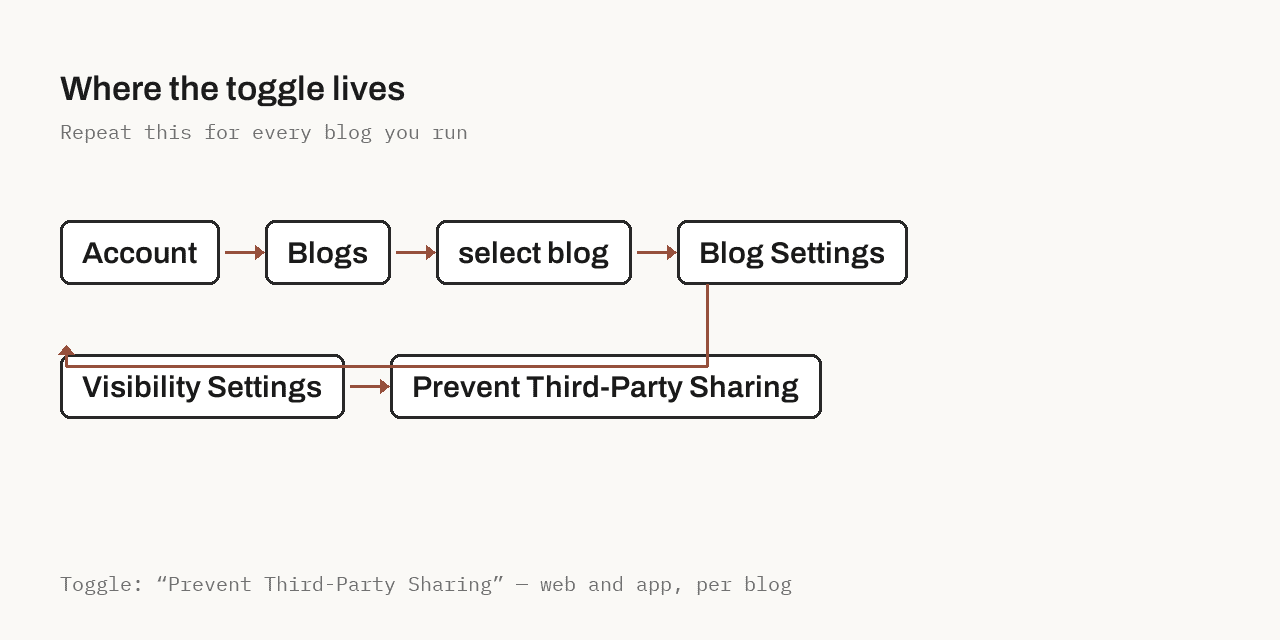
If you are searching for Tumblr alternatives in 2026, the most likely reason is that Tumblr’s parent company, Automattic, now shares Tumblr posts with AI companies by default. You can opt out without leaving: go to Account > Blogs > select your blog > Blog Settings > Visibility Settings, then turn on “Prevent Third-Party Sharing” for each blog you run. If you want to leave the platform entirely instead, the right replacement depends on what you actually used Tumblr for. Ghost or WordPress cover long-form blogging, Cara covers artists who want to avoid the same AI-scraping problem, Mastodon or Bluesky cover the feed-and-reblog social side, and Pillowfort is the closest functional copy of Tumblr itself, for a one-time $5 or free with an invite.
What actually changed
In February 2024, reporting from Gizmodo and TechSpot revealed that Automattic, which owns both WordPress.com and Tumblr, had struck deals to supply user content to AI companies including Midjourney and OpenAI. Internal documentation described an “initial data dump” covering all public Tumblr posts from 2014 to 2023, and the batch reportedly included some content that was not meant to be publicly visible.
Automattic has not published a full account of when each batch of data was shared or with whom. In response to the backlash, Tumblr’s own staff account posted that the company would let users turn off third-party sharing per blog, though it stopped short of saying the setting would default to off.
None of this happened in isolation. In April 2025, Automattic cut 281 people, 16% of its workforce. CEO Matt Mullenweg’s own statement, reported by TechCrunch, cited a “highly competitive market” and technology “evolving at unprecedented levels” as reasons the company needed to improve its “productivity, profitability, and capacity to invest.” He did not name AI specifically, though the timing lines up with the same company now monetizing user content to train it.
How to opt out of AI training without leaving
The setting lives on each blog individually, not on your account as a whole, which matters if you run more than one.
On the web: Account > Blogs, select the blog, then Blog Settings > Visibility Settings, and toggle on “Prevent Third-Party Sharing.”
In the app: open the blog, tap the settings gear, scroll to Visibility, and toggle the same option. Repeat for every blog you run.
Tumblr automatically turned the new toggle on for any blog that had already enabled the older “discourage search engines from indexing this blog” setting. Check that blog first if you had already opted out of search visibility.
This does not undo what already happened. The reporting is specific that Automattic had already assembled and shared a data batch covering 2014 to 2023 before this toggle existed. Turning it on now stops future sharing. Nothing in Automattic’s public statements says it retroactively pulls a blog’s older posts back out of a training set that was already delivered.
If you are leaving for good, the right platform depends on what you posted
A flat top 10 list is not useful here, because a fandom blogger, a photographer and someone who just wants an ad-free feed are solving different problems.
| If you mostly posted | Go to | Cost | What you give up |
|---|---|---|---|
| Long articles, essays | Ghost | From $18/mo, annual | Tumblr’s built-in discovery feed |
| Long articles, essays | WordPress.org (self-hosted) | Hosting cost varies | Any built-in audience or feed |
| Original art, photography | Cara | Free | Off-platform following you built elsewhere |
| Reblogs, short posts, fandom | Mastodon | Free | A single unified feed; you pick a server |
| Reblogs, short posts, fandom | Bluesky | Free | Decentralization; one company still runs it |
| Everything, want it to just look like Tumblr | Pillowfort | $5 once, or free via waitlist | Still in beta, smaller community |
Long-form blogging: Ghost or WordPress
Ghost starts at $18 a month billed annually for its Starter plan, capped at 1,000 members, and is an ad-free publishing platform built for writers who want to own their audience through email and RSS rather than an algorithmic feed. WordPress.com is the free option, ironic given who owns Tumblr, but the self-hosted WordPress.org version is a separate product from Automattic’s hosted service and is not part of the AI-sharing arrangement described above.
Artists and creators: Cara
Cara is a free portfolio and social app built specifically in response to platforms training AI on artists’ work without consent. It runs an AI-image detector to keep generated content out of feeds and tags uploads to signal AI companies not to scrape them. For anyone leaving Tumblr specifically over the AI-training issue, it is the alternative built around solving that exact problem rather than merely avoiding it.
Feed-and-reblog social: Mastodon or Bluesky
Mastodon is decentralized, so you join one server among thousands while your posts still reach anyone following you on a different server. It has no algorithmic feed and no ads. Bluesky works more like a conventional chronological timeline with its own reply and repost mechanics. Neither replicates Tumblr’s blog-plus-reblog structure exactly, and both trade Tumblr’s built-in audience for a smaller, still-growing one.
Closest like-for-like copy: Pillowfort
Pillowfort is the platform most people mean when they say “just like old Tumblr.” It is still in open beta, and its own signup page offers two paths in, a one-time $5 fee for instant access or a free rolling waitlist that the site currently lists as running under an hour. It is entirely user-funded, with no venture backing, and periodically runs donation drives to stay online. That funding model is also the honest risk, because a platform with no outside investor has less runway if a donation drive falls short.
What does not work anymore
Soup.io, still recommended in some older “Tumblr alternatives” roundups, was discontinued on 20 July 2020 “due to expenses and declining revenue,” per Wikipedia’s record of the shutdown. The domain has since been resold to an unrelated site. If you see it recommended anywhere in 2026, that page has not been checked in six years.
FAQ
Is Tumblr shutting down? No. Automattic still owns and runs it, and has not announced any plan to shut it down. The 2025 layoffs were part of a restructuring across every Automattic brand, and Tumblr was one of several affected.
Can I get my posts removed from the AI training data that was already shared? Automattic has not published a deletion or opt-back-out process for data already delivered to Midjourney or OpenAI. The “Prevent Third-Party Sharing” toggle is documented as preventing future sharing, not retracting past batches.
Do I lose my old Tumblr posts if I switch platforms? No, and Tumblr does not delete your blog when you stop using it. You can export your posts through Tumblr’s own settings and keep the original blog live as an archive while you post elsewhere.
If the Tumblr data-sharing story made you wonder what else you have quietly agreed to, the same check applies to your phone. Our guide to auditing Android app permissions walks through finding out what every app you have installed can actually see.

A tech Journalist and Photographer, Dhawal Sharma is a technology enthusiast who loves to research the latest innovations and technology. He has contributed to the Honor Community for a very long period and has crucial expertise in writing tech news and reviewing smartphones and laptops. Analyzing and bringing the facts about any piece of tech is what he loves the most. He is a great product photographer and is the Gizmopedia of TheLeaker. Find him on Facebook and Instagram, and you can also email him at [email protected].
Comments are closed.