
Most of the Redmi Note 14 family is expected to get Android 17 through HyperOS 4. The Redmi Note 14 5G, which is also sold as the Note 14 SE 5G, is the one phone that is not, and that rests on Xiaomi’s own published update commitment rather than on any leak. Treat it as what the policy promises, not as a Xiaomi statement about Android 17 specifically, because a support commitment sets a floor and doesn’t forbid the company from going past it.
The quick answer: Xiaomi opened HyperOS 4 beta registration in China on 13 August 2026 and named three device waves, starting 14 August. No Redmi Note model appears in any of them, and no global, EEA or India beta has been announced at all, so nothing here is confirmed eligibility yet. The Note 14 4G, Note 14 Pro 4G, Note 14 Pro 5G and Note 14 Pro+ 5G all appear on the expected-device roster Beebom maintains, which is a prediction rather than a Xiaomi list. Beebom calls it a complete list, but Xiaomi has confirmed only its opening beta devices, so treat the rest as expectation. There’s at least real firmware to point at for those four. nokiamob’s tracker records HyperOS 4 pre-release branches for the Note 14 4G, Note 14 Pro 4G, Note 14 Pro and Note 14 Pro+, several of them global, and none for the Note 14 5G. Two caveats and both matter. That page says plainly a firmware branch is not a promise, and a HyperOS 4 branch is about HyperOS 4, so it is suggestive here and not decisive. The Redmi Note 14 5G is absent from it, and that exclusion rests on firmer ground than the rest of the table, because Xiaomi promised the model two major Android updates from an Android 14 start, which ends at Android 16. Keep the two names apart here. MIUIROM’s tracker says the Note 14 5G will likely not get HyperOS 4 or will get it built on Android 16, so the claim this page defends is that Android 17 is not expected. A HyperOS 4 skin on Android 16 is a different thing and remains possible. It runs the other way too. Xiaomi delivered Android 17 to the Xiaomi 17 series in July on HyperOS 3.3, so the skin version and the Android version move independently and a HyperOS 4 roster is weak evidence about Android 17 in either direction. The update-count commitment is the part that carries weight. So treat the eligible side as a strong expectation, and the excluded side as what Xiaomi’s published policy commits to rather than as a confirmed exclusion. With the China beta only just open and no Note in it, expect the rollout to reach the Note 14 range around late 2026 at the earliest.
Which Note 14 do you actually have?
This matters more here than on almost any other phone, because the answer changes between models that sit next to each other on the same shelf.
Check Settings, then About phone, and read the model number as well as the marketing name. “Redmi Note 14” and “Redmi Note 14 5G” are different phones with different chipsets, and the model number is what tells them apart. Model numbers below come from each device’s GSMArena spec sheet, except the SE, which is listed by PhoneDB.
| Model | Model number | Android 17 (HyperOS 4) | Notes |
|---|---|---|---|
| Redmi Note 14 4G | 24117RN76G (global) | Expected | Four major updates promised, so Android 18 should follow |
| Redmi Note 14 5G | 24094RAD4G (global), 24094RAD4I (India) | Not expected | Absent from the rosters, and the only Note 14 with no pre-release firmware branch. Two major updates promised, ending at Android 16. May still get HyperOS 4 built on Android 16 |
| Redmi Note 14 SE 5G | 24094RAD4I (India) | Not expected | Same model number and same 2+4 year terms as the India Note 14 5G |
| Redmi Note 14 Pro 4G | 24116RACCG | Expected | On the rosters |
| Redmi Note 14 Pro 5G | 24090RA29G (global), 24090RA29I (India) | Expected | Three major updates promised, so Android 17 is its last |
| Redmi Note 14 Pro+ 5G | 24115RA8EG (global), 24115RA8EI (India) | Expected | Three major updates promised, so Android 17 is its last |
Those are the SKUs sold in the markets this site covers, and the list isn’t exhaustive. The India Pro+ is not a relabelled global unit either, because it ships a different main camera and a bigger battery. Match your own number rather than the nearest name.
Nothing about that table is intuitive. The usual assumption is that a more expensive phone gets supported longer, and here the 4G model is on the rosters while the 5G model is not.
The row Indian readers should look at twice is the Redmi Note 14 SE 5G, launched in India in July 2025 at Rs 14,999. Xiaomi’s own product page calls it “a striking new shade of the Redmi Note 14 5G”, and its published spec sheet lists Android 14 with “2+4 Years” of OS and security updates. It carries the model number 24094RAD4I, which is the India Redmi Note 14 5G. An SE therefore follows the excluded phone’s policy. If you bought one on the strength of the “14” in the name, it is not on track for Android 17.
Two regional details are easy to trip over before you go looking for a Chinese build to compare against. The Note 14 4G and Note 14 Pro 4G are global releases and have no Chinese counterpart. The Note 14 series that launched in China on 26 September 2024 was 5G only, and the 4G models arrived with the global launch in January 2025. And the Note 14 5G exists as separate SKUs, 24094RAD4G globally and 24094RAD4C in China, so a Chinese firmware thread about “the Note 14” is not describing the phone most readers here own.
One more model wears the Note 14 name without fitting neatly into that table. The Redmi Note 14S launched in Central and Eastern Europe in March 2025 as a rebadged Redmi Note 13 Pro 4G. Beebom’s roster lists it with the rest of the Note 14 family, while MIUIROM has it marked as in question, so its status is genuinely unsettled rather than settled either way. If your phone box says Note 14S, that is the model you are checking.
Why the Note 14 5G is the odd one out
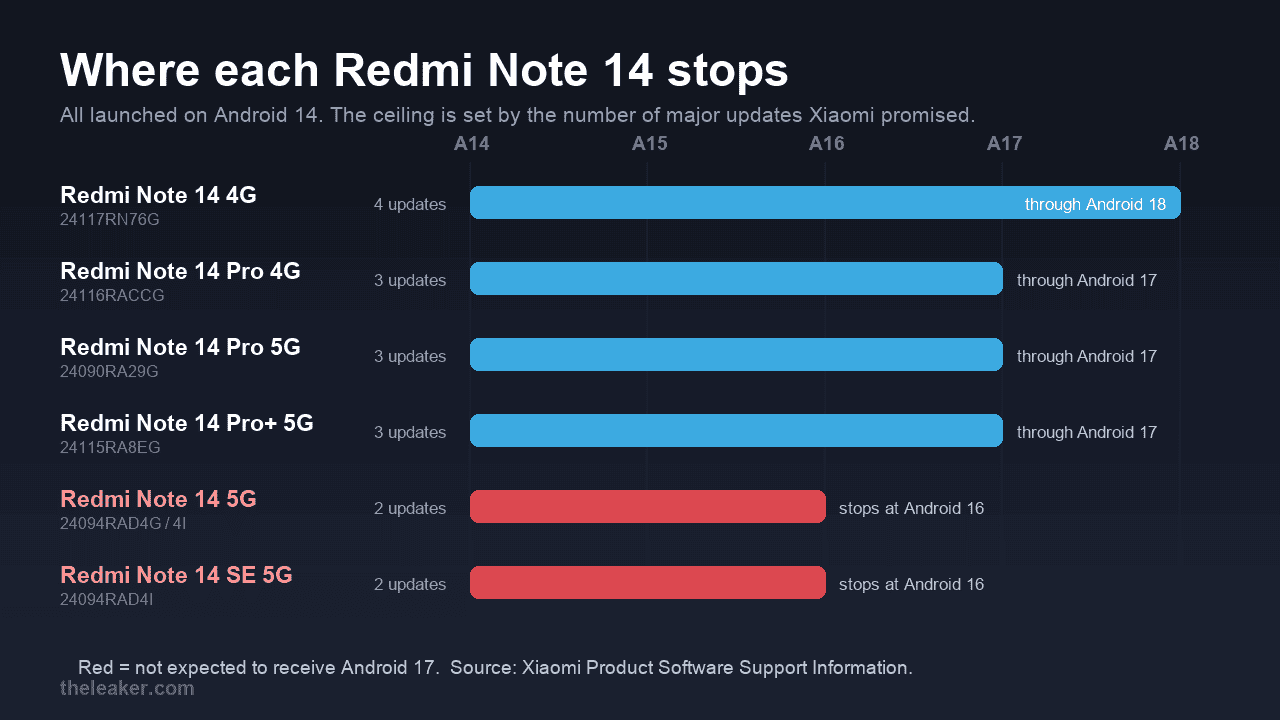
This is not a mystery Xiaomi has stayed quiet on. It comes down to the update commitment Xiaomi published for each model at launch, on its own Product Software Support Information page, and the two models started with different terms. The Note 14 4G was promised four major Android updates and six years of security patches, which from its Android 14 starting point runs through Android 18. The Note 14 5G was promised only two major Android updates and four years of security patches, which from the same Android 14 starting point caps out at Android 16, exactly where it is expected to stop. Android 17 is not a missed update. It is one update past what Xiaomi committed to for that specific model.
Reporting from GSMArena, sourced to that same Xiaomi support page, laid out the gap between the two models when the policy first drew attention. Two caveats hold. Xiaomi’s announced beta waves name no Redmi Note at all, and there’s no global stable-rollout list yet, so eligibility for every other model in the table is still an expectation. And “not getting Android 17” does not mean “stops working”. Security patches continue on their own schedule after the last OS version, which is the part that actually matters for safety.
When will it arrive?
Xiaomi confirmed a reveal in July or August 2026 beginning in China, as reported by Gizmochina, and it was unveiled in China on 13 August 2026, with the first beta wave opening to a named set of devices, according to MIUIROM’s HyperOS 4 tracker. What Xiaomi has still not published is a complete global stable-rollout list, so eligibility for any specific Note 14 model outside China remains unconfirmed. Earlier beta dates that circulated for early August came and went with no official presentation and no build numbers. So every date below is a shape, not a schedule.
- Flagships first. The current Xiaomi flagship line gets the stable build ahead of everything else.
- China before global, with a catch. Gizmochina expects the global announcement to follow the Chinese one by a few weeks, reasoning from how HyperOS 3 rolled out rather than from anything Xiaomi has stated about HyperOS 4. Even if that holds, it will not help you time a Note 14 4G, Pro 4G or 14S build, because none of those models has a Chinese version to watch.
- Note series after flagships. Mid-range families like the Note 14 follow, generally in a staged rollout by region.
Realistically that puts the Note 14 range in late 2026 at the earliest for the first regions, and into 2027 for some markets. If you are in the US, note that Redmi phones are not sold through US carriers, so a Note 14 bought there is an imported unit and runs whichever region’s firmware its SKU carries, which may be global, EEA, India or China. Read the model number and the ROM code in Settings rather than assuming it is the global build.
How to check for the update yourself
Go to Settings, then About phone, then HyperOS version, and tap Check for updates.
A few things to keep in mind before you go hunting:
- Staged rollouts are normal. Two identical phones in the same city can be days or weeks apart. Nothing is wrong with yours.
- Do not flash a build meant for another region. Cross-flashing between Chinese and global firmware is the fastest way to lose banking apps, break VoLTE, or brick the phone outright.
- Ignore sites offering the update as a download. It arrives over the air, signed for your exact model and region.
Checking another device? See our Xiaomi, Redmi and POCO Android 17 update tracker for the full family, or the Android 17 update tracker for every brand.
What you actually get
Android 17’s headline addition is Bubbles. Google’s developer documentation for the feature describes it as a way to float an app above whatever else is on screen, so a chat or a calculator can sit on top of what you are doing. Google documents a five-bubble limit for the Pixel Bubble Bar; Xiaomi does not publish a figure for HyperOS, so do not assume the same ceiling here.
Alongside that, Android 17 brings the usual layer of security and privacy work, plus performance and productivity changes. On a Redmi you will experience most of this through HyperOS 4’s own interface, so the visual changes come from Xiaomi rather than Google.
If your Note 14 5G is not getting it
The phone does not become unusable, and there is no need to replace it on this news alone.
- Security patches continue past the final OS version. Xiaomi’s own commitment for the Note 14 5G is four years of security patches from launch, well beyond the point it stops getting new Android versions, and they are what protects you day to day.
- Apps keep working. Play Store apps target a range of Android versions, and Android 16 stays supported for years.
- Google Play system updates deliver some platform components independently of the full OS version, so parts of the phone keep moving forward regardless.
If you are buying now and long support matters, check the specific model rather than the series name, and treat any seller’s claim about “3 years of updates” as something to verify against Xiaomi’s support page for that exact variant.
Frequently asked questions
Is the Redmi Note 14 getting Android 17?
The Note 14 4G, Note 14 Pro 4G, Note 14 Pro 5G and Note 14 Pro+ 5G are all expected to. The Note 14 5G is absent from every roster that has circulated so far.
Why does the cheaper 4G model get it when the 5G does not?
Xiaomi committed to different update terms for the two models at launch. The Note 14 4G gets four major Android updates and six years of security patches; the Note 14 5G gets two major updates and four years. Both launched on Android 14, so the 4G’s allotment reaches Android 18 while the 5G’s stops at Android 16. Price has nothing to do with it.
I have a Redmi Note 14 SE 5G. Does that count as a Note 14 5G?
Yes. Xiaomi’s Indian product page describes the SE as a new shade of the Redmi Note 14 5G, and its spec sheet lists the same “2+4 Years” of OS and security updates. Settings will report the model number 24094RAD4I on both, so About phone cannot distinguish them either. Assume the SE stops at Android 16.
Is this official from Xiaomi?
The update-count commitment behind the Note 14 5G’s cutoff is official, published on Xiaomi’s own support page. The HyperOS 4 eligibility of the rest of the range is not. Xiaomi’s China beta waves cover its flagship and K-series phones and name no Redmi Note, and no global stable-rollout list exists yet, so which other models get it and when still reflects the expected-device rosters trackers have circulated since February 2026, and those can change.
What version of Android does the Note 14 have now?
Most Note 14 units shipped on Android 14 or 15 with HyperOS, and have since moved to Android 16. Check Settings, then About phone.
Will HyperOS 4 slow my phone down?
A major version bump often causes a few days of heavier background activity while the phone re-indexes and re-optimizes apps. If it is still slow after roughly a week, clear the cache of the apps you use most under Settings, then Apps, before considering a reset. Do not go looking for a “wipe cache partition” item in recovery: many devices that use seamless A/B updates, Xiaomi’s included, no longer carry a separate cache partition for it to clear.
Changelog
- 13 August 2026: Page published.
Related: Xiaomi HyperOS: Settings to Change on Day One
Updated 24 August 2026. Xiaomi announced HyperOS 4 on 13 August and opened a staged China beta on 14 August, so the lines saying it had published nothing are gone. Four of them were on this page, in three different phrasings, and one sat a sentence away from the correct account. That changes nothing about the verdict here and doesn’t strengthen it either, because an opening China beta is not an eligibility list.
An outside review with web access then went through every citation on the page. It found that Beebom does not call its own roster unofficial, so this page no longer says it does. It found pre-release firmware branches for four Note 14 models, better than a prediction list, so those are cited now, with the caveat that they are evidence about HyperOS 4 and not directly about Android 17. It separated HyperOS 4 from Android 17, since the 5G may still get the skin built on Android 16. India model numbers for the Pro and Pro+ are added, the claim that a US import runs the global build is corrected, and a dead Google support link is replaced. The certainty of the verdict is dialled back too, because a two-upgrade commitment is a floor Xiaomi promises rather than a ceiling it is barred from passing.

Akshay Mhatre is a Tech Journalist who likes to keep up with the latest from the tech world. He has worked at many popular news portals like BGR and TechRadar before joining TheLeaker as a News writer and journalist. A writer by day and a VFX artist by night. In his free time, he also likes to make motion graphics and concept art. You can find him on Instagram @akshayrazr_95 and contact him on akshaymhatre[@]theleaker.com.