
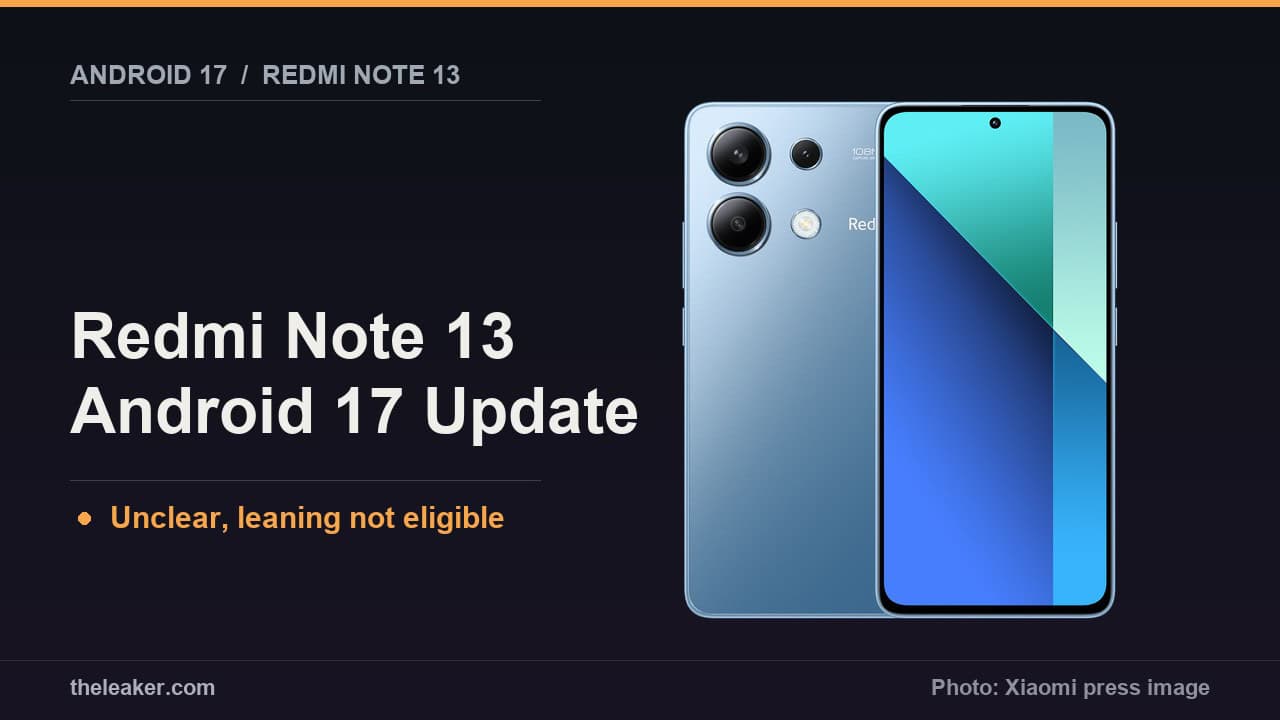
The Redmi Note 13 is one of the best selling Android phones of the last few years, which makes it strange how hard it is to get a straight answer about its software future. Search for the Redmi Note 13 Android 17 update and you get brand-wide eligibility lists that mostly do not mention it at all. Here is what the absence actually means.
The quick answer: The Redmi Note 13 is very unlikely to get Android 17. Xiaomi has not published an official HyperOS 4 device list, but the Redmi Note 13 series is absent from the credible eligibility lists circulating, which start at the Redmi Note 14. The arithmetic supports that: the Note 13 launched on Android 13 under a policy of two to three version updates, which takes it to Android 15 or at best Android 16, not 17. We mark it Unclear, leaning not eligible rather than a flat no, because Xiaomi has confirmed nothing either way. Security patches continue regardless, and Xiaomi’s patch window on this series runs longer than its version window.
Why this is hard to answer
Three things make the Redmi Note 13 specifically confusing, and it is worth naming them because they explain why the lists disagree.
First, Xiaomi has not published an official supported-device list for HyperOS 4. Every list you find is inference from Xiaomi’s tier policies, which is fine as far as it goes but means absence from a list is weaker evidence than it looks.
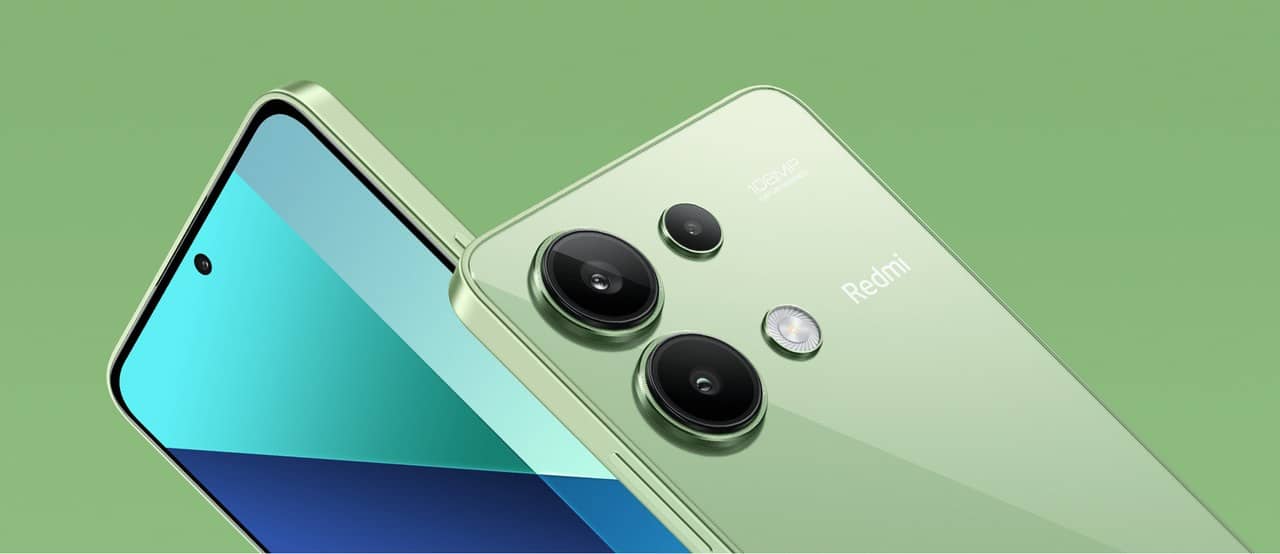
Second, the Redmi Note 13 is not one phone. There is a Note 13 4G, a Note 13 5G, a Note 13 Pro, a Note 13 Pro 5G and a Note 13 Pro+, and they do not share a chipset or, necessarily, a software fate. Lists that say “Redmi Note 13 series” are flattening real differences.
Third, HyperOS version numbers and Android version numbers do not line up. A phone can receive a new HyperOS release that is built on the same Android version it already had. Owners see a big update arrive and reasonably assume they got a new Android. Often they did not.
The version arithmetic
| Model | Launched with | Typical version policy | Realistic final Android | Android 17? |
|---|---|---|---|---|
| Redmi Note 13 4G / 5G | Android 13 | 2 versions | Android 15 | Unlikely |
| Redmi Note 13 Pro / Pro 5G | Android 13 | 2 to 3 versions | Android 15 or 16 | Unlikely |
| Redmi Note 13 Pro+ | Android 13 | 2 to 3 versions | Android 15 or 16 | Unlikely |
| Redmi Note 14 series | Android 14 | 2 to 3 versions | Android 16 or 17 | Expected |
Reading down that table, the Note 13 would need to receive four Android versions to reach 17, against a policy of two to three. Even the Pro+ at the generous end of the range lands on Android 16 at best.
That is the substantive reason the Note 13 is missing from HyperOS 4 lists, and why the lists begin at the Note 14. It is not an oversight.
Why “unclear” rather than “no”
We would rather give a definitive answer, and there are two reasons we are not going to on this one.
Xiaomi has published nothing official, so a flat “no” would be presenting inference as fact, which is exactly what makes most eligibility lists unreliable. And a stated support policy works more like a floor than a hard ceiling. Manufacturers sometimes revise commitments after launch under enough sales pressure, and the Note 13 sold in enormous volume. We found no confirmed case of Xiaomi doing this for a specific Redmi Note model, but it is not something the policy rules out.
The honest position is that the Note 13 is on the wrong side of the policy line, no credible source places it on the list, and it would take an unusual decision by Xiaomi to change that. Plan on not receiving Android 17, and treat it as a bonus if it arrives.
What your Redmi Note 13 does keep getting
The end of version updates is not the end of support, and on Xiaomi devices the gap between the two is unusually wide.
Xiaomi’s security patch commitment on the Redmi Note 13 series runs to around four years, considerably longer than its version commitment of two to three, with an end date around January 2028. A Note 13 that stops receiving new Android versions continues receiving security patches for a substantial period afterward.
On top of that, Google Play Services, the Play Store, Chrome and every app you use update through Play independently of your Android version. Most of what changes month to month on a phone in daily use arrives that way rather than through system updates.
You may also still receive new HyperOS releases built on your existing Android base. Those can bring real interface and feature changes without being an Android version update, which is the source of much of the confusion above.
Which Redmi phones are expected to get it
If the Note 13 is on the wrong side of the line, it is useful to know where the line actually falls, both for context and if you are considering an upgrade.
| Device | Status | Expected timing |
|---|---|---|
| Redmi K90 series | Expected | September to December 2026 |
| Redmi Note 17 series | Expected | Late 2026 |
| Redmi Note 15 series | Expected | Early 2027 |
| Redmi Note 14 series | Expected | 2027, likely final version update |
| Redmi Note 13 series | Unclear, leaning not eligible | Not expected |
The Note 14 is the oldest Redmi Note credibly placed on the HyperOS 4 lists, and even there Android 17 is expected to be its final version update rather than a mid-life one.
That is the useful thing to take from this if you are shopping. Buying a one-generation-old Redmi Note at a discount is good value on hardware and buys you very little software runway, often a single version update. If long support matters more to you than price, the Redmi Note range is not where to find it at any generation, and a Samsung A series phone on the newer six year policy is a materially different proposition at a similar price.
How to check exactly what you have
Open Settings, then About phone. The screen shows your HyperOS version and your Android version as separate lines, and it is the Android line that answers this question.
To check for anything pending, tap the version banner at the top of that screen, which opens the update page.
One detail that matters on Xiaomi specifically: check whether your device is on a global or a China build. The version string carries a region identifier. China and global are separate software tracks with different rollout schedules, and if you bought your Note 13 as a grey import you may be on the track your local coverage is not describing.
Frequently asked questions
Is the Redmi Note 13 definitely not getting Android 17?
Not definitely, because Xiaomi has confirmed nothing. But it is absent from every credible HyperOS 4 list, and reaching Android 17 would require a fourth version update against a policy of two to three. Plan on not getting it.
I just got a big HyperOS update. Was that Android 17?
Almost certainly not. HyperOS releases and Android versions are numbered separately, and a HyperOS update can arrive on the same Android base you already had. Check Settings, then About phone, and read the Android version line specifically.
Does my Note 13 stop getting security updates too?
No. Xiaomi’s security window on the Redmi Note series is around four years, longer than its version window, so patches continue after your final Android version.
Would the Pro or Pro+ get it when the standard model does not?
Possibly, since the Pro+ sits at the more generous end of the policy, but even that lands on Android 16 at best, well short of 17. If Xiaomi does extend anything in this series, the Pro+ is the most likely candidate.
Changelog
- 11 August 2026: Added source links for the eligibility-list and security-patch claims, hedged the Pro+ final Android version to match conflicting third-party reporting, and softened an unsourced claim about Xiaomi extending policies.
- 1 August 2026: Page created. Redmi Note 13 series marked Unclear, leaning not eligible: absent from all credible HyperOS 4 lists, and reaching Android 17 would require a fourth version update against a two to three version policy. Xiaomi has published no official list.
Checking another device? See our Xiaomi, Redmi and POCO Android 17 update tracker for the full list, or the Android 17 update tracker for every brand.

Yash Jain writes about Android and Apple for The Leaker, focusing on how to guides, download resources, and top and best roundups. His articles walk readers through setup steps and app choices, compare options across categories, and follow news updates across both mobile platforms as they develop.