
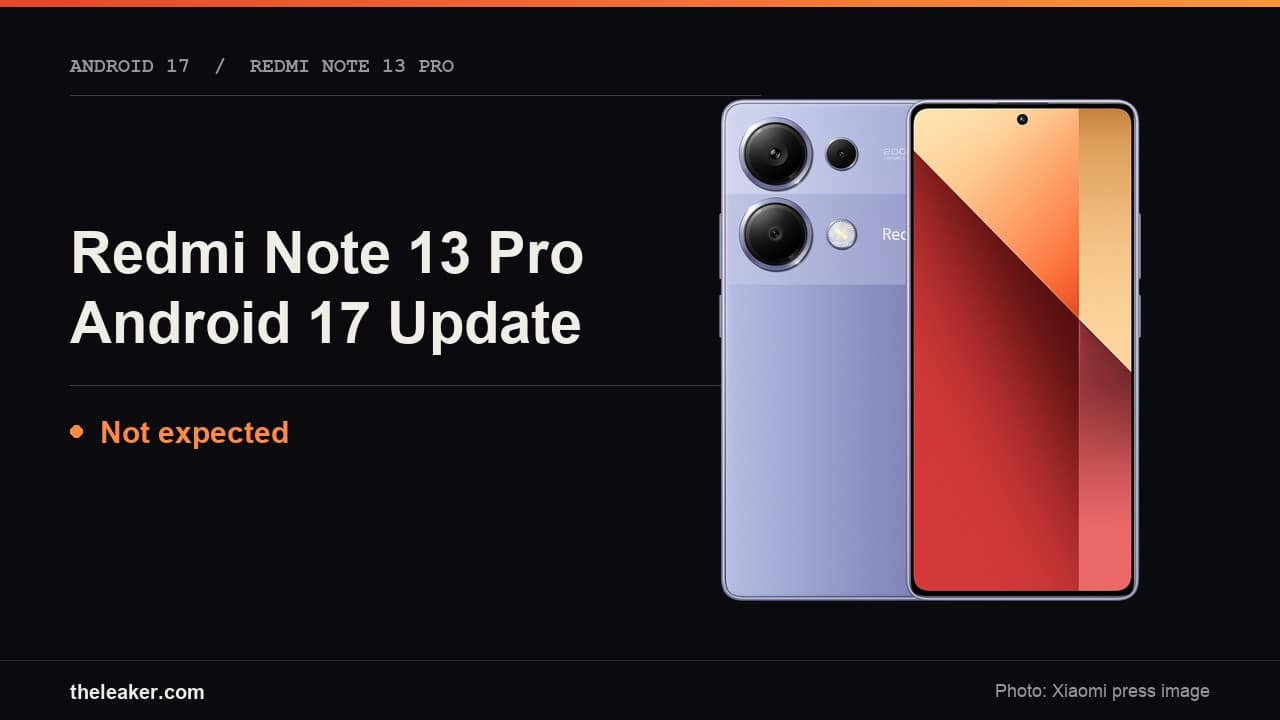
Android 17 is not expected on the Redmi Note 13 Pro. The phone has already used up the three major upgrades it launched with, which is a different situation from a delayed rollout, and the big eligibility lists are bad at showing the difference.
The quick answer: No. The Redmi Note 13 Pro shipped on Android 13 carrying a three-major-upgrade commitment, so Android 16 is the last major version Xiaomi has promised it, and Android 17 sits one step past that promise. A commitment sets a floor. It is what the published policy guarantees, and Xiaomi has never issued a statement ruling Android 17 out. One scoping point before the arithmetic, because it decides how much weight this carries for you. The pages where Xiaomi publishes an update count are its India ones. Its global Note 13 Pro 5G spec sheet lists the operating system as MIUI 14 and gives no upgrade count at all, so the figure below is documented for the India SKUs and is an inference for the global ones. Xiaomi publishes it for two of the three variants: its spec sheets for the Note 13 Pro 5G and the Note 13 Pro+ 5G both read “3 Major Android Updates | 4 Years Security Patch Updates”. For the 4G Pro, Xiaomi’s own spec sheet lists the operating system and no upgrade count, so that variant rests on secondary reporting: GSMArena records “up to 3 major OS updates” for the 4G model, 23117RA68G. Don’t read the HyperOS 4 lists as the answer here, in either direction. Xiaomi shipped Android 17 to the Xiaomi 17 series in July on HyperOS 3.3, not on HyperOS 4, so the version of the skin and the version of Android move independently and a phone’s absence from a HyperOS 4 roster proves nothing about Android 17. The update count is the evidence that matters. For what it’s worth the phone is also absent from those rosters, which start at the Redmi Note 14. Android 16 is the last major version this phone gets. Security patches run four years from launch on the two variants Xiaomi publishes a figure for, which runs past the final OS version. That’s the promise, not a statement about your handset. Check the security patch level in Settings to see what yours has actually received.
Why the answer is no
The arithmetic is straightforward once you know where the phone started, and it is the same for the Pro, the Pro 5G and the Pro+.
| Stage | Version |
|---|---|
| Launched on | Android 13 |
| First major update | Android 14 |
| Second major update | Android 15 |
| Third and final major update | Android 16 |
| Android 17 | Not expected |
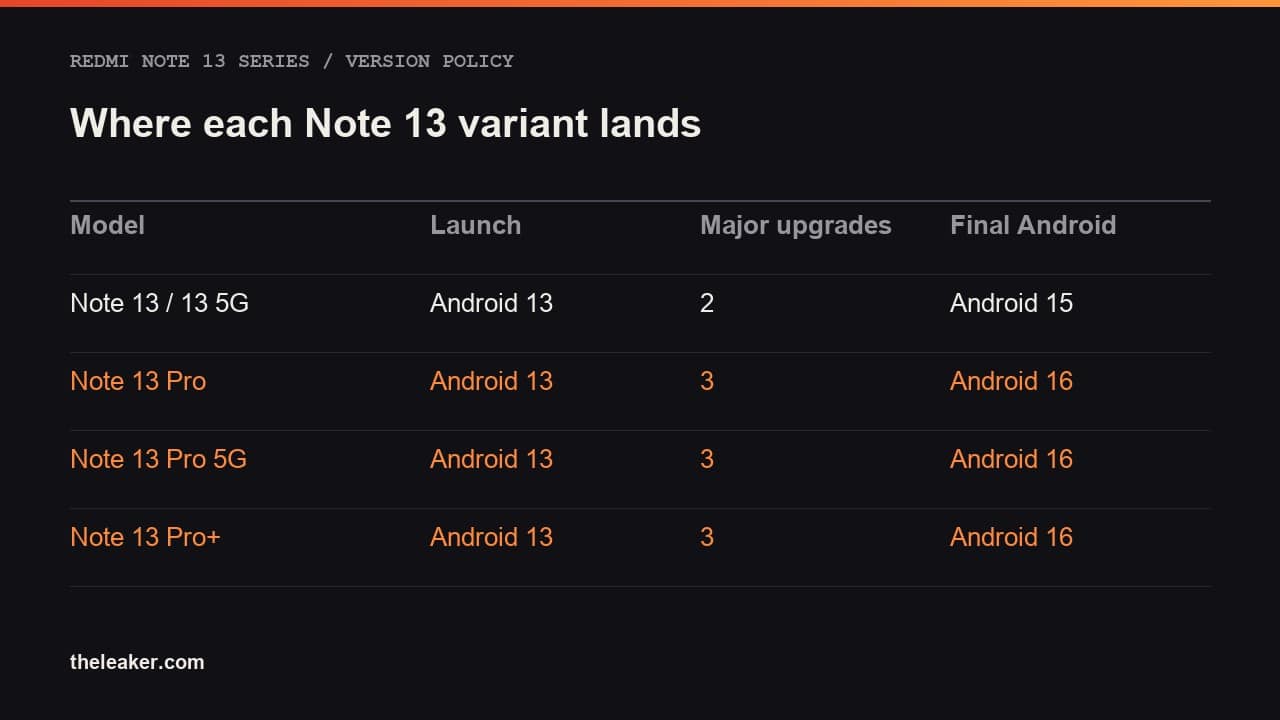
Three major versions was the commitment for this higher tier when the phone launched. Xiaomi’s own spec sheets for the Pro 5G and the Pro+ 5G both state three major Android updates and four years of security patches, and Android Authority’s roundup of manufacturer update policies records the same three upgrades for the Pro+. The 4G Pro is the variant Xiaomi does not publish a count for, and its three-upgrade figure comes from GSMArena’s spec sheet rather than from Xiaomi. Xiaomi has since improved the policy on newer models, and those improvements are not applied retroactively, which is the detail that trips people up. A phone bought in 2024 is held to the 2024 promise, not the 2026 one.
This applies across the higher tier of the Note 13 family. The Note 13 Pro 4G (23117RA68G), the Note 13 Pro 5G (2312DRA50G global, 2312DRA50I India) and the Note 13 Pro+ 5G (23090RA98G, 23090RA98I) all shipped on Android 13 with three upgrades, and all three land on Android 16. Check the model number under Settings if you are unsure which one you have, because the marketing name alone does not tell you. The base Note 13 sits on a lower tier, where GSMArena records up to 2 major OS updates for the 2312DRAABG, stopping it a version earlier at Android 15. See our breakdown of the standard Note 13 for that side of the family.
Why the eligibility lists confuse this
One rebadge is worth clearing up first, because it puts this phone on an Android 17 list under a different name. The Redmi Note 14S sold in Europe is this same hardware rebadged, and it is expected to get HyperOS 4. That does not carry over. The 14S launched in 2025 as a new retail model, and a commitment attaches to the model as sold rather than to the silicon inside it, so its clock starts at its own launch. Xiaomi has not published an upgrade count for it. Its global spec sheet names the OS and stops there, and MIUIROM currently has the 14S marked as in question, so its own status is unsettled either way. If you own a Note 13 Pro, the 14S row on any list is not your row.
Most Android 17 lists are organized by brand and run to sixty or more rows. Two things go wrong in that format.
First, they group by series. A line reading “Redmi Note 13 series” tells you nothing about whether your specific Pro, Pro 5G or Pro+ is included, and in practice the variants within a series do sometimes diverge.
Second, and more importantly, they list what is included and stay silent about what is not. If your phone simply is not on the page, you cannot tell whether that means “excluded” or “not yet confirmed”. For a phone at the end of its cycle those are completely different answers, and the silence is why this question keeps getting asked.
Here the silence lines up with the version arithmetic rather than contradicting it. The phone has had its three upgrades, so there is nothing left in the commitment for Android 17 to come out of.
What you still get, and it is more than people assume
The end of OS updates is not the end of support, and the distinction genuinely matters.
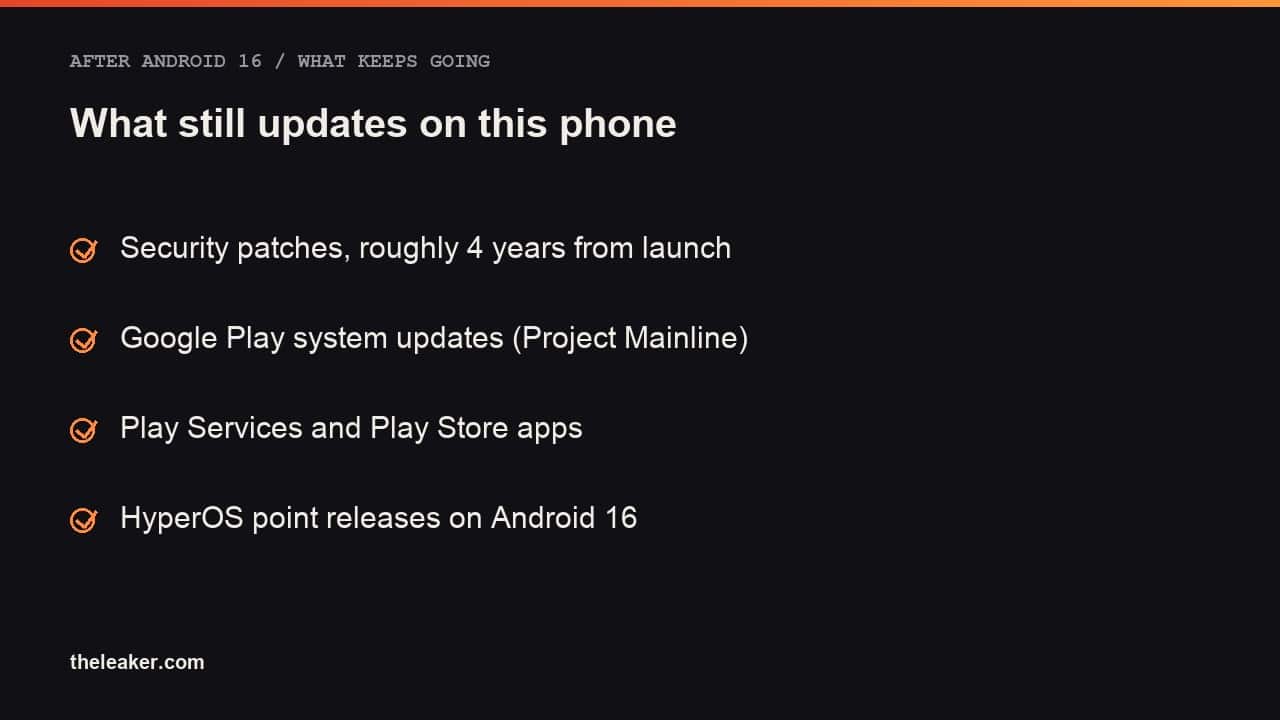
- Security patches continue. These are the updates that actually protect you. Xiaomi’s spec sheets promise four years of them from launch on the Pro 5G and Pro+ 5G, running past the last major version on their own schedule. Day to day, patches matter more than version numbers.
- Google Play system updates keep arriving. Since Project Mainline, Google ships selected platform modules through the Play Store instead of through full OS updates, so components like media handling and connectivity can keep updating without a version bump. Which modules a given phone receives is up to what it ships with, so treat this as a cushion and not a guarantee.
- Most apps keep working. Developers target a wide range of Android versions, and Android 16 should stay a mainstream target for years. Support fades gradually. Individual apps do eventually raise their minimum.
- Play Services updates independently, which covers a large slice of what people think of as “Android” features.
How to confirm it yourself
Do not take any list on trust, including this one. Check the phone.
- Settings, then About phone. Note the exact model name and the current Android version.
- Tap HyperOS version, then Check for updates.
- Check the security patch date under Android security update. That date tells you how current your patches are. It is not the phone’s end-of-support date, which is a separate thing Xiaomi publishes per model, so read the two separately and don’t infer one from the other.
That last step is the one worth repeating, because a recent patch date is the real health indicator. A phone on Android 16 with a current patch is in better shape than a phone on Android 17 that has not been patched in a year.
One extra check worth making on Xiaomi phones specifically: the version string also carries a region identifier. China and global builds are separate software tracks with different rollout schedules, so a gray-import Note 13 Pro may be on a track this article is not describing.
What not to do
Do not install a custom ROM to chase the version number unless you actively want to maintain the phone yourself. Unlocking the bootloader on a Xiaomi device wipes it, can stop banking and payment apps that check device integrity from running, and usually hands you the job of applying security patches, though some maintained ROMs ship their own. For most people that is a downgrade in real safety in exchange for a higher number on the About screen.
Do not install anything offering “Android 17 for Redmi Note 13 Pro” as a download. Official updates arrive over the air, signed for your exact model and region. Nothing on a file mirror is the update.
Do not cross-flash regional firmware. Moving between Chinese and global builds is a common way to lose VoLTE, break apps, or brick the phone.
Should you upgrade the phone?
Not on this news alone. A Note 13 Pro that holds charge and runs smoothly has years of practical life left, and the security patches are still coming.
The signals actually worth acting on are different ones: the security patch date falling more than six months behind, battery health dropping to the point of daily inconvenience, or an app you depend on raising its minimum Android version. None of those is triggered by Android 17 shipping to other phones.
If you do decide to replace it, the lesson from this page is worth carrying into the purchase. Check the update commitment for the exact model before buying, not the series, and remember that a longer promise on a newer phone does not extend to the one you already own.
Frequently asked questions
Is the Redmi Note 13 Pro getting Android 17?
It is not. The phone shipped on Android 13 with a three-major-upgrade commitment, which ends at Android 16, and it does not appear on the HyperOS 4 eligibility lists that begin at the Redmi Note 14.
What about the Note 13 Pro+ and the Note 13 Pro 5G?
Same three-upgrade commitment, same result, and these are the two variants Xiaomi states it for on its own product pages rather than leaving it to spec databases. Both land on Android 16 and are absent from the Android 17 rosters, same as the 4G Pro. Owners of a Pro+ can confirm the variant by the model number 23090RA98G or 23090RA98I on the box and under Settings, and there is a China-market 23090RA98C on a separate software track.
Will my phone stop getting security updates too?
No. Security patches continue past the final OS version. Xiaomi’s spec sheets commit to four years from launch on the Pro 5G and Pro+ 5G; Xiaomi’s 4G Pro specification page does not state a major-upgrade count, but that is not the same as publishing nothing: Xiaomi’s Product Software Support Information page lists a security-update end-of-life date per phone, so look your exact model up there and treat that date as the thing to watch. Check that date under Settings, then About phone.
Could Xiaomi change its mind?
It is possible but unlikely. Manufacturers occasionally extend support, though it is rare for a device already at the end of its stated policy. Treat an extension as a bonus rather than something to plan around.
Is Android 16 still safe to use?
Yes. Being one version behind is not a security problem in itself. An unpatched phone is the problem, and a patched Android 16 device is in good shape.
Changelog
- 13 August 2026: Page published.
Checking another device? See our Xiaomi, Redmi and POCO Android 17 update tracker for the full list, or the Android 17 update tracker for every brand.
Updated 24 August 2026: Xiaomi announced HyperOS 4 on 13 August and opened a staged China beta on 14 August. There’s no Redmi Note in any of the three waves, which is consistent with what this page already said. The answer for the Note 13 Pro doesn’t change, and it rests on the phone’s three-major-upgrade commitment rather than on the beta schedule.
Also 24 August 2026. An outside review with web access went through the page. The biggest correction lands on the reasoning, not the answer. HyperOS 4 rosters were being read as evidence about Android 17, and they are not, because Xiaomi delivered Android 17 to its flagships in July on HyperOS 3.3. The update-count commitment is what carries the verdict, so that is what the page now leans on. The verdict is now stated as an expectation, because a three-upgrade promise guarantees a floor and says nothing about a ceiling. The security section no longer tells you the phone is safe, because that is a claim about your handset, and a vendor promise cannot support one. It also keeps the patch level and the end-of-support date apart now.
Third pass, 24 August 2026. Three more corrections from the same review. The update count Xiaomi publishes is on its India spec pages, and its global page for the Pro 5G gives no count at all, so that scope is now stated instead of glossed. The Note 14S no longer gets credited with a published commitment, because Xiaomi has not published one for it. And the Project Mainline and app-compatibility lines are softened from guarantees to what they actually are, which is a cushion that fades rather than a floor that holds.

I am the chief editor of TheLeaker. I also maintain the backend stuff of the site. I’m a tech enthusiast and loves to do Python coding in my free time. I have worked at many giant publications like XDA Developers and NXTtech before starting TheLeaker.
You can get in touch with me at Garv[at]theleaker.com.