
Buying a refurbished phone can get you the best value in tech: last year’s flagship for mid-range money, working perfectly, with a warranty. It can also get you a stolen handset with a swollen battery and a fake grade sticker.
The gap between those two outcomes isn’t luck. It’s almost entirely down to who you buy from and what you check in the first hour.
The quick answer: The seller matters more than the phone. A manufacturer-certified or major-retailer refurbished unit with a real warranty and a stated return window is a genuinely good buy. You’re getting tested hardware at a discount, and the warranty is what makes the risk acceptable. A cheap listing from an unknown marketplace seller with vague grading and no returns is a gamble. Before you buy, confirm four things: a warranty of at least a few months, a clear return policy, an explicit statement about battery health, and whether the phone is carrier-locked or blacklisted. Then, the moment it arrives, check the IMEI, confirm no account locks, test every port and camera, and check the battery. Do that inside the return window and you’ve removed almost all the downside.
What “refurbished” actually means (and why it means nothing on its own)
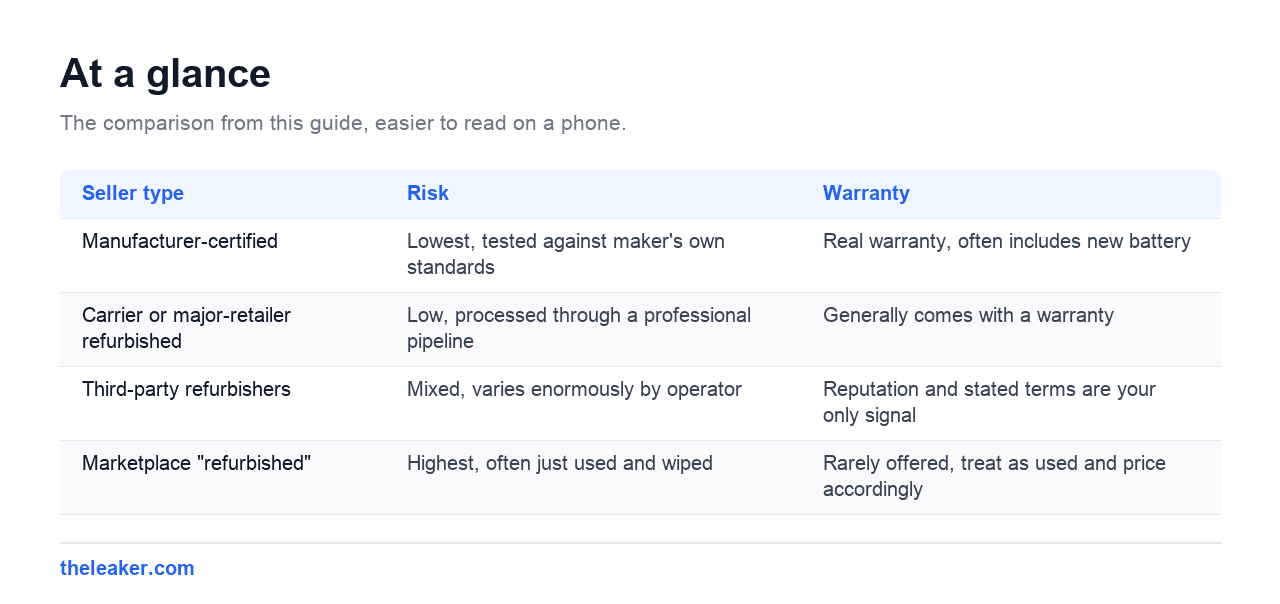
| Seller type | Risk | Warranty |
|---|---|---|
| Manufacturer-certified | Lowest, tested against maker’s own standards | Real warranty, often includes new battery |
| Carrier or major-retailer refurbished | Low, processed through a professional pipeline | Generally comes with a warranty |
| Third-party refurbishers | Mixed, varies enormously by operator | Reputation and stated terms are your only signal |
| Marketplace “refurbished” | Highest, often just used and wiped | Rarely offered, treat as used and price accordingly |
There’s no universal legal definition. “Refurbished” is a word sellers apply to wildly different things, and you need to know which kind you’re looking at.
Manufacturer-certified. The phone went back to the maker or an authorised partner, was tested against their standards, had failing parts replaced with genuine components, and comes with a real warranty. Most expensive, least risky. Often includes a new battery and new outer shell, which is why these can be indistinguishable from new.
Carrier or major-retailer refurbished. Returns and trade-ins processed through a professional pipeline, graded, and sold with a warranty. Quality is generally good and the discount is better. Parts may or may not be original: worth asking.
Third-party refurbishers. A large and very mixed category. Some are excellent operations with genuine testing and decent warranties. Others buy job lots, wipe them, and pass them on. Reputation and warranty terms are your only signal.
“Refurbished” on a marketplace listing. Frequently means “used, and I wiped it.” Treat this as used, priced accordingly, and buy only with strong buyer protection.
A useful shorthand you’ll see in some regions: renewed and refurbished are often used interchangeably by retailers, and neither word guarantees anything specific. The warranty terms tell you what you’re getting. The adjective doesn’t.
Reading the grade
Most sellers grade cosmetics on an A/B/C or “excellent/good/fair” scale. These scales are not standardised between sellers: one company’s Grade B is another’s Grade A.
What matters:
- Grading almost always describes cosmetic condition only. It says nothing about battery health or internal repairs.
- Lower cosmetic grades are often the best value. Scratches on the back, under a case, that you will never see. If you use a case and screen protector, buying the ugliest working grade is a legitimate strategy.
- Screen condition is the exception. Scratches on the display you will notice every day. If a grade allows visible screen marks, weigh that differently from body scuffs.
The five things to check before you pay
1. Warranty length, in writing. This is the single most important line in the listing. A meaningful warranty (several months at minimum, ideally a year) means the seller has skin in the game and expects the phone to work. No warranty means they don’t. Price should reflect that gap, and usually the “bargain” listing doesn’t discount nearly enough to compensate.
2. Return window. A no-questions return period of a couple of weeks is what lets you actually test the thing. A seller confident in their process offers one.
3. Battery status. Ask directly: is the battery new, or is there a stated minimum health percentage? Good refurbishers either replace batteries or guarantee a floor. Silence on this point usually means the original battery, at whatever condition it happened to be in. Since the battery is the part of a used phone most likely to be worn out, this matters enormously.
4. Lock status. Two different locks to worry about. Carrier lock means the phone only works on one network: check whether it’s stated as unlocked. Account lock is the serious one: if a phone still has the previous owner’s account attached, factory resetting doesn’t help and the device is effectively a paperweight. Reputable sellers clear this. Marketplace sellers sometimes don’t know or don’t say.
5. Update support remaining. A refurbished phone is by definition not new, so part of its software support window is already spent. Look up the model’s launch date and the manufacturer’s stated support policy for that specific model, then work out what’s left. A great price on a phone with a year of patches remaining is a worse deal than it looks. Support policies vary a lot by brand and have been changing, so check the maker’s own page rather than assuming.
What to test the hour it arrives
Do all of this immediately, while you can still return it. It takes about twenty minutes.
- Check the IMEI. Dial
*#06#to display it. Run it through a reputable IMEI checker to confirm it isn’t reported lost or stolen, and check it’s not blacklisted on carrier networks. Confirm it matches the number on the box and in Settings. A mismatch is a serious red flag. - Confirm no account lock. The phone should boot to a clean setup screen with no request for someone else’s credentials. If it asks for a previous owner’s account, return it immediately. Don’t accept “I’ll send you the password.”
- Verify the model in Settings. Check that the model number, storage capacity and Android version match what you paid for. Counterfeit and misrepresented listings exist, especially at the cheap end.
- Test every camera. Front, rear, and each rear lens individually: ultrawide and telephoto are commonly damaged and rarely checked. Shoot a photo and a video with each. Look for dust specks inside the lens and check autofocus actually locks.
- Test the screen properly. Display a full-white image and a full-black image at full brightness. Look for dead pixels, dark patches, uneven backlighting, and on OLED panels, burn-in: faint ghosting of a keyboard or status bar. Then drag a finger slowly across the entire surface to find dead touch zones.
- Test all the ports and buttons. Charge it. Plug in headphones if there’s a jack. Press every physical button. Test the fingerprint sensor and face unlock. Insert your SIM and make a real call: check the earpiece, the speakerphone, and the microphone by recording a voice memo.
- Test the radios. Wi-Fi, Bluetooth to a real device, GPS with a maps app until it gets an accurate fix, and NFC with a payment or tag if you use it.
- Check the battery. Some Android phones expose battery health in Settings; many don’t. If yours doesn’t, do it empirically: charge to full, then use the phone normally for a day and watch the drain. A battery that drops alarmingly fast, or a phone that gets unusually hot while charging, is telling you something. If it runs hot, work through the usual overheating causes first to rule out a rogue app before blaming the hardware.
- Look for physical warning signs. Gaps between the screen and the frame, a back panel that doesn’t sit flush, or any bulge. These can indicate a swollen battery, which is a stop-using-it-now problem, not a cosmetic one.
Red flags that should end the transaction
- Price far below every other listing. Refurbished pricing is fairly efficient. A price that’s dramatically lower than the market usually means stolen, locked, counterfeit, or badly broken.
- No warranty and no returns. Combined, these mean you’re buying blind with no recourse.
- Seller wants payment outside the platform. Bank transfer, gift cards, or “let’s do this off-site” removes your buyer protection. That’s the entire point of the request.
- Vague or evasive answers about lock status or battery. A professional refurbisher answers these instantly because they check them as standard.
- Stock photos only, or photos that don’t match the description. You should see the actual unit, or be buying from an operation large enough that stock photos are normal and the warranty covers you.
- Pressure and urgency. “Three other people are asking” is a sales technique, not information.
Frequently asked questions
Is buying a refurbished phone actually worth it?
From a reputable seller with a warranty, yes. It’s one of the better value plays in tech. You typically get a phone one or two generations old, professionally tested, for a substantial discount, and the hardware in that tier is still excellent. The savings are real and the risk is manageable. The caveat is that the discount comes partly out of your software support window, since the model’s update clock started at its launch, not at your purchase. Factor that in and the maths usually still works.
What’s the difference between refurbished and renewed?
In practice, very little: different retailers use different words for similar programmes, and neither term has a fixed legal meaning. What actually distinguishes one listing from another is the warranty length, the return policy, and whether the seller states anything specific about battery replacement and testing. Ignore the adjective and read those three things instead.
How can I tell if a refurbished phone is stolen?
Check the IMEI. Dial *#06# to display it, then run it through a reputable IMEI checking service to see whether it’s reported lost or stolen or blacklisted by carriers. Also confirm the phone isn’t tied to a previous owner’s account, if setup asks for someone else’s credentials, that’s a phone that either was never properly released or wasn’t the seller’s to sell. Do both checks inside your return window.
Should I worry about the battery in a refurbished phone?
It’s the part most worth asking about. Batteries are consumable, and a phone that’s been in use for a couple of years may have meaningfully reduced capacity even if everything else is perfect. Good refurbishers either fit new batteries or publish a minimum health guarantee. If a listing says nothing about the battery, assume it’s the original one. A replacement battery is a fairly cheap service, so if the phone is otherwise a bargain, factor that cost in rather than walking away.
The bottom line
Refurbished phones are a genuinely good idea badly served by a market with no shared standards. The device you receive can be indistinguishable from new or it can be somebody else’s problem, and the listing often reads the same either way.
So stop evaluating phones and start evaluating sellers. Warranty length, return window, and a straight answer about the battery and lock status. Those three things tell you more than any grade sticker. Buy from someone who offers all three, run the twenty-minute checklist the day it lands, and you get the value without the gamble. Once it passes, moving your data across is the easy part.
Related: How Much RAM and Storage Do You Actually Need in a Phone? · How Long Will Your Phone Get Updates? Android Support Explained

Hola everyone! I’m Sajid and I’m a typical freelance Graphic Designer with a keen interest in technology and science stuff. I actually like to write about the recent happenings around the world of technology as a part of The Leaker.