
A VPN encrypts the connection between your device and its own server, hides your IP address from sites you visit, and lets you appear to be browsing from a different location. It does not make you anonymous, it will not stop ads or tracking on its own, and its legal status varies by country. The ten facts below cover what a VPN actually does before you pick one.
This is the quick-facts version. For how a VPN’s encryption and protocol actually work, see what a VPN is. For an honest look at whether you need one at all, see do you actually need a VPN on your phone. For the specific task of unblocking a site, including a country-by-country legal table, see how to use a VPN to access blocked websites.
1. It encrypts your connection to the VPN server, not the whole journey
Your device and the VPN’s server exchange encrypted traffic, so your ISP and anyone on the same network cannot see which sites you visit. Once your traffic leaves the VPN server heading to the actual website, ordinary HTTPS encryption, which most sites already use, takes over from there.
2. It replaces your IP address with the VPN server’s
Sites see the server’s address and location instead of yours. This is the mechanism behind both privacy and geo-unblocking, and it is the entire product: everything else follows from this one substitution.
3. It does not make you anonymous
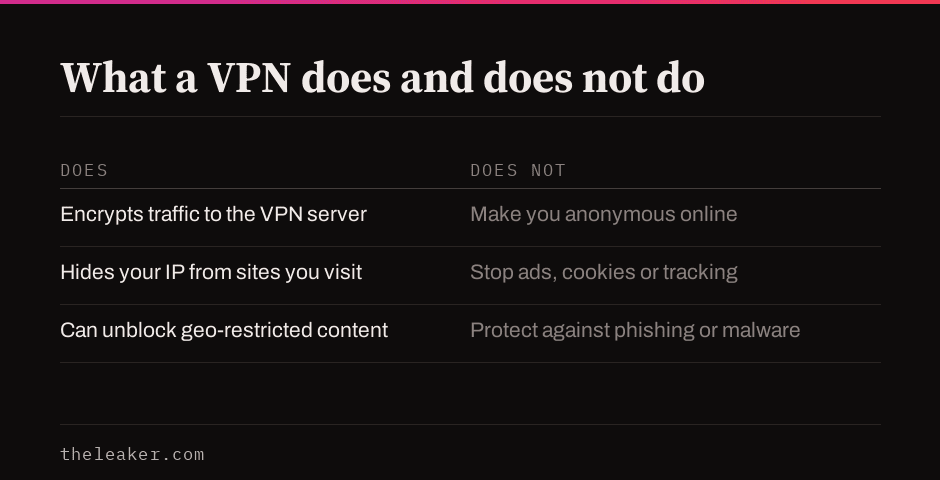
Changing your IP address does nothing if you are logged into Google, your email, or your bank the whole time. The Electronic Frontier Foundation is blunt about this: a VPN hides your traffic from your network operator, not your identity from the services you are already signed into.
4. It can unblock geographically restricted content, with real legal variation
A VPN can make your connection appear to originate from another country, which unblocks content restricted by region. Whether doing this is legal, restricted, or against a service’s own terms depends heavily on the country and the service. Our full breakdown covers this country by country.
5. Free VPNs carry a documented, not just theoretical, risk
In May 2024 the US Department of Justice dismantled a botnet built by distributing free VPN apps that secretly turned 19 million devices into a proxy network without their owners’ knowledge. A 2025 investigation separately found more than a dozen popular free VPN apps on major app stores with undisclosed ties to a sanctioned company. This has actually happened, more than once, not just a hypothetical.
6. It will slow your connection down, at least a little
Routing traffic through an extra server adds distance and encryption overhead. Modern protocols like WireGuard, which most current VPN apps use by default, have made this far less noticeable than it used to be, but a small slowdown is still normal and expected.
7. Most VPNs cover every device you own
A single subscription typically covers phones, computers, tablets, and sometimes a router configuration, so you are protecting one account rather than buying separate licenses per device.
8. Its legal status genuinely depends on where you are
VPN use is legal in most of the world. It is restricted or requires state approval in a handful of countries, and the specifics differ enough between them that treating “some countries ban VPNs” as one fact is not accurate enough to act on. Check current law for your specific country before relying on one to bypass a government block.
9. It is not a substitute for basic security habits
A VPN does not stop you from typing your password into a phishing page, does not scan for malware, and does not protect an account with a weak or reused password. Treat it as one layer among several, never as the only one.
10. A VPN alone will not get you cheaper prices
The claim that connecting through a VPN unlocks cheaper flights or subscriptions by hiding your location is mostly outdated. A 2025 investigation found only a handful of airlines showed any measurable price difference by location at all, and where it existed the saving was small enough that currency conversion fees usually erased it.

I am the chief editor of TheLeaker. I also maintain the backend stuff of the site. I’m a tech enthusiast and loves to do Python coding in my free time. I have worked at many giant publications like XDA Developers and NXTtech before starting TheLeaker.
You can get in touch with me at Garv[at]theleaker.com.