
A VPN unblocks a website by routing your connection through a server elsewhere, so your ISP and the site itself see the VPN server’s location instead of yours. Pick a reputable provider, install its app, connect to a server outside the block, and the site loads normally. This defeats the two most common blocking methods, DNS and IP blocking, and most SNI-based filtering too. It does not reliably defeat the most advanced state-level filtering, which is a separate problem covered below. Before using a VPN to route around a government block specifically, check your country’s actual law: the rules vary enormously and are not the same everywhere, covered in the table further down.
This page covers the specific mechanics of unblocking a site. For what a VPN actually does and does not protect you from day to day, see our honest answer on whether you need a VPN on your phone. For the protocol and encryption details, see what a VPN is and how it works. For a beginner’s overview in ten short facts, see our 10 things to know about VPNs.
Why a website gets blocked in the first place
Three different mechanisms cause most blocks, and a VPN handles them differently.
DNS blocking. Your ISP’s DNS server, the directory that turns a domain name into an address, simply refuses to answer for a blocked domain, or answers with the wrong address. A VPN routes your DNS lookups through its own tunnel instead, bypassing your ISP’s directory entirely.
IP blocking. A firewall drops any connection heading to a specific address. A VPN defeats this because your traffic now heads to the VPN server’s address first, and the destination site never sees your original connection attempt at all.
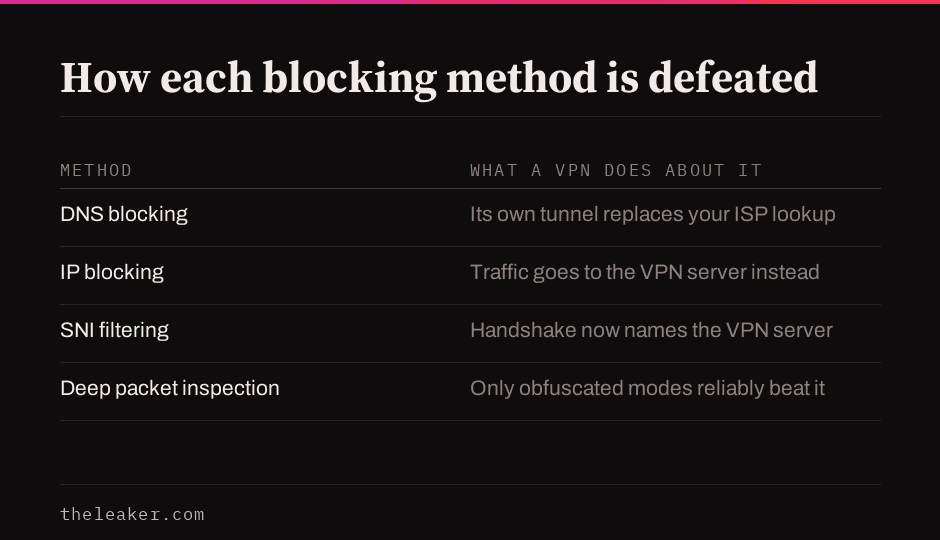
SNI-based filtering. This one is less well known and worth understanding, because it explains a lot of “why did that suddenly stop working” cases. When your browser connects to an encrypted site, it briefly announces the site’s name in plain text before encryption kicks in, called Server Name Indication. A network-level filter can read that one plain-text field and kill the connection without decrypting anything else. A VPN defeats this too, because the SNI a censor sees now belongs to the VPN’s own server, not the site you are actually visiting.
Where a VPN stops working: deep packet inspection
The most restrictive networks go a step further and try to detect the VPN itself, not just the site behind it. China’s Great Firewall is the best-documented example: research published at USENIX Security 2025 found it decrypts the initial handshake packets of QUIC connections at scale, specifically hunting for the traffic patterns of circumvention tools, and imposes a temporary block on any address it catches doing this. This is why VPNs marketed for use in China run special obfuscated modes that disguise VPN traffic as ordinary web traffic, and why an ordinary VPN connection that works everywhere else can fail there specifically. Outside a small number of countries with this level of filtering, a normal VPN connection is enough.
Setting up a VPN to unblock a site
- Pick a provider with a server in the right place. If a site is blocked in your country specifically, any server outside your country usually works. If you need to appear to be in one specific country, confirm the provider has a server there.
- Install the app from the provider’s own website or your device’s app store, not a third-party download site.
- Connect to a server in the location you need. Most apps show this as a map or a country list.
- Reload the site. If it still does not load, see the troubleshooting section below before assuming the VPN itself is broken.
Where this is legal, restricted, or risky
VPN use itself is legal in most of the world. Specific countries restrict or ban it, and the rules differ enough between them that treating them as one category is a real mistake. Check your own country’s current law before relying on a VPN to reach government-blocked content specifically.
| Country | Status |
|---|---|
| China | Unauthorized VPN use to reach blocked sites is illegal. Only state-approved VPNs for licensed business use are lawful. An amended Cybersecurity Law effective January 2026 raised penalties and extended enforcement to VPN providers themselves, including foreign ones. |
| Russia | Individual use is not itself a criminal offense and no one has been convicted solely for using one, but hundreds of VPN services and the most common VPN protocols are actively blocked, and advertising a VPN is banned outright. |
| United Arab Emirates | VPN use itself is legal under UAE federal law. It becomes illegal specifically when used to commit or conceal another crime, most commonly using it to make unlicensed VoIP calls through apps not approved by the local telecoms regulator. |
| Oman | Not banned as of mid-2026, but the regulator has publicly warned against unauthorized VPN use and a proposal to formally restrict individual use was under public consultation as of May 2026. |
| Turkmenistan, Belarus, Iraq | Widely reported as banned or heavily restricted with fines for use, though the primary legal text is harder to source than for the countries above; treat this as consistent industry reporting rather than a government citation. |
Streaming sites specifically
Netflix’s own help page states plainly: “VPN apps or services can make your device or network look like it’s connecting from somewhere other than your physical location and can cause this error or other issues,” and that VPN use is unsupported for live events and its ad-supported tier. Streaming services detect VPN traffic mainly by checking your IP address against commercial databases that catalogue known VPN and data-centre IP ranges, which is why a VPN server used by thousands of other people is more likely to already be flagged than one you have exclusively.
When the VPN is connected but the site still will not load
Three distinct problems get lumped together as “the VPN isn’t working,” and they need different fixes.
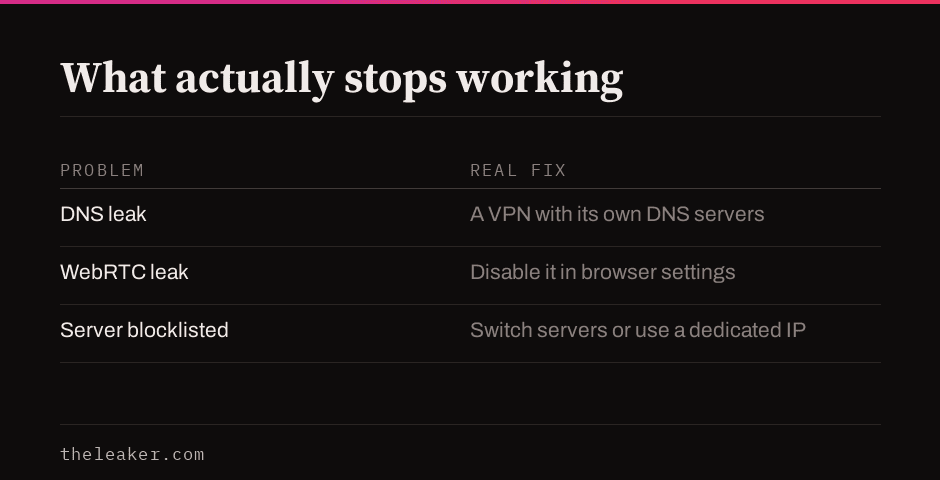
A DNS leak happens when your device keeps sending DNS lookups to your normal network’s DNS server instead of the VPN’s, often because Windows queries every network interface at once and uses whichever answers first. The fix is a VPN that routes DNS through its own servers rather than the system default; test at a site like dnsleaktest.com and switch providers if it consistently leaks.
A WebRTC leak happens because your browser can be asked, via ordinary JavaScript, for your real network address for video-call purposes, and it complies without asking you, regardless of whether a VPN is active. Chrome and Edge do not have a built-in toggle for this and need an extension; Firefox can disable it in about:config; Brave routes it through the VPN by default.
The destination has blocklisted that specific server, which is not a leak or a misconfiguration at all, just the site correctly recognising a known VPN IP address and refusing it. Switching to a different server in the same country, or to a provider offering dedicated IP addresses rather than one shared by many users, is the actual fix here.
Free VPNs: what actually goes wrong, not just the theory
The theoretical risk of a free VPN logging or selling your traffic is well known. What is less often cited is that it has happened, with names attached. In May 2024, the US Department of Justice dismantled a botnet built by distributing free VPN apps that secretly turned 19 million devices across more than 190 countries into a proxy network for other people’s traffic, without their owners’ knowledge. Separately, a 2025 investigation by the Tech Transparency Project found more than a dozen popular free VPN apps on both major app stores with undisclosed ties to a sanctioned Chinese cybersecurity firm, still available after being reported. Neither of those is a hypothetical.
What VPNs are actually good for, and one popular claim that is not true
Beyond unblocking sites, the two legitimate uses the Electronic Frontier Foundation names are accessing your organisation’s internal network while travelling, and reaching content that is geographically restricted. One popular claim does not hold up under current testing: that connecting through a VPN gets you cheaper flights by hiding your location from the airline. A 2025 investigation found only a small handful of airlines showed any measurable price difference by location at all, and where it existed it averaged around 4% before currency conversion costs, which usually erases the saving. Treat that advice as mostly retired.
Frequently asked questions
Will any VPN work for any blocked site? For DNS, IP, and most SNI-based blocking, yes. Against country-level deep packet inspection in places like China, only providers running specific obfuscated modes built for that purpose reliably work.
Is it illegal to use a VPN to watch a show not available in my country? It is not a criminal matter anywhere covered above, but it is against the terms of service of most streaming platforms, which is a contract issue with the platform rather than a legal one.
Why did my VPN suddenly stop unblocking a site it used to work on? The site most likely added the VPN server’s IP address to its blocklist after enough other people were also caught using it. Switching servers within the same VPN app usually restores access immediately.

I am the chief editor of TheLeaker. I also maintain the backend stuff of the site. I’m a tech enthusiast and loves to do Python coding in my free time. I have worked at many giant publications like XDA Developers and NXTtech before starting TheLeaker.
You can get in touch with me at Garv[at]theleaker.com.
Comments are closed.