
Play Store errors have terrible manners: a cryptic code, a failed download, and no explanation. The good news is that behind the dozens of different codes (495, 505, 927, DF-DFERH-01 and friends) there are really only about five underlying problems, and the same short ladder of fixes clears almost all of them. This guide gives you the universal fix ladder first, then a code-by-code reference for the stubborn cases.
The quick answer: most Google Play Store errors, regardless of the code, are fixed by the same sequence: check your connection and date/time settings, clear the Play Store’s cache and data, clear Google Play Services’ cache, uninstall and reinstall Play Store updates, remove and re-add your Google account, and free up storage if you’re above 90% full. Work through those six steps in order and the vast majority of download and install errors disappear without anything as drastic as a factory reset.
The universal fix ladder (works for almost every code)
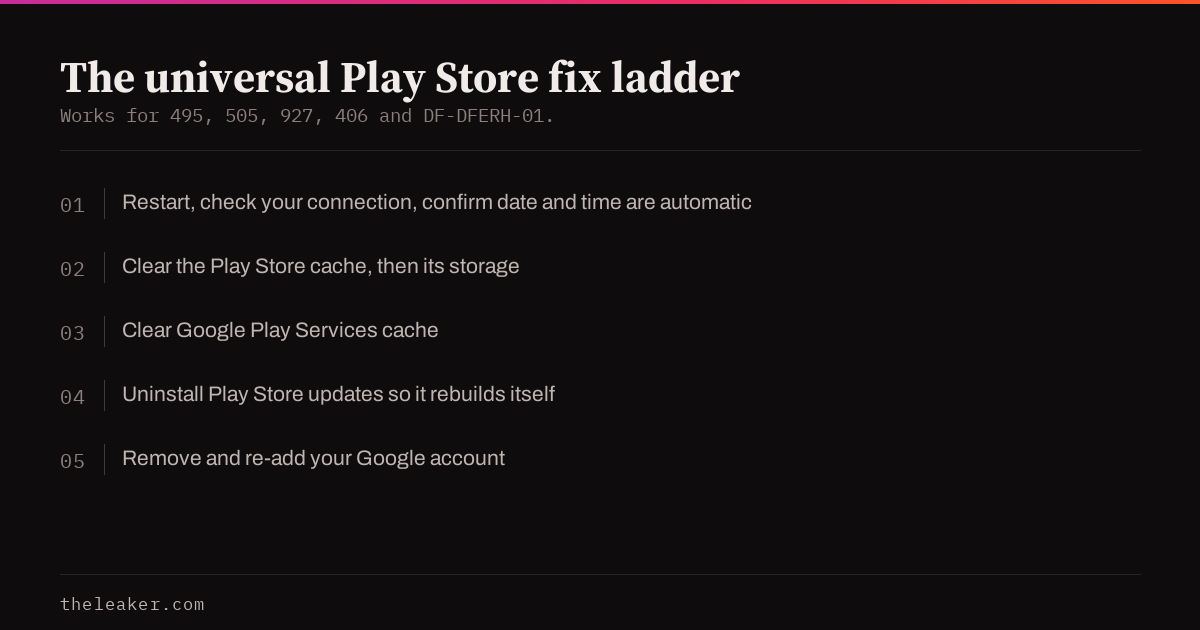
Do these in order: each step takes a minute or two, and stop as soon as your download works.
Step 1: The boring basics
- Restart the phone. Genuinely fixes a surprising share of Play Store errors by resetting stuck services.
- Check your connection. Switch between Wi-Fi and mobile data and retry. Downloads that fail only on Wi-Fi often point at router or DNS trouble: see our connection troubleshooting guide.
- Check date and time. Settings → System → Date & time → turn on automatic. A wrong clock breaks the secure connection to Google’s servers and produces some of the weirdest errors on this page.
Step 2: Clear the Play Store’s cache, then data
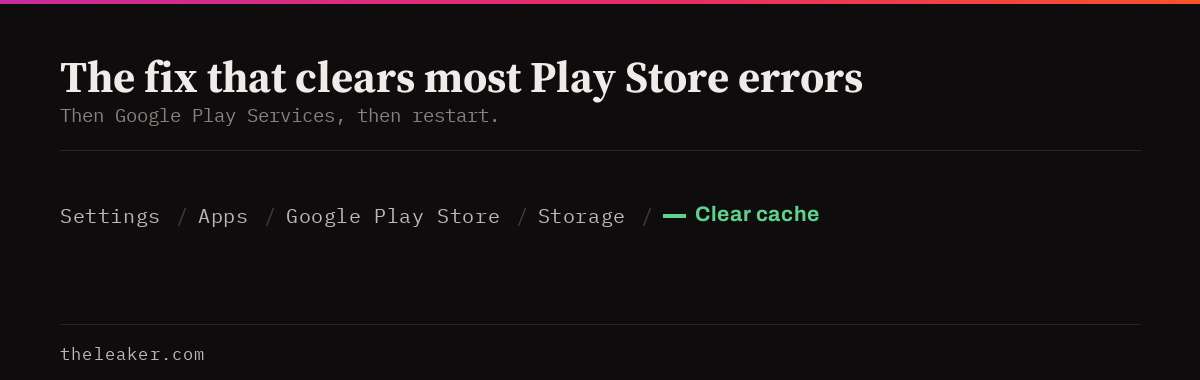
- Go to Settings → Apps → Google Play Store → Storage.
- Tap Clear cache, reopen the Play Store, retry.
- Still failing? Return and tap Clear storage/Clear data. This resets the Store app itself (your installed apps, purchases, and account are untouched; you may need to re-accept terms on next launch).
Step 3: Clear Google Play Services’ cache
Play Services is the machinery underneath the Store, and its cache corrupts too: Settings → Apps → Google Play Services → Storage → Clear cache. (Clearing its data is heavier, it resets device registration and can log you out of Google apps briefly, save it for genuinely stuck cases.)
Step 4: Uninstall Play Store updates
Settings → Apps → Google Play Store → ⋮ menu → Uninstall updates. This rolls the Store back to the factory version; it then re-updates itself to the latest release cleanly in the background. This step fixes the “Google Play Store has stopped” crash loop more often than anything else.
Step 5: Remove and re-add your Google account
- Settings → Passwords & accounts → select your Google account → Remove account.
- Restart the phone.
- Add the account back and retry the download.
This refreshes the authentication tokens behind errors like 403, 491, and DF-DFERH-01.
Step 6: Free up storage
Install failures with codes like 498 and 927 are frequently just a full phone wearing a disguise. Get comfortably under 90% full. Our guide to freeing up Android storage without deleting anything recovers 10-30 GB for most people in twenty minutes.
Error-by-error reference
| Code | Likely cause | Fix |
|---|---|---|
| 495 | Session error between the Store and Google’s servers | Clear Store and Play Services data, then re-add your account |
| 505 | Rare duplicate-permissions conflict on modern Android | Clear Store cache and data, uninstall any clashing old app |
| 403 | Account mix-up, often two Google accounts on one device | Remove the secondary account, clear Store data, retry |
| 491 | Account token corruption | Remove and re-add your account, clear Play Services cache |
| 498 / 927 | Full storage, or the Store itself mid-update | Free up storage and clear cache, or wait two minutes and retry |
| 406 | Stale state after a factory reset or device restore | Clear Store cache and data, then re-add your Google account |
| DF-DFERH-01 | Account or DNS issue, the most common modern error | Check date and time, clear Play Services cache, re-add account |
“Unfortunately, Google Play Store has stopped”
A crash, not a download error. Fix order: restart → clear Store cache/data (Step 2) → uninstall Store updates (Step 4). If it still crashes, clear Google Play Services cache too. This one essentially never needs more than that in current Android versions.
Error 495: “Problem downloading or updating apps”
A session error between Store and servers. Clear data for both Google Play Store and Google Play Services (Steps 2-3), then remove and re-add your account (Step 5). Trying the download on mobile data instead of Wi-Fi also clears 495 surprisingly often.
Errors 504 and 495’s cousin, 413: download/update impossible
Usually connection-layer problems: switch networks, disable any VPN or private DNS temporarily, then run Steps 2-3. If you’re on a school/office/hotel network, its firewall may be interfering: test on mobile data before blaming the phone.
Error 505: “Unknown error code during application install”
Historically a duplicate-permissions conflict between two apps. On modern Android it’s rare and almost always resolves with Steps 2 + 4, plus uninstalling any old, long-abandoned app the new install might be clashing with.
Error 403: “The request is forbidden”
An account mix-up, classically triggered by having two Google accounts on one device. Try the download from your other account, or remove the secondary account, clear Play Store data, and retry. Also check that no VPN/proxy is active: 403 is Google’s servers refusing a request that looks off.
Error 491: “Downloads and updates impossible”
Account token corruption. Step 5 (remove account → reboot → re-add) is the targeted fix, with a Play Services cache clear (Step 3) alongside.
Error 492: install failure
In the old days this pointed at the Dalvik cache and forums told you to flash custom recoveries. Ignore all of that on a modern phone: run Steps 2-3, free storage (Step 6), and reboot. If a single specific app keeps hitting 492, uninstall any previous/leftover version of it first.
Errors 498 and 927: download interrupted
498 is a full cache/storage problem: free space (Step 6) and clear Store cache. 927 usually means you tried to download while the Play Store itself was mid-update: wait two minutes, then retry; if it persists, Steps 2-3.
Error 406: apps won’t install after a reset
Shows up most after factory resets or new-phone restores. Clear Play Store cache and data, then remove and re-add the Google account. It’s a stale-state error and clears fully with the ladder.
Error 941: update interrupted
Clear cache + data for Play Store and Download Manager if your phone still exposes it (Settings → Apps → show system → Download Manager), then retry. On phones without a visible Download Manager, Steps 2-4 cover it.
DF-DFERH-01: “Error while retrieving information from server”
The most common modern Play Store error, and it’s account/DNS-flavoured: check date & time (Step 1), clear Play Services cache (Step 3), remove and re-add the account (Step 5). If you use a custom Private DNS with ad-blocking (AdGuard and similar), test with it off: aggressive block lists sometimes catch Play Store endpoints.
“Your device isn’t Play Protect certified”
Not a bug in your settings. The device (or its ROM) isn’t certified by Google. On a mainstream phone bought new, this appearing suddenly usually resolves with a Play Services cache clear and reboot. On imported, refurbished, or custom-ROM devices it’s a certification status issue rather than something the fix ladder can cure.
What NOT to do (outdated advice still floating around)
- Don’t factory reset as a first resort. It’s the advice old guides jump to; the ladder above resolves nearly everything without it. Reset only when a single device has multiple system-level problems, and back up first.
- Don’t hunt for root-only fixes. Deleting hosts files with root file managers and wiping Dalvik cache in custom recovery were 2015-era answers. Modern Android neither needs nor allows them, and rooting a daily phone just to fix a Store error is trading a papercut for surgery.
- Don’t sideload “fixed” Play Store APKs from random sites. A modded Play Store APK is one of the most dangerous things you can install. The genuine Store re-updates itself; give it the chance.
Frequently asked questions
Will clearing Play Store data delete my apps or purchases?
No. Your apps, purchase history, and subscriptions are tied to your Google account on Google’s servers. Clearing Store data only resets the Store app’s local state: at worst you’ll re-accept the terms of service and your download queue restarts.
Why do Play Store errors keep coming back on my phone?
Chronic repeat errors usually trace to one of three things: storage that hovers near full (fix that permanently), an ad-blocking DNS or VPN that intermittently blocks Google endpoints, or a heavily skinned/older device missing Play Services updates. Rule them out in that order.
Is there one fix that solves the most codes at once?
Clearing cache + data for both Google Play Store and Google Play Services, followed by a reboot, is the single highest-value combination. It’s the core of fixes for 495, 492, 498, 406, DF-DFERH-01, and the crash error. If you only have two minutes, do that.
Do these fixes work on Android TV and Wear OS?
The same ladder applies: both platforms run the Play Store with the same cache/data/account model, just under slightly different settings paths (Settings → Apps on TV; the watch’s companion app or on-watch settings for Wear OS). Storage pressure is an even more common cause on TVs, which ship with tiny storage.

Hi there! I am Pranav. As an I.T. engineer, I am always curious about the arrival of new technology & trends. So here I am to share my curiosity. When I am not working, I am a cricket buff or researching random stuff, right from a Pinto Astrophysics.