

Your internet feels slow, and your instinct says “I need a faster plan.” Often, the real bottleneck is something your ISP never mentions: DNS. The lookup that happens before every single website loads. Cloudflare’s 1.1.1.1 is a free public DNS resolver that can make your internet connection feel faster almost immediately, and switching to it takes one tap with the app or two minutes by hand. Here’s what it actually does, what it doesn’t, and the best way to set it up in 2026.
The short version: 1.1.1.1 replaces your ISP’s often-sluggish DNS with Cloudflare’s, which speeds up the “finding the website” step of browsing and encrypts your DNS lookups so your network can’t see which sites you’re resolving. It won’t increase your download speed, a speed test will look identical, but pages start loading noticeably sooner, especially on ISPs with poor DNS. On Android you don’t even need the app: Settings → Network & internet → Private DNS → one.one.one.one does it natively, system-wide, on every network.
What 1.1.1.1 actually speeds up (and what it doesn’t)

Every time you open a website, your device first asks a DNS resolver to translate the name (theleaker.com) into a server address. That lookup happens before anything downloads, and it happens dozens of times per page, once for every domain the page pulls resources from. If your ISP’s resolver takes 80-150 ms per lookup and Cloudflare’s takes 10-20 ms, that difference compounds into pages visibly starting faster.
What it will not do: raise your Mbps. DNS runs before the download, not during it, so speed-test numbers won’t move. Think of it as shortening the dialing, not the conversation. If your downloads are slow, that’s a plan/coverage problem; if pages hesitate before loading, DNS is a prime suspect.
The privacy angle is arguably the bigger win: standard DNS is unencrypted, meaning anyone on your network (a public Wi-Fi operator, or your ISP) can log every domain you visit. 1.1.1.1 supports encrypted DNS (DNS-over-HTTPS and DNS-over-TLS), closing that window. Cloudflare’s stated policy is that it doesn’t sell resolver data and doesn’t log your IP address alongside queries.
The best setup on Android: skip the app, use Private DNS
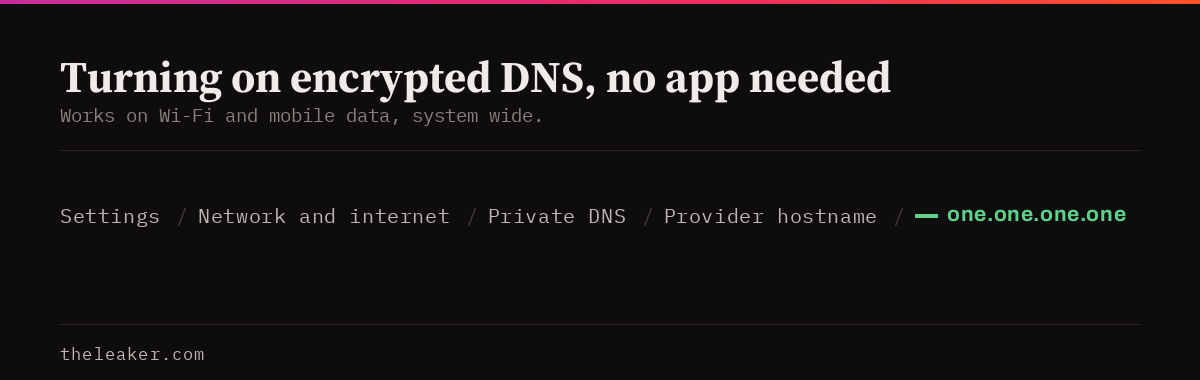
Since Android 9, encrypted DNS is built into the OS: no app, no VPN slot occupied, works on Wi-Fi and mobile data alike:
- Open Settings → Network & internet → Private DNS (Samsung: Settings → Connections → More connection settings → Private DNS).
- Choose Private DNS provider hostname.
- Enter
one.one.one.oneand save. (Google’s equivalent isdns.google: both are excellent; pick one.)
That’s the whole job. Every app on the phone now resolves through encrypted Cloudflare DNS. This native route is better than the app for pure DNS switching because it doesn’t occupy Android’s single VPN slot. You can still run a real VPN when you need one. It’s one of the highest-value hidden settings on Android, alongside the others in our faster-phone settings guide.
When the 1.1.1.1 app (with WARP) is the better choice
The free 1.1.1.1: Faster & Safer Internet app (Android and iOS) does more than DNS. Its WARP mode routes your whole connection through Cloudflare’s network over a modern encrypted protocol: like a lightweight VPN, but free, unmetered, and built for speed rather than location-changing.
Choose the app over native Private DNS if you want:
- Encryption of all traffic on hostile networks: airport/hotel/café Wi-Fi, where WARP shields everything, not just DNS lookups.
- One-tap simplicity: install, tap the big switch, done.
- Protection on old phones: Android 8 and below lack native Private DNS; the app fills the gap.
Know its limits: WARP is not an anonymity or region-unlocking VPN. Websites still see roughly your real region, it won’t unblock geo-restricted streaming catalogs, and while WARP is active, other VPN apps can’t run (one VPN slot per phone). There’s a paid WARP+ tier that routes you through Cloudflare’s least-congested paths, but for most people the free tier is the whole story.
Setting it up everywhere else
- Windows 11: Settings → Network & internet → your connection → Hardware properties → DNS server assignment → Edit → Manual → IPv4:
1.1.1.1and1.0.0.1, and set DNS over HTTPS to “On (automatic template)” for encryption. (The desktop 1.1.1.1/WARP app exists too if you prefer one-click.) - iPhone: the 1.1.1.1 app is the easy path; iOS has no simple system-wide Private DNS field.
- Your router (best coverage): set the router’s DNS to
1.1.1.1/1.0.0.1and every device on your home network benefits automatically: smart TVs included, no per-device setup.
Is it actually faster for you? Test it honestly
DNS gains depend entirely on how bad your ISP’s resolver is. Two honest tests:
- Feel test: browse your usual sites for a day with Private DNS on, then off. On ISPs with weak DNS the difference in how quickly pages begin loading is obvious; on ISPs with good DNS you may feel nothing.
- Measured test: Cloudflare’s own diagnostic at
1.1.1.1/helpconfirms you’re actually using their resolver and whether your lookups are encrypted. DNS benchmark sites can compare resolver latency from your exact location.
Don’t expect speed-test miracles: expect snappier page starts, and treat the encryption as the guaranteed part of the deal.
Frequently asked questions
Is 1.1.1.1 safe to use?
Yes. It’s operated by Cloudflare, which runs a significant share of the internet’s infrastructure, and it’s one of the most-used public resolvers in the world alongside Google’s 8.8.8.8. Lookups can be encrypted, and its no-selling, minimal-logging policy is independently audited. The realistic downside is occasional incompatibility with a network’s internal services, which turning it off for that network resolves.
Will 1.1.1.1 hide my browsing from my ISP completely?
It hides your DNS lookups. Your ISP still routes your actual traffic and can see the IP addresses/domains you connect to through other signals. For meaningfully private browsing on top of encrypted DNS, you’d add WARP (encrypts the transport), and for anonymity, a dedicated VPN or Tor, which are different tools for a different job.
Does 1.1.1.1 or WARP drain battery?
Native Private DNS: effectively zero. It’s just a different server answering lookups. The WARP app: a small but real cost, similar to any always-on VPN tunnel, and generally lighter than most because of the modern protocol it uses. If battery is precious, use native Private DNS and enable WARP only on untrusted networks.
Why do some sites break or show endless CAPTCHAs with it on?
Rare, but it happens: some networks (banks, offices, captive hotel portals) expect you to use their DNS, and some sites treat Cloudflare-range traffic with extra suspicion when WARP is on. The pragmatic fix is per-network: turn Private DNS/WARP off for that one network or site, keep it on everywhere else.

A tech Journalist and Photographer, Dhawal Sharma is a technology enthusiast who loves to research the latest innovations and technology. He has contributed to the Honor Community for a very long period and has crucial expertise in writing tech news and reviewing smartphones and laptops. Analyzing and bringing the facts about any piece of tech is what he loves the most. He is a great product photographer and is the Gizmopedia of TheLeaker. Find him on Facebook and Instagram, and you can also email him at [email protected].