

The quick answer: Asus has confirmed no new Zenfone or ROG Phone models in 2026, redirecting engineering resources into AI hardware instead. Chairman Jonney Shih said so in a pre-event media interview ahead of Asus’s January year-end gala. He said no new models. He never said Asus is exiting the smartphone business. Asus has said software updates, warranty coverage and technical support continue for phones already sold, without attaching an end date to that promise. If you own a ROG Phone 9 or Zenfone 12 Ultra specifically, here’s a concrete number Asus itself hasn’t spelled out for you. Both devices are promised exactly two major Android version upgrades, both already received the first one (Android 16, in November 2025), so Android 17 is the last major version either phone is due. Security patches run longer, through 2029 for the ROG Phone 9 and 2030 for the Zenfone 12, per Asus’s own published policy. Your phone doesn’t stop working. But its support runway is now finite in a way it wasn’t before, and there’s no obvious replacement waiting for either the gaming crowd or the compact-flagship crowd.
What Asus actually said, and what it didn’t
The first reporting came out of Taiwan, where Digitimes reported in early January that Asus was taking a production break across both phone lines, meaning the expected Zenfone 13 and ROG Phone 10 simply weren’t happening. That report also carried the line owners most needed to hear, that software updates and warranty service would keep running for existing devices.
Then it got more definitive. Chairman Jonney Shih confirmed the same thing in a pre-event media interview ahead of Asus’s mid-January year-end gala, according to the original Taiwanese report the international coverage was built on, saying no new phone models with resources going to AI products instead. TechRadar reported the remarks, and Notebookcheck’s follow-up put the pivot in context: Asus posted strong 2025 revenue growth driven largely by its AI server business. Robotics and AI glasses were named as the areas getting the attention.
Notice what’s missing. Shih didn’t say “we are exiting the smartphone business forever.” He said no new models. That’s an open-ended pause, not a formal wind-down, and Asus has been careful to keep the language soft. Android Authority reported that Asus said it would keep taking care of existing phone users, while noting internal support arrangements were still being finalized.
That’s the honest state of it. A company that says it will support you, without saying for how long, while it moves the people who used to build your phone onto something else.
Why “pause” probably means more than a pause
Phones aren’t a tap you turn back on. A modern flagship takes somewhere between a year and 18 months from silicon selection to retail. Digital Trends made this point when the news broke. A company that skips a full cycle isn’t one cycle behind, it’s further behind than that, because the market moved while it stood still.
There’s also a cost story that plausibly sits underneath this, though Asus hasn’t confirmed it as its reason. Mobile DRAM contract prices jumped sharply in the second quarter of 2026, TrendForce reported, as AI data-center demand competes for the same manufacturing capacity. Asus never had Samsung’s scale or Apple’s pricing power in phones, and a mid-sized brand with thin margins and no memory business of its own absorbs a component-cost spike harder than a giant does. Asus hasn’t said this out loud; it’s a reasonable inference from the timing alone.
So: treat this as a likely exit that the company has left a door open on. Plan for the worst case, be pleasantly surprised if a ROG Phone shows up in 2027.
How long will your phone keep getting updates?
This is the part that actually matters day to day, and it’s where you should set expectations carefully.
Even before the pause, Asus was not generous on software. Its recent flagships were promised two major Android version upgrades, per Android Authority’s rundown of manufacturer update policies. Some older Asus phones sit on shorter terms still.
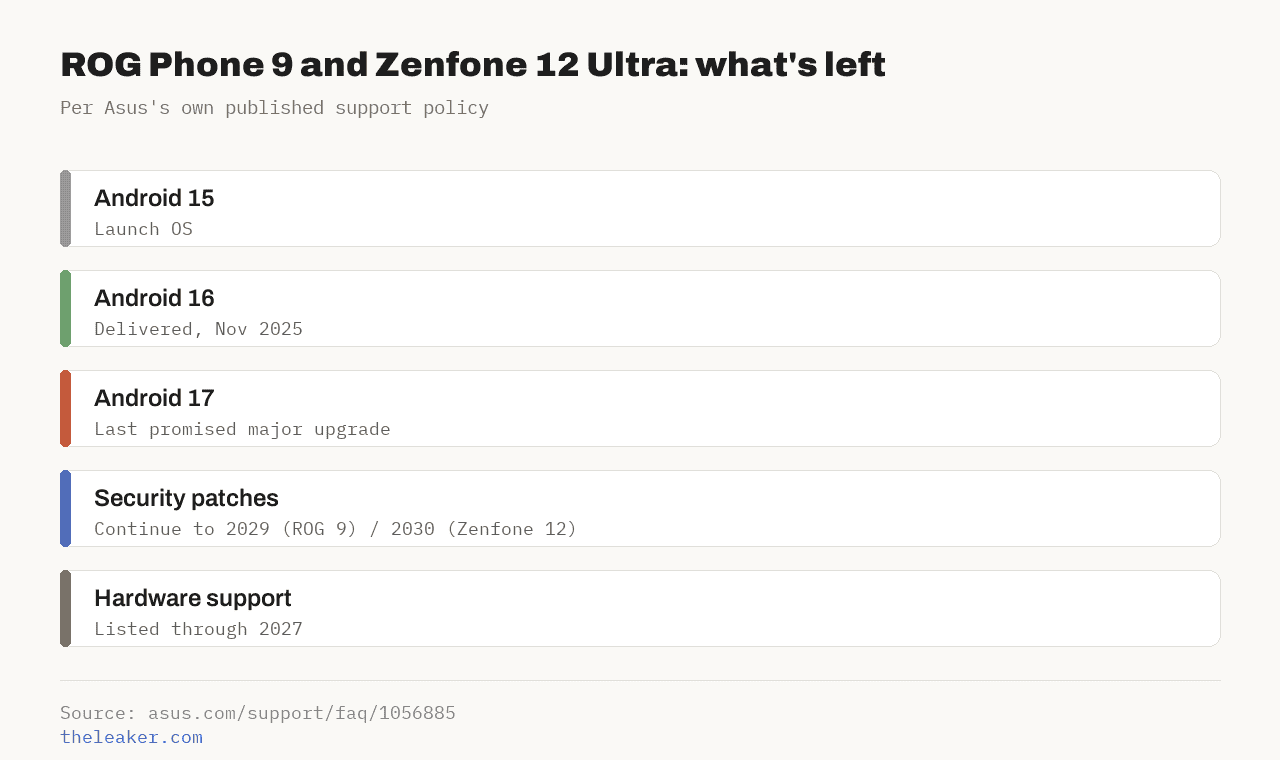
For the ROG Phone 9 and Zenfone 12 Ultra specifically, that count is now settled, per Asus’s own published support policy: both launched on Android 15, both already used their first upgrade on Android 16, and Asus’s security-patch commitment runs through 2029 for the ROG Phone 9 and 2030 for the Zenfone 12. That’s the end of major-version upgrades. A specific, dated security-patch tail continues after it.
What to do: if you own a newer model not covered above, find out exactly what your model was promised (Android Authority’s policy table is a starting point) and count from its launch Android version. A phone can sit on shelves for months before you buy it, so the launch version is the more reliable anchor than a purchase date. Patches may well continue past your last version upgrade, Asus has committed to that in principle, but assume the minimum and treat anything extra as a bonus. The pause itself doesn’t change the number Asus promised. It changes your confidence that a company no longer selling phones keeps its software team staffed to hit that number the way a company still selling them would.
Warranty, repairs and spare parts
Asus has said warranty service continues, and there’s no reason to doubt that for phones still inside their warranty term. Asus’s own published policy lists a hardware-support end date of 2027 for both the ROG Phone 9 and Zenfone 12 Ultra. Parts availability is described as conditional on supply, so that date is a target, not a guarantee.
2027 is a stated commitment. It says nothing about parts inventory afterward. Out-of-warranty repair beyond that depends on a supply of screens, batteries and boards, and Asus hasn’t published anything about parts availability past its 2027 hardware-support date. That’s a genuine unknown, and we’re not going to guess a timeline for it.
Practical advice, in rough order of usefulness:
- If your battery is already degraded and you plan to keep the phone, get it replaced sooner rather than later, while official parts are still flowing.
- Keep the phone in a case.
- Register the device and hang on to your proof of purchase.
- Read the terms of any third-party extended warranty carefully before assuming it covers a repair rather than just a payout.
If you’re a gaming-phone person, where do you go?
The ROG Phone was the most complete gaming handset on the market, with shoulder triggers, an air-cooling accessory, a bypass-charging setup that spared the battery during long sessions, and the AeroActive ecosystem around it. Losing it leaves a real hole.
The obvious successor is RedMagic. TechRadar’s gaming phone rankings now put the RedMagic 11 Pro as the standout value pick, and note that Asus’s own ROG Phone 9 Pro, long the top recommendation, is going to be overtaken on raw hardware because there’s nothing coming to replace it. RedMagic’s pitch is close to Asus’s, with an internal fan, shoulder triggers, a gaming-focused software layer and a high refresh display.
Below that, iQOO and the enthusiast-tier phones from OnePlus and Realme cover most of what gamers actually want (sustained performance, big batteries, fast charging) without the dedicated gaming hardware. You give up the triggers and the accessory ecosystem. You keep the frame rates.
One caveat worth stating plainly: gaming-phone availability varies enormously by country, and warranty support for grey-market imports is often nonexistent. Check that the model you want is officially sold where you live before you fall in love with it.
If you bought a Zenfone for its size, this is harder
Gaming buyers have options. Compact-flagship buyers have fewer.
The Zenfone’s whole argument, at least through the Zenfone 9 and 10 era, was that you could get top-tier silicon in a phone you could actually use one-handed. That category has been shrinking for years across the whole industry, and Asus was one of the last companies making a serious case for it.
Today the realistic options are the smaller phones in Samsung’s and Google’s flagship lines, plus Apple if you’re willing to leave Android. None of them are as small as a Zenfone 9 was. If size is your priority, the uncomfortable truth is that your best move may be keeping your current Zenfone running as long as its software holds, then accepting a larger phone when it doesn’t.
If and when you do switch brands, the migration is less painful than it used to be: Android’s built-in transfer tools handle apps, messages and settings reasonably well now. Our guide to moving everything to a new Android phone walks through what actually carries over and what you’ll need to set up by hand.
Should you sell now?
Depends entirely on why you own the phone.
If you’re the kind of buyer who upgrades every two years anyway, a discontinued brand is generally a weaker resale position than an actively-marketed one, all else equal. We haven’t tracked Asus resale prices ourselves, so treat that as a reasonable expectation. It isn’t a figure we’re quoting you.
If you love the phone and use it until it dies, ignore all of that. Nothing about the pause makes your handset worse today. It still has the same screen, the same chip, the same battery life. The only thing that changed is the calendar.
The middle case (you like it, you’d keep it three or four more years) is the one where you should pay attention. That timeline runs past the end of guaranteed software support, and running an unpatched phone as your primary device isn’t something we’d recommend. In that scenario, plan on a replacement around the time your patches stop rather than waiting for the phone itself to fail.
What we still don’t know
Quite a lot, and anyone telling you otherwise is guessing.
Whether this is permanent. Shih framed it as no new models. He did not frame it as a shutdown. Asus has not filed anything, sold anything or formally dissolved the division that we’ve seen reported. A 2027 return is not impossible. It’s just not something to bet a purchase on.
How long patches actually run. Asus has committed to continued software updates without attaching an end date to that commitment. Android Authority reported that internal support arrangements were still being worked out. Until Asus publishes a schedule, the stated per-model policy is the only number you can plan around.
What happens to spare parts. No public commitment either way. This is the single biggest practical unknown for long-term owners.
Whether the AeroActive and accessory ecosystem survives. Gaming accessories are tied to specific ROG models. If production of those stops too, replacing a broken cooler gets awkward.
Whether other mid-sized brands follow. With memory costs where they are, Asus is unlikely to be the last brand to reassess whether a small-volume phone business is worth running.
Is my Asus phone going to stop working?
No. It’ll keep working exactly as it does now for as long as the hardware lasts. Apps will keep updating through Google Play, and Google Play services updates arrive independently of Asus. What ends eventually is Asus’s own software support, new Android versions first, then security patches.
Should I buy a discounted Asus phone now that they’re being cleared out?
Only if the discount is steep and you understand the support window. A heavily reduced ROG Phone 9 is still a very capable device, and the hardware isn’t suddenly worse. You’re buying into a support clock that started before you did, and Asus has given no indication it plans to extend individual models’ commitments, though it hasn’t ruled that out either the way it has left the door open on returning to phones at all. Work out how many patch-months are left, decide whether that’s worth the price, and go in with your eyes open.
Changelog
- 11 August 2026: Added the concrete update math for the ROG Phone 9 and Zenfone 12 Ultra: both already used the first of their two promised major upgrades on Android 16, so Android 17 is their last, with security patches continuing to 2029 and 2030 and hardware support listed through 2027, all per Asus’s own published policy. Corrected the claim that chairman Jonney Shih addressed staff at the gala; he made the statement in a pre-event media interview beforehand. Removed several predictions (resale value, repair-shop parts squeeze, warranty-claim difficulty) that weren’t attributable to a source, and hedged the mobile-DRAM cost story as a plausible inference rather than Asus’s stated reason. Cut two FAQ answers that only restated the body without adding information, and fixed a FAQ answer that flatly ruled out extended support in a way the body doesn’t. Replaced the text-heavy featured image and swapped the inline checklist graphic for the update-policy timeline above.
Related: Fairphone and the Right to Repair: Can a Phone Really Last a Decade?

I am the chief editor of TheLeaker. I also maintain the backend stuff of the site. I’m a tech enthusiast and loves to do Python coding in my free time. I have worked at many giant publications like XDA Developers and NXTtech before starting TheLeaker.
You can get in touch with me at Garv[at]theleaker.com.