

You open Google One or your phone’s backup settings, and there it is: “Waiting to back up.” Hours later, it still says the same thing. Your photos, chats, and app data are sitting on your phone, not in the cloud, and Google isn’t telling you why. The good news? This is almost always caused by one of a handful of settings, and you can fix Google Drive’s “waiting to back up” message in a few minutes without a PC, without ADB, and without root.
The quick answer: Android backups stuck on “Waiting to back up” usually happen for one of five reasons: your phone is waiting for Wi-Fi because backup over mobile data is turned off, battery optimization is killing the backup process in the background, your Google account storage is full, backup has been paused (often without you realizing it), or a very large file is jamming the queue. Start by checking your Google One storage quota. If you have space, toggle backup off and on, allow backup over mobile data if you’re not on Wi-Fi, exempt Google One and Google Play Services from battery optimization, and then tap Back up now while the phone is plugged in and charging. In stubborn cases, clearing the Google Play Services cache resets the backup scheduler and gets things moving again.
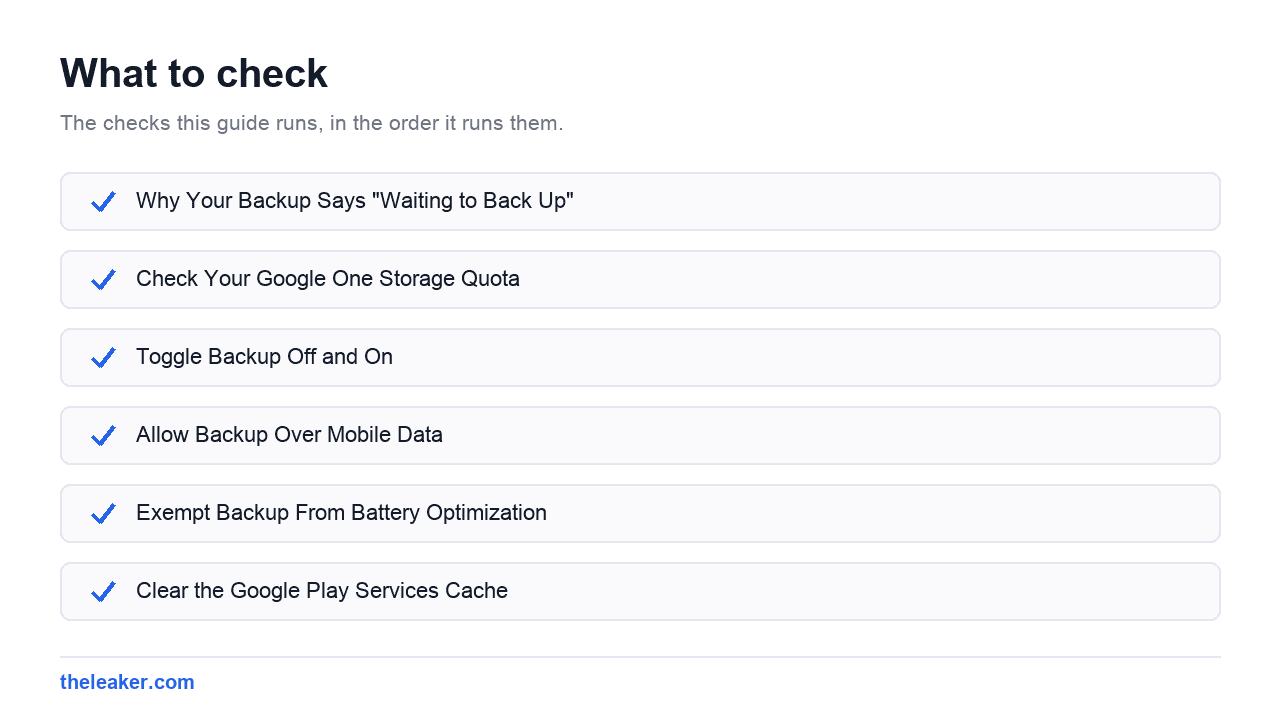
Why Your Backup Says “Waiting to Back Up”
Android’s backup system is deliberately conservative. By default, it only runs when three conditions line up: the phone is connected to Wi-Fi, it’s charging (or has plenty of battery), and it’s idle. If any one of those isn’t true, the backup just sits in the queue and shows “Waiting to back up” or “Backup waiting.”
That design makes sense: Google doesn’t want to burn your mobile data or drain your battery uploading gigabytes of photos. But it also means a small settings change, an aggressive battery saver, or a full storage quota can silently stall your backups for weeks. Here are the usual suspects:
- Not on Wi-Fi: Backup over mobile data is off by default on most phones, so the backup waits for a Wi-Fi connection that may never come.
- Battery optimization: Some manufacturers ship aggressive battery managers that kill background processes, including the backup service.
- Storage quota full: Your free 15GB (shared across Gmail, Drive, and Photos) is used up, so there’s nowhere to put the backup.
- Backup paused: Backups can end up paused after an account change, a system update, or a manual toggle you forgot about.
- Large files: A multi-gigabyte video or a huge WhatsApp media folder can stall the queue, especially on a slow connection.
Work through the fixes below in order. Most people are done by step two or three.
Fix 1: Check Your Google One Storage Quota
This is the most common cause and the easiest to rule out. Every Google account gets 15GB of free storage, shared across Gmail, Google Drive, and Google Photos. If it’s full, backups simply stop, and the error message doesn’t always make that obvious.
- Open the Google One app (or go to one.google.com in a browser).
- Look at the storage bar at the top. If you’re at or near 100%, that’s your problem.
- Free up space by deleting large Drive files, emptying Gmail’s spam and trash, and clearing out blurry or duplicate photos in Google Photos.
If you’d rather clean up your phone itself before uploading everything, our guide on how to free up storage on Android without deleting anything covers a few tricks that pair nicely with this. And if you genuinely need more than 15GB, a Google One plan is the straightforward answer: backups resume automatically once space is available.
Fix 2: Toggle Backup Off and On
A stuck backup state often clears with a simple reset of the toggle:
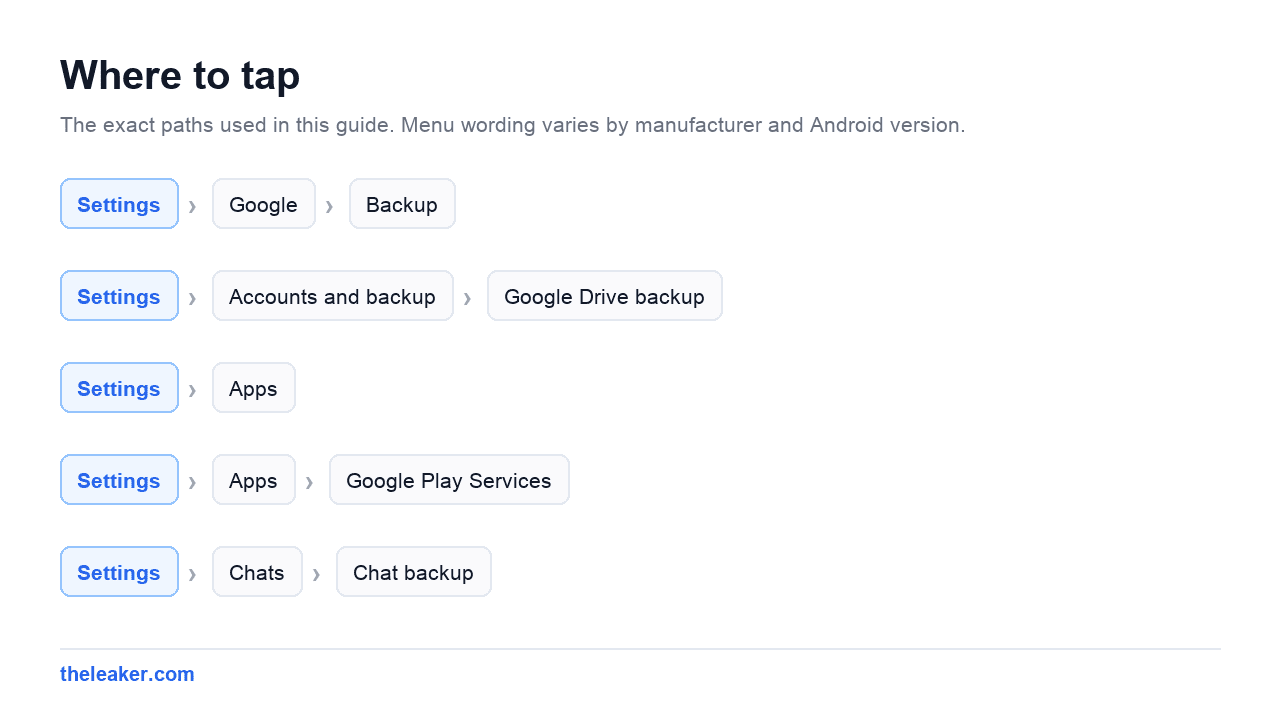
- Go to Settings > Google > Backup (on Samsung phones: Settings > Accounts and backup > Google Drive backup).
- Turn Backup by Google One off.
- Restart your phone.
- Turn the backup toggle back on and tap Back up now.
While you’re on this screen, check that backup isn’t paused. If you see a “Backup paused” or “Off” state next to any category (apps, photos, SMS, call history, device settings), switch it back on. Also confirm the phone is backing up to the correct Google account, if you’ve added a second account, backups sometimes point at the wrong one.
Fix 3: Allow Backup Over Mobile Data
If you’re rarely on Wi-Fi, your phone may be waiting forever for a connection it never gets. You can tell it to use mobile data instead:
- Open Settings > Google > Backup.
- Tap the settings gear or the option for backup preferences.
- Enable Back up using mobile or metered Wi-Fi data (wording varies slightly by phone and Android version).
Fair warning: a first full backup can be several gigabytes, mostly photos and videos. If you’re on a limited data plan, connect to Wi-Fi for the initial backup and use mobile data only for the small daily incremental backups afterward.
Fix 4: Exempt Backup From Battery Optimization
Phones from several manufacturers aggressively kill background apps to stretch battery life, and the backup service is a frequent casualty. To stop that:
- Go to Settings > Apps, find Google One, tap Battery, and set it to Unrestricted.
- Do the same for Google Play Services and Google Photos if you use it for photo backup.
- If your phone has its own battery manager (common on Samsung, Xiaomi, OnePlus, and others), add these apps to the “never sleep” or protected list.
Backups also strongly prefer to run while the phone is charging and idle. The single most reliable trick: plug your phone in, connect to Wi-Fi, tap Back up now, and leave the screen off for an hour.
Fix 5: Clear the Google Play Services Cache
Google Play Services handles the backup scheduling behind the scenes. If its cache gets into a bad state, backups can hang indefinitely. Clearing it is safe and doesn’t delete any of your data:
- Go to Settings > Apps > Google Play Services (you may need to show system apps).
- Tap Storage, then Clear cache.
- Restart your phone, then go back to the backup screen and tap Back up now.
If that still doesn’t do it, clear the cache (not data) for the Google One app too, and make sure both Google One and Play Services are updated in the Play Store. Outdated versions are a known source of backup weirdness.
WhatsApp Backup Stuck? That’s a Separate System
A lot of “backup waiting” complaints are actually about WhatsApp, which runs its own backup to your Google account and can get stuck independently. If your WhatsApp backup won’t finish:
- Open WhatsApp and go to Settings > Chats > Chat backup. Check the frequency isn’t set to “Never” and that it’s using the right Google account.
- Check whether videos are included. A media-heavy backup can be enormous: excluding videos often unsticks it instantly.
- Note that WhatsApp backups now count against your Google account storage for most users, so a full quota stalls WhatsApp too. Back to Fix 1.
- Connect to Wi-Fi, plug the phone in, and tap Back up manually. Leave WhatsApp open in the foreground for a few minutes to let it start.
Don’t Forget: Photos Back Up Separately
One more source of confusion: your photos and videos are handled by Google Photos, not the device backup. The Google One backup covers app data, SMS, call history, contacts, and settings. If your camera roll isn’t uploading, open Google Photos, tap your profile picture, and check Photos settings > Backup. Make sure backup is on, the right account is selected, and, if you want uploads away from home: “Use mobile data” is enabled there too. It’s entirely possible for your device backup to be healthy while photo backup is stuck, and vice versa.
Frequently Asked Questions
Why does my phone only back up when it’s charging?
That’s intentional. Android schedules automatic backups for when the phone is charging, idle, and on Wi-Fi to avoid draining your battery or data. You can override it any time by tapping Back up now manually, which runs immediately regardless of charging state, though plugging in still helps it finish faster and avoids the system killing it midway.
My backup is stuck at 99%. What now?
A backup that stalls at the very end is usually choking on one large file or a flaky connection. Restart the phone, switch to a stable Wi-Fi network, and run Back up now again. It resumes rather than starting over. If it keeps sticking, clear the Google Play Services cache (Fix 5) and check whether one huge video in your queue is the culprit.
What does the free 15GB actually cover?
The free 15GB is shared across your whole Google account: Gmail, Google Drive files, Google Photos uploads, WhatsApp backups, and your device backup. Device backups themselves are relatively small. It’s almost always photos, videos, and email attachments that eat the quota. Check the breakdown in the Google One app to see exactly what’s using space.
Do I still need the old ADB trick to fix this?
No. Years ago, a popular workaround involved connecting your phone to a PC and forcing a backup with ADB shell commands. On modern Android that’s unnecessary. The settings-based fixes above resolve virtually every stuck backup, and Google has made manual backups far more reliable than they were in 2019.
That’s it. In almost every case, a stuck Android backup comes down to storage, settings, or battery management: not a broken phone. Run through the fixes in order, plug in, and let it finish overnight. If this guide got your backup moving again, share it with someone whose phone has been “waiting to back up” since last year.

Yash Jain writes about Android and Apple for The Leaker, focusing on how to guides, download resources, and top and best roundups. His articles walk readers through setup steps and app choices, compare options across categories, and follow news updates across both mobile platforms as they develop.