
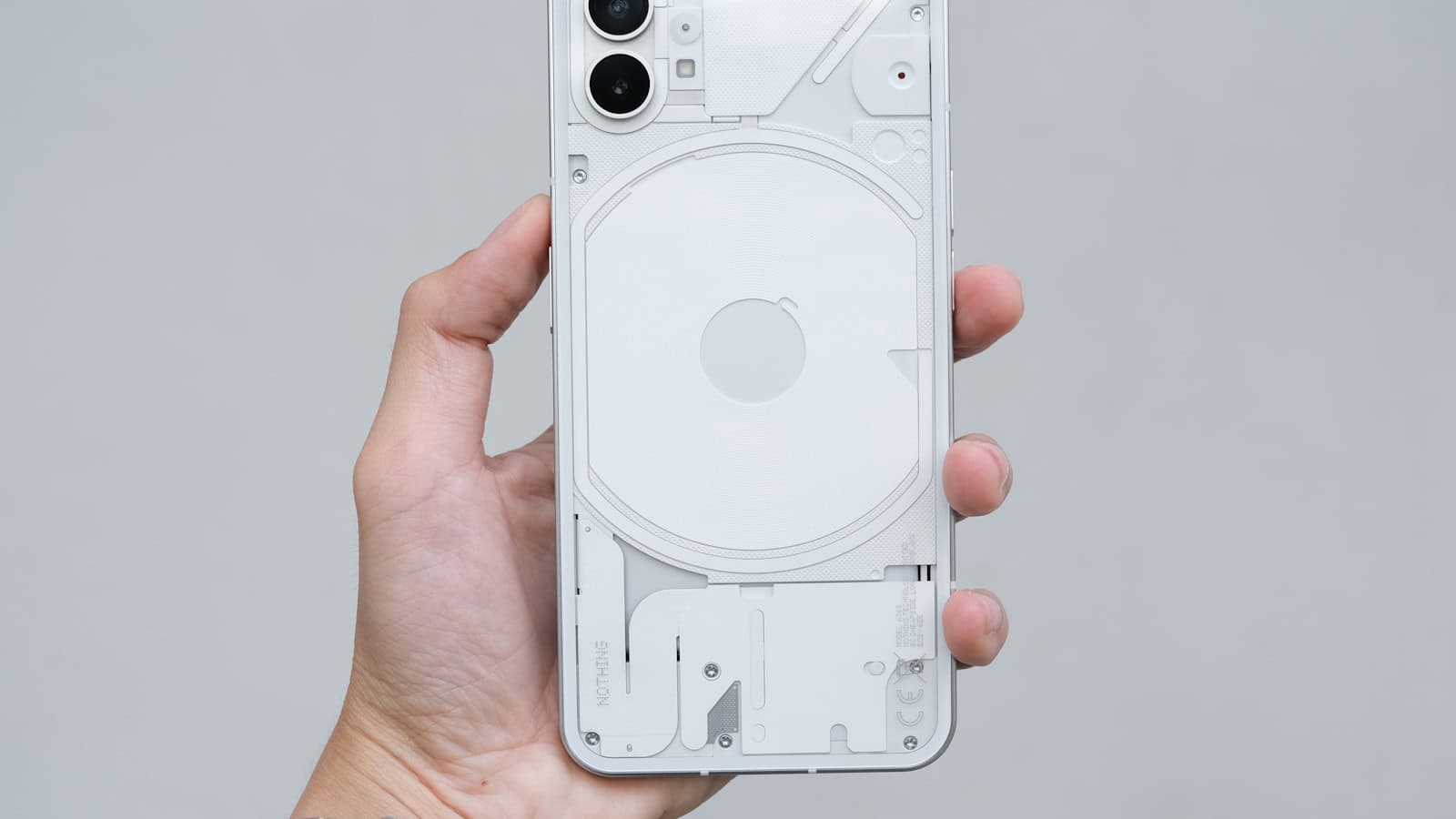
Walk into a US carrier store and you get Apple, Samsung, and a wall of Motorola. Walk into a European one and you get Apple, Samsung, and a slightly different wall. Everything else, the genuinely interesting stuff, belongs to a handful of underrated phone brands living on brand websites, Amazon listings, and import forums. Some of it is excellent. Some of it will leave you with a phone that can’t make a call on your network.
The quick answer: The best under-covered phone brands in 2026 are Nothing, Sony, Motorola, HMD and Fairphone, and each one carries a specific, knowable catch. Nothing has the sharpest design language and a 5+7 update promise on the Phone (3), but skipped a 2026 flagship entirely and is keeping the Phone (4a) out of the US. Sony still builds the enthusiast’s phone, with microSD and a headphone jack, but the Xperia 1 VIII costs €1,499 and Sony has no plans to sell it in America. Motorola is the one brand here with real US carrier distribution, and its weakness is update length. HMD has retreated from the US and is retiring the Nokia name. Asus, meanwhile, has left the phone business outright. Import at your own risk: band and VoLTE compatibility is the thing that actually bites.
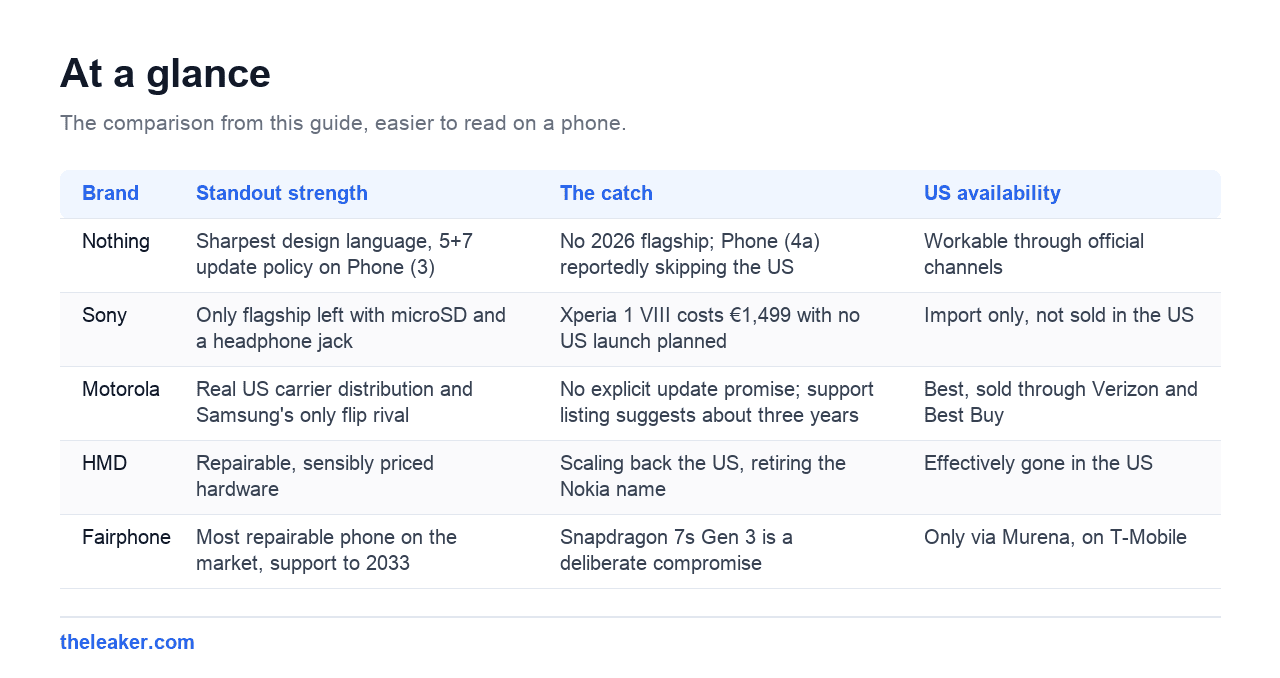
| Brand | Standout strength | The catch | US availability |
|---|---|---|---|
| Nothing | Sharpest design language, 5+7 update policy on Phone (3) | No 2026 flagship; Phone (4a) reportedly skipping the US | Workable through official channels |
| Sony | Only flagship left with microSD and a headphone jack | Xperia 1 VIII costs €1,499 with no US launch planned | Import only, not sold in the US |
| Motorola | Real US carrier distribution and Samsung’s only flip rival | No explicit update promise; support listing suggests about three years | Best, sold through Verizon and Best Buy |
| HMD | Repairable, sensibly priced hardware | Scaling back the US, retiring the Nokia name | Effectively gone in the US |
| Fairphone | Most repairable phone on the market, support to 2033 | Snapdragon 7s Gen 3 is a deliberate compromise | Only via Murena, on T-Mobile |
Nothing: the design is real, the roadmap is confusing
Nothing is the only new phone brand of the last five years with an identity you could pick out of a lineup. The Glyph lighting, the transparent backs, the deliberately austere software. It’s a coherent point of view, which is rare.
The Phone (3) launched at $799 for 12GB/256GB and $899 for 16GB/512GB, as Droid Life reported at announcement. It also carries Nothing’s longest software commitment yet: a 5+7 policy, meaning five years of Android version updates and seven years of security patches, per Android Authority’s reporting.
Here’s where it gets odd. Nothing is not releasing a flagship in 2026 at all. GSMArena reported in January 2026 that CEO Carl Pei confirmed no new flagship this year, with the Phone (3) carrying the line and an upgraded Phone (4a) arriving instead: better display, cameras and performance, and premium materials. Pei’s argument was that annual flagship churn isn’t worth doing for its own sake.
Who should consider it: anyone who wants an Android phone that looks and feels designed rather than assembled, and who values a long update runway.
The catch: a flagship you buy today is already a year old with no successor coming, and the interesting 2026 device is reported to skip the US market. US availability for Nothing has always been patchier than Europe’s. The Phone (3a) series arrived in America through a beta program rather than normal retail.
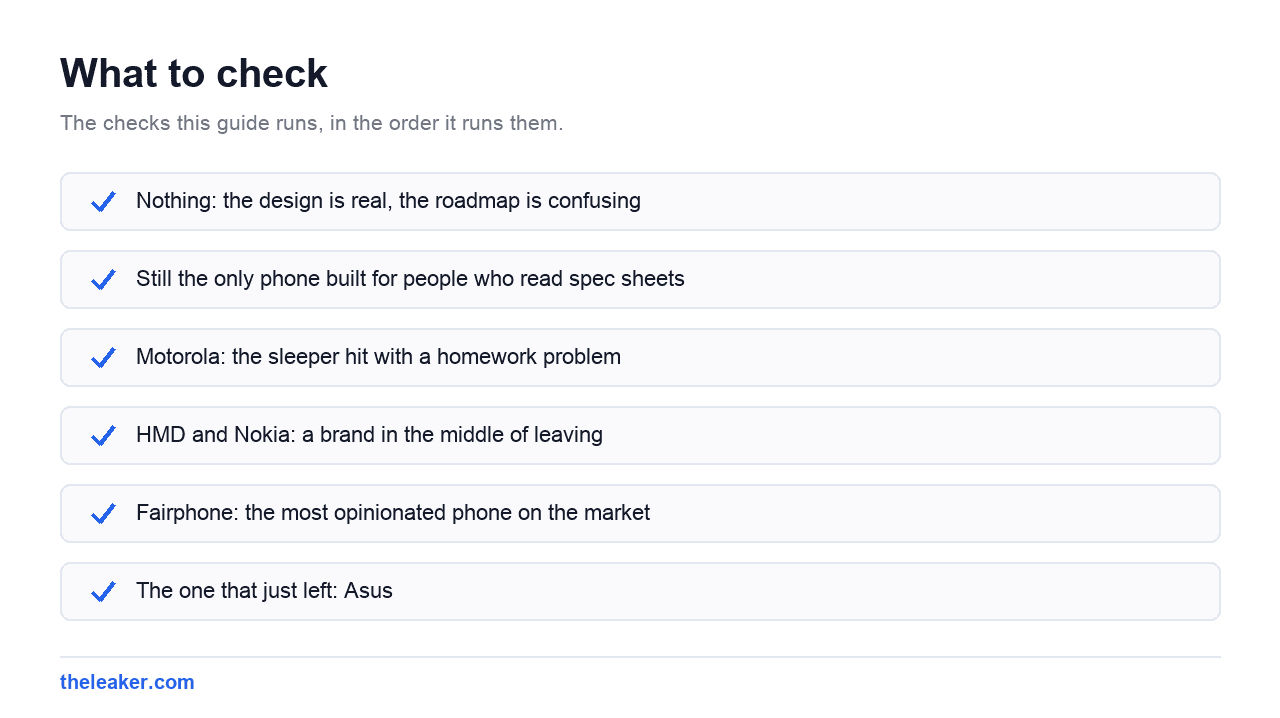
Sony: still the only phone built for people who read spec sheets
Sony makes a phone almost nobody sells and a certain kind of person adores. The Xperia 1 VIII, announced in May 2026, keeps the two features the rest of the industry deleted: a microSD slot and a 3.5mm headphone jack. 9to5Google’s launch coverage lists a 6.5-inch FHD+ LTPO AMOLED at 120Hz, Snapdragon 8 Elite Gen 5, 12GB/256GB or 16GB/1TB, a 48MP main sensor with 48MP ultrawide and a 48MP telephoto at 2.9x, and a 5,000mAh battery with 30W wired and 15W wireless charging.
Price: €1,499 in Europe, £1,399 in the UK. And the line that defines Sony’s position in 2026. There are no plans to bring it to the US. Sony hasn’t launched an Xperia flagship in North America since 2023.
Who should consider it: photographers and videographers who want manual control, anyone who still carries a wired IEM, and people who use expandable storage. Nobody does this combination anymore.
The catch: the price is brutal, the software support story is thinner than its rivals’, and in America you are importing a device Sony has not certified for your carriers. European buyers get a normal retail experience; American buyers get a project.
Motorola: the sleeper hit with a homework problem
Motorola is the anomaly here. An underrated brand that is actually easy to buy. It has genuine US carrier distribution, which none of the others can claim, and its foldables are the only real alternative to Samsung’s flip.
On price, GSMArena’s report on leaked US pricing put the Razr 2026 at $799.99, the Razr+ 2026 at $1,099.99, and the Razr Ultra 2026 at $1,499.99. On the slab side, 9to5Google reported that the Motorola Edge (2026) arrived in the US on 11 June at $599 through Motorola.com, Best Buy and Verizon: with a 6.3-inch AMOLED, a 5,000mAh battery, 60W wired charging, IP68/69, and a $50 increase over the previous model.
Who should consider it: US buyers who want something other than Samsung without importing anything; anyone who wants a flip phone and refuses to buy a Z Flip; and people who like Motorola’s near-stock software.
The catch: updates. 9to5Google noted Motorola made no explicit software update promise for the Edge (2026). Motorola’s own support listing for the model indicates security updates running to June 2029 with at least bi-monthly cadence: roughly three years. That is short next to Nothing’s seven-year security window or Samsung’s and Google’s commitments, and it is the single biggest reason to hesitate. Motorola’s record here has been inconsistent for years, as Android Authority’s roundup of manufacturer update policies documents.
HMD and Nokia: a brand in the middle of leaving
HMD built a real following with repairable, sensibly priced phones: iFixit gave the HMD Skyline a 9 out of 10 and sells its parts directly. It is also, in 2026, a brand you should approach with caution.
GSMArena reported that HMD is scaling back US operations, citing a challenging geopolitical and economic environment, with devices pulled from its US website; Android Authority’s coverage ties the retreat to tariff pressure on a company whose whole model is low prices. HMD says it will honour warranty and service for existing products. Separately, HMD’s licence to use the Nokia name on phones runs out in 2026, and the company has been moving to its own HMD branding, with Nokia-branded smartphones already delisted across European markets, as GSMArena covered.
Who should consider it: European buyers who want cheap, repairable hardware and don’t need long-term brand continuity.
The catch: American buyers should treat HMD as effectively gone. And anyone buying a Nokia-branded phone in 2026 is buying into a name that is being retired from smartphones.
Fairphone: the most opinionated phone on the market
Fairphone is the repairability benchmark. The Fairphone (Gen. 6) took a perfect 10 out of 10 from iFixit’s teardown, and Fairphone’s own page lists twelve user-swappable modules, a five-year warranty, software support until 2033, a €39.95 battery and an €89.95 display. European pricing is €549 for the Android build and €599 for the /e/OS build.
Who should consider it: buyers who intend to keep a phone five years or more, and who value repairability and supply-chain ethics above raw performance.
The catch: a Snapdragon 7s Gen 3 at that price is a deliberate compromise, the cameras dropped from the Fairphone 5’s triple 50MP setup to a dual arrangement, and US access is awkward. Murena sells it in America at $899 running /e/OS, and both Murena and Fairphone’s US support page point buyers to T-Mobile or T-Mobile MVNOs. Verizon is not supported.
The one that just left: Asus
If you were about to recommend a ROG Phone to a gamer, stop. GSMArena reported in January 2026 that chairman Jonney Shih confirmed Asus is discontinuing smartphone releases and redirecting resources to commercial PCs, robotics and smart glasses. The ROG Phone 9 FE and Zenfone 12 Ultra were the last launches. Asus says it will continue maintenance, software updates and warranty service for existing phones, but no duration was specified.
Buying a discontinued flagship at a discount is tempting. Just price in the fact that nobody at Asus is building a successor, and the support runway is undefined.
The import trap: bands, VoLTE and whitelists
This is the section that saves people money. If you are in the US and buying any of these phones through a route the carrier didn’t sanction, three things can go wrong.
- Bands. A phone built for Europe or Japan may lack the LTE and 5G bands your carrier leans on. Rural T-Mobile depends heavily on n71; AT&T’s FirstNet uses Band 14. Missing those doesn’t mean no signal. It means bad signal in exactly the places you’d notice.
- VoLTE. Every US carrier implements voice-over-LTE slightly differently and certifies devices individually. An uncertified phone can end up with data but flaky or absent calling.
- Whitelisting. AT&T and Cricket enforce an IMEI whitelist, checked on every network connection. T-Mobile is far more permissive and generally allows any device with the right bands. Verizon has the strictest band and VoLTE requirements of the three.
The practical rule: in the US, T-Mobile and its MVNOs are the safe harbour for imported and small-brand phones. Verizon is the riskiest. AT&T sits in between with the whitelist hanging over you. In Europe this problem barely exists, bands are broadly harmonised and carriers don’t whitelist, which is precisely why Sony, Nothing and Fairphone feel like normal choices there and exotic ones in America.
Resale is the other quiet cost. Small-brand phones depreciate faster because the second-hand market for them is thin. If you rotate phones every two years, that gap can wipe out the money you saved at purchase. If you keep phones for five years, it’s irrelevant. And whichever you pick, moving in is the easy part. Our guide to transferring everything to a new Android phone covers the migration.
What we still don’t know
Nothing’s 2026 plans are only half-disclosed. Pei confirmed the Phone (4a) and no flagship, but pricing and full market availability for that device haven’t been laid out in the reporting we’ve seen, and the US position in particular remains murky.
Motorola hasn’t committed publicly to a software policy for the Edge (2026), so the three-year picture comes from support listings rather than a promise. That could improve, or it could quietly not.
HMD’s post-Nokia identity is unproven. New HMD-branded hardware is arriving in Europe, but whether the brand holds its audience once the Nokia name is gone is an open question. Fairphone’s next move is also unannounced. Its CEO has teased two new 2026 products without confirming that either is a phone. And Asus has left the door slightly ajar rather than locked it; a return is possible but nothing is scheduled.
Which of these brands is actually safest to buy in the US?
Motorola, by a wide margin. It is sold through carriers including Verizon and through Best Buy, so bands, VoLTE and whitelisting are non-issues. Nothing is workable through official US channels. Fairphone works via Murena but only on T-Mobile. Sony’s flagship isn’t sold in the US at all, and HMD has pulled back from the market.
Is it safe to import a Sony Xperia to the United States?
It’s possible but not risk-free. Sony hasn’t certified the Xperia 1 VIII for US carriers, so you’re relying on band overlap and carrier tolerance. T-Mobile or a T-Mobile MVNO is the most forgiving option; Verizon is the least. Check the exact model’s band list against your carrier before spending €1,499 plus import costs.
How much do software update promises really matter?
They matter most if you keep phones a long time. A seven-year security window like the Nothing Phone (3)’s means the device stays safe to use well past the point it stops feeling new. A three-year window means you’re shopping again sooner, which changes the true cost of a cheaper phone considerably.
Should I buy a discounted Asus ROG Phone now that the brand has exited?
Only with eyes open. Asus has said it will keep providing maintenance, updates and warranty service for existing phones, but hasn’t stated for how long, and there is no successor coming. If the discount is steep and you plan to replace the phone within a couple of years, it can make sense. As a long-term purchase, it’s a gamble.

A tech Journalist and Photographer, Dhawal Sharma is a technology enthusiast who loves to research the latest innovations and technology. He has contributed to the Honor Community for a very long period and has crucial expertise in writing tech news and reviewing smartphones and laptops. Analyzing and bringing the facts about any piece of tech is what he loves the most. He is a great product photographer and is the Gizmopedia of TheLeaker. Find him on Facebook and Instagram, and you can also email him at [email protected].