
Two of the three apps this article used to recommend, Pixel Filter and Hibernation Manager, no longer exist on the Play Store, and the third, Greenify, now does less than Android’s own built-in power management on a modern phone. The real answer for an AMOLED screen in 2026 is largely free and already on your device. Turn on Dark theme, since black pixels on AMOLED draw close to zero power, enable Battery Saver, and let Adaptive Battery restrict apps you rarely use rather than fighting it with a third-party hibernation app. For general battery drain beyond the AMOLED-specific angle, see our full guide to fixing fast battery drain.
What happened to the three apps this article used to recommend
Pixel Filter, the app that dimmed individual AMOLED pixels through an overlay, was removed from the Play Store in February 2024. Its own developer had already stopped maintaining it years earlier, and the project’s public source code states plainly why: changes to Android 8 restricted how apps can draw over the notification panel and navigation buttons, breaking the technique the app depended on.
Hibernation Manager, which lowered CPU frequency and force-stopped background apps, was removed from the Play Store in October 2023.
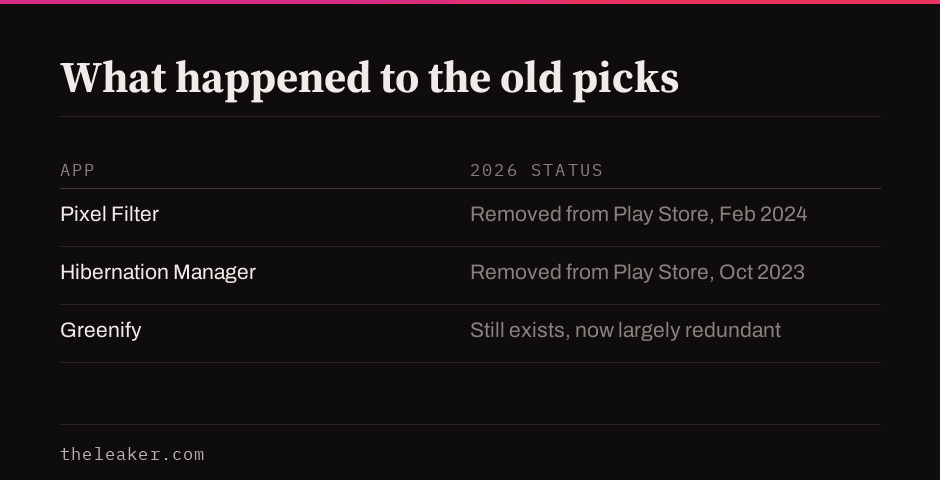
Greenify is still available and still updated, but its actual usefulness has narrowed. Doze mode, which Android introduced in 2015, and Adaptive Battery’s app standby buckets, added in 2018, now handle most of what Greenify was built to do: predicting which apps you barely use and restricting their background activity automatically, using the phone’s own usage data rather than a fixed rule set. Multiple technical discussions among Android developers describe third-party hibernation tools as now redundant with, and occasionally in conflict with, this built-in system on a non-rooted phone. If you are rooted, Greenify’s more aggressive modes still have a niche; on stock Android, the OS is already doing the job.
Turn on Dark theme, for a real and measurable reason
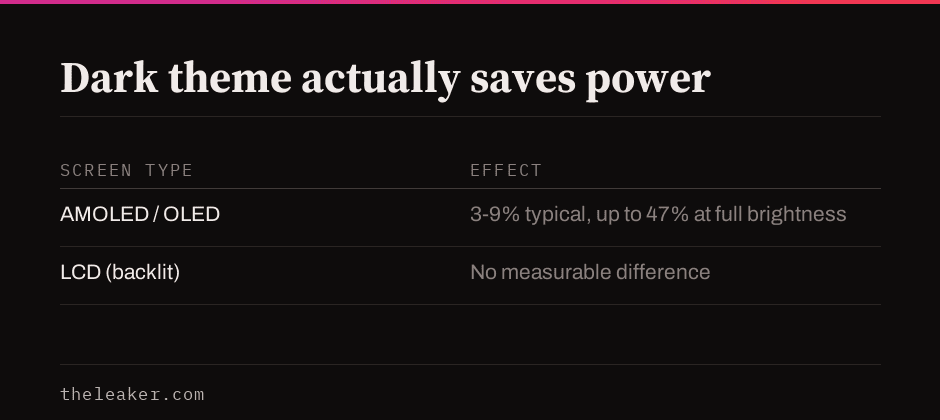
This is the one AMOLED-specific trick actually worth keeping from the original premise, because it is real physics rather than a third-party app’s claim. An AMOLED or OLED pixel lights itself individually rather than being lit from behind, so a black pixel draws close to zero power while a white one draws close to maximum. Dark theme is not a placebo on this display type the way it would be on an LCD screen, which is always backlit regardless of what color is on screen.
A study presented at the ACM MobiSys 2021 conference by Purdue University researchers measured this directly across real apps and phones. Dark mode saved roughly 3 to 9 percent of battery at typical screen brightness around 30 to 50 percent, rising to nearly 40 to 47 percent at full brightness. The saving scales with how bright your screen runs and how much white the interface would otherwise show, so it matters more on a phone you keep near full brightness outdoors than one used mostly indoors at a lower setting.
Let Android’s own battery tools do the rest
Under Settings, then Battery, Adaptive Battery limits background activity for apps based on how often you actually use them, without you managing anything by hand. Battery Saver throttles background sync, reduces performance headroom, and can cap the refresh rate, and is worth turning on below whatever threshold matters to your day rather than waiting until you are nearly empty.
If a specific app is still draining more than it should, Settings, then Apps, then the app itself, then Battery usage lets you set it to Restricted individually, which is a more targeted version of what a hibernation app used to promise, built into the OS and unable to conflict with the OS’s own power management since it is the same system.
If your phone has a high refresh rate screen, of 120Hz or higher, confirm it is set to adaptive rather than a fixed high rate under Settings, then Display. Modern AMOLED panels can vary their refresh rate to match what is on screen, and forcing a fixed high rate everywhere spends power the display did not need to use.
What this will not fix
None of the above will meaningfully help a phone whose battery has simply aged and lost real capacity, which shows up as the phone reaching the same percentages far faster than it used to regardless of settings. That is a hardware question, not a software one, and no app or setting changes the chemistry of a worn cell.
Frequently asked questions
Is Greenify still worth installing? On a rooted phone, its more aggressive modes still do something extra. On a standard, non-rooted phone, Android’s own Adaptive Battery already covers most of the same ground.
Does Dark theme actually save battery on every phone? Only on AMOLED and OLED screens, where black pixels draw very little power. On an LCD screen, which is backlit regardless of color, Dark theme makes no measurable difference to battery life.
Why did my phone get worse at holding a charge over time even though I changed nothing? Battery cells lose capacity with age and charge cycles. If none of the settings above help and the phone is more than a couple of years old, a genuinely worn battery is the more likely explanation.

Akshay Mhatre is a Tech Journalist who likes to keep up with the latest from the tech world. He has worked at many popular news portals like BGR and TechRadar before joining TheLeaker as a News writer and journalist. A writer by day and a VFX artist by night. In his free time, he also likes to make motion graphics and concept art. You can find him on Instagram @akshayrazr_95 and contact him on akshaymhatre[@]theleaker.com.