
CamScanner has not contained malware since September 2019. A previous version of this article told readers to uninstall it immediately over a Trojan found in a third-party ad library; Google removed the app, CamScanner shipped a clean build without that library, and it has been back on both app stores ever since, actively updated. The real reason to consider an alternative in 2026 is different: CamScanner’s own privacy policy states scans can be stored on servers in China, which matters more for some documents than others. If you want a dedicated scanner app anyway, Adobe Scan, Google Drive’s built-in scanner, and Genius Scan are the three current options worth using. One name from the original version of this list, Microsoft Office Lens, no longer exists at all: Microsoft discontinued it in February 2026.
If you would rather not install any app, your phone very likely already has a scanner built in. Our guide to scanning documents with your phone covers Google Drive, Samsung’s camera, and the other built-in tools in detail, including the lighting and positioning tricks that matter more than which app you pick.
What actually happened to CamScanner, and what changed
In 2019, Kaspersky researchers found a Trojan dropper hidden inside an advertising library that CamScanner had licensed from a third-party vendor. Google pulled the app from Play. CamScanner’s developer removed the compromised ad library and shipped a clean version, which returned to the Play Store that September. No credible security research since has reproduced that finding, and the app remains under active development: it holds a 4.8-star rating across 1.9 million ratings on the App Store, with updates shipping every few weeks.
The real 2026 consideration is different from a malware scare. CamScanner’s own privacy policy states that scanned data “can be located in either China or any other country or district,” which is a real factor for anyone scanning a passport, a contract, or anything else they would rather not have stored under a jurisdiction they cannot verify. India has also kept a formal government ban on the app since 2020 over the same data-sovereignty concern, though enforcement has been inconsistent even inside government departments.
The alternatives worth using in 2026
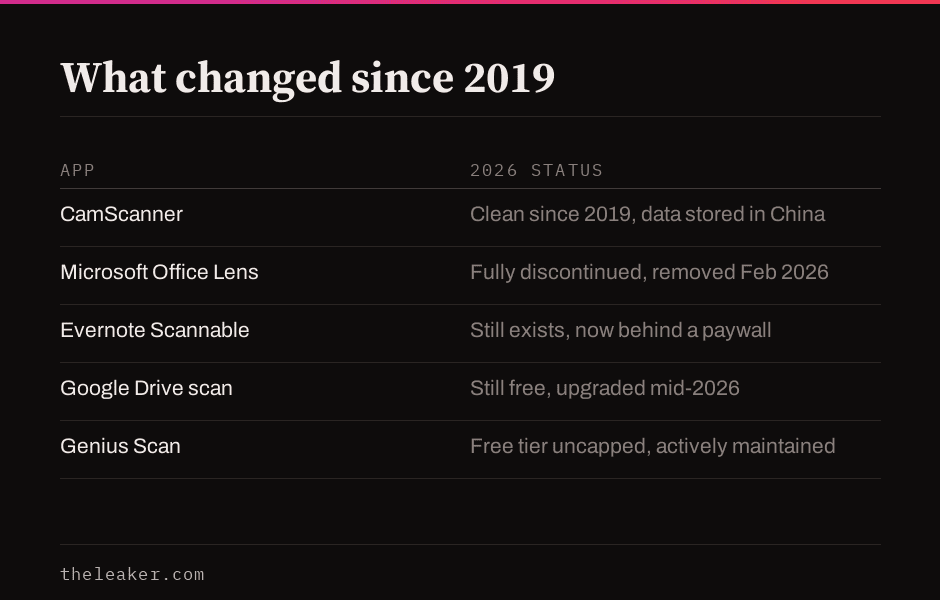

Adobe Scan remains the strongest all-round option. Scanning and OCR are free; a free Adobe account is only needed to sync scans to the cloud, and a paid tier adds file combining and higher OCR limits. Adobe added AI-generated document summaries to the Scan and Acrobat ecosystem in 2025, which is genuinely useful for a long contract you have just scanned and do not want to read in full.

Google Drive’s built-in scanner got a substantial overhaul in mid-2026, adding batch scanning where you hover over several pages the way you would record a video, automatic duplicate detection, and a feature that keeps the sharpest frame when your hand shakes. It processes on-device and needs no separate app if you already use Drive. This is also the tool covered step by step in our built-in scanning guide linked above.

Genius Scan is the pick if you specifically do not want an account or a subscription. Its free tier has no scan limit and no watermark, which is unusual, and it became the app most commonly recommended to people migrating away from Microsoft’s discontinued scanner, covered next.
What happened to Microsoft Office Lens
The original version of this article recommended Office Lens, renamed Microsoft Lens in 2021. It no longer exists. Microsoft’s own support page confirms the app was removed from both the App Store and Google Play on February 9, 2026, with scanning functionality shut off entirely a month later. Microsoft’s suggested replacement is OneDrive’s built-in scan feature, but it does not carry over Lens’s direct export to Word, PowerPoint or OneNote, so anyone who relied on that workflow specifically is better served by Adobe Scan or Genius Scan instead.
Evernote Scannable, now behind a paywall
Evernote Scannable is still on the App Store, but it changed materially since 2019. A 2024 update put its core export function behind a subscription, currently $49.99 a year or $2.99 a week, and requires signing into an Evernote account to use even for a single scan. It has received bug-fix-only updates since December 2024. If you already pay for Evernote it remains usable; as a free quick-scan tool, which is how this list originally recommended it, it no longer qualifies.
If you have an iPhone
Apple’s own Notes app can scan documents natively, with no separate download. Open a note, tap the attachment button, choose Scan Documents, and it detects edges and crops automatically the same way a dedicated scanner app does. For anyone who only scans occasionally, this alone may cover the entire need.
Frequently asked questions
Is CamScanner safe to use in 2026? There is no credible evidence of malware in the current version. The open question is where your data is stored, not whether the app itself is malicious.
Do I need to uninstall CamScanner if I already have it? No. That advice was correct in 2019 for the version that existed then, and it does not apply to the current, clean build. Decide based on where you want scanned data stored, not on a six-year-old incident.
What replaced Microsoft Office Lens? Nothing from Microsoft directly. OneDrive gained a scan feature, but it is missing several things Lens could do. Genius Scan and Adobe Scan are the closer replacements.
Is Evernote Scannable still free? No. Its core export function has required a paid Evernote subscription since a 2024 update.

He is another staff writer at TheLeaker.com who likes to play with the latest phones, Gadgets, and his MacBook. He is the man behind all the Android update threads. You can find him on Twitter and contact him at [email protected].